
The current conflict in Ukraine has frequently been compared to the first world war. There is an echo of the same grimness and intensity: the huge artillery barrages, the sprawling network of trenches, the horrifying casualty rates. Amid all that, Sir Keir Starmer and Emmanuel Macron, clinging on to their ‘coalition of the willing’, are invoking another memory. If they can make The Big Push, we will reach a peace settlement monitored by their ad hoc European-led alliance.
The two leaders have made a genuine step forward. At a meeting in Paris with President Volodymyr Zelenskyy, American envoys Steve Witkoff and Jared Kushner and two dozen heads of state and government, they gave a formal commitment to deploy military forces to Ukraine to assist in implementing a potential peace settlement. Sir Keir Starmer claimed an end to the conflict was ‘closer… than ever’, while Kushner described the agreement as ‘a big, big milestone’.
The British army is the smallest it has been since the 1790s
The Paris declaration provides for the establishment of a ‘multinational force for Ukraine’, supplied principally by European nations but with some involvement from other members of the coalition of the willing (Canada, Australia, New Zealand and Japan are all participants). Its mission will be to ‘support the rebuilding of Ukraine’s armed forces and support deterrence’, including ‘practical and technical support to Ukraine in building defensive fortifications’. Cooperation with Ukraine will increase in ‘training, defence industrial joint production, including with the use of European relevant instruments, and intelligence cooperation’.
The ‘multinational force’ will operate from what Starmer called ‘military hubs across Ukraine’, but there was an important caveat from President Macron. Speaking to French television, he reassured a perhaps-wary public that ‘these are not forces that will be engaged in combat’.
The coalition of the willing will be dependent on assistance from the United States. The foundation of the Paris declaration is a ‘proposed US-led ceasefire monitoring and verification mechanism’ which will involve sensors, drones and satellites to detect any breaches of a ceasefire, and which will be overseen by a special commission to ‘attribute responsibility and determine remedies’.
America has also agreed to ‘security protocols’ to support a settlement which, according to Steve Witkoff, involves acting as a deterrent but also taking action to ‘defend’ Ukraine in the event of renewed aggression.
This does seem at first glance to be a well-developed framework for ending the conflict in Ukraine. But there are (at least) three obvious problems: it is not at all clear that the UK and France have the military resources available to do what they say; there is no reason to think that the slightly elusive commitment of the United States is reliable; and Russia has repeatedly rejected the kind of settlement described.
Macron spoke of contributing ‘several thousand’ French personnel. France already has more than 21,000 soldiers, sailors and airmen deployed around the world, defending France’s possessions outside Europe, stationed with strategic partners and participating in Nato, EU, UN and other missions. There are also ongoing plans to increase defence expenditure by around 13 per cent and invest in new equipment across the services.
All of this depends on Prime Minister Sébastien Lecornu persuading the National Assembly to approve his budget. While it has voted in principle to raise defence expenditure, there are deep divisions on the threats facing France, and the Assembly is awkwardly deadlocked by three blocs of the left, the centre and the right.
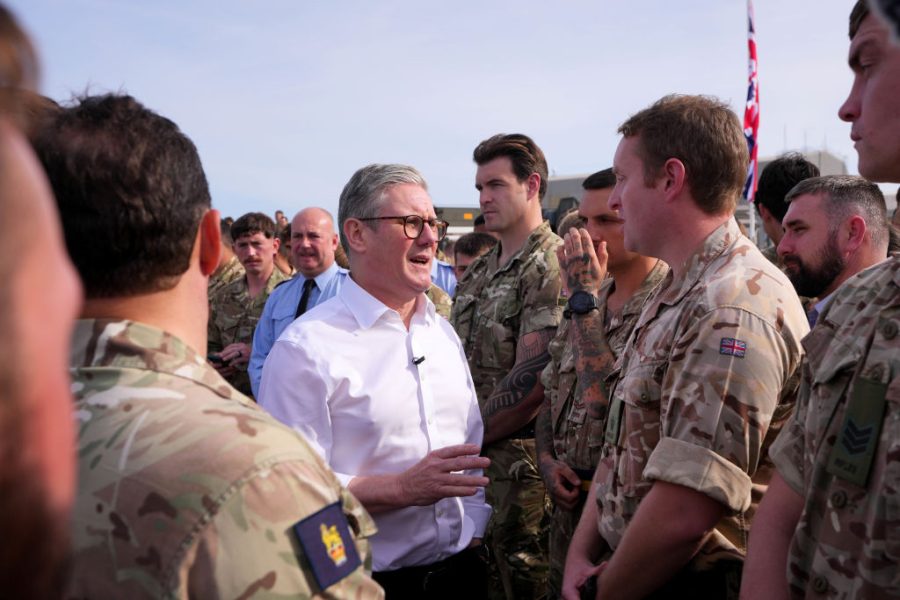
Britain, meanwhile, only has around 7,500 personnel deployed internationally, but there is little if any scope to expand. We are not fulfilling our commitment under Article 3 of the North Atlantic treaty to ‘maintain and develop their individual and collective capacity to resist armed attack’. Resources for our leadership of the Nato Battlegroup in Estonia are stretched and reinforcing it would be difficult. The British army is the smallest it has been since the 1790s and is still shrinking. Where will we find ‘boots on the ground’ for Ukraine? On US security guarantees, Steve Witkoff was expansive:
The president strongly stands behind security protocols… They are as strong as anyone has ever seen. The president does not back down from his commitments. He is strong for the country of Ukraine.
This is laughably untrue. There has never been a president as unreliable as Donald Trump and we have seen endless evidence that he is anything but ‘strong for the country of Ukraine’. What we do know is that he will act in what he perceives to be his interests at any given moment – nothing else matters to him.
Then there is Russia. Two of President Vladimir Putin’s key demands are that Ukraine should cede territory still under Kyiv’s control to Russia, and that there can be no Nato military forces based in Ukraine. Deputy Minister of Foreign Affairs Sergei Rybakov said only weeks ago that his country would not ‘subscribe to, agree to, or even be content with, any presence of Nato troops on Ukrainian territory’.
Perhaps we are ‘closer than ever’ to a peace settlement between Ukraine and Russia. But until someone can explain how these challenges are to be surmounted rather than wished away, the last yards of this journey are almost impossible to complete. The Prime Minister has cited Roy of the Rovers as his favourite book, but his approach to this week’s agreement suggests he is channelling Hemingway: isn’t it pretty to think so?
Comments