
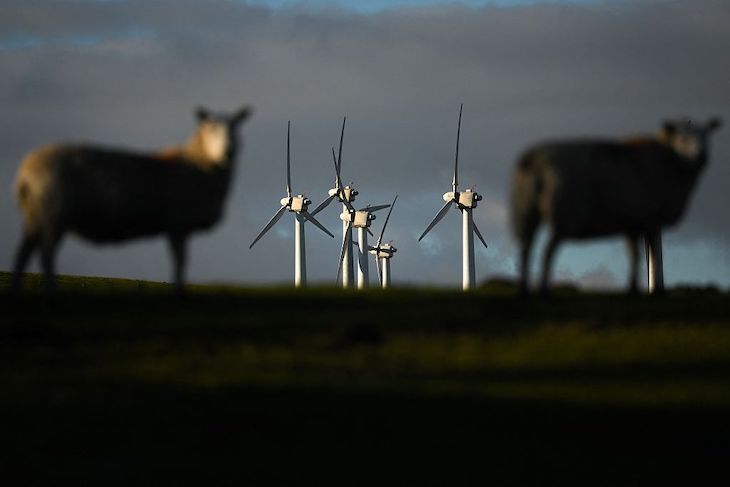
If you thought that Net Zero couldn’t get any sillier, it just has. Remember how, according to Boris Johnson, Britain was going to become the ‘Saudi Arabia of wind’, exporting massive amounts of abundant power? Actually, we are importing record amounts of electricity: a net 330 terawatt-hours’ worth in 2024, equivalent to over 10 per cent of that consumed in Britain in 2024. This comes via subsea cables from France, the Netherlands, Belgium and Norway.
UK households are also subsidising energy consumers abroad
But, as the energy company Octopus pointed out before a House of Lords committee on Tuesday, even when we do export electricity we are often doing so at a loss, with UK households effectively subsidising their counterparts in France and other countries. This bizarre arrangement is a function of our energy market rules and the failure to build grid capacity fast enough to match the power output from wind and solar farms.
The issue of constraint payments – compensation paid to wind farm operators when they are generating too much power to be fed into a grid which lacks the capacity to carry the energy around the country – is already widely known. Last year, wind farms were paid £382 million to turn off their turbines. Gas power plants in the south of England had to be switched up in order to make up the lost power, meaning that consumers had to pay twice over. The aggregate cost of constraints in 2025 was £1.4 billion, equivalent to £49 for every UK household.
What is less widely-known is that UK households are also subsidising energy consumers abroad. Under market rules, wind farm operators are allowed to sell surplus electricity to energy companies across the Channel. Trouble is that the many of the wind farms are in the North of Scotland while the interconnectors which export the electricity are in the south of England. When there is insufficient grid capacity to transmit the energy southwards, the French get their cheap ‘wind’ power anyway – even though it has actually been generated more expensively by gas peaking plants in the south of England. The difference is passed onto UK energy consumers. According to Octopus, this could cost UK consumers £16 billion between 2030 and 2050. It is a problem which the company says will get worse thanks to Keir Starmer’s reset of UK-EU relations which would recreate a single market in electricity.
What is so foolish is that the problem of inadequate grid capacity has been known about for years, and yet still governments – of both colours – have commissioned endless new wind generation capacity, knowing that it is running far ahead of the grid’s capacity to cope.
Conservative leader Kemi Badenoch earlier this week wrote that Net Zero was the ‘economics of the madhouse’, and so it is. But it is pertinent to ask: where was she when the Net Zero target was being nodded through the House of Commons in 2019 with hardly an MP raising any objection? Funny enough, but I don’t remember her raising too many objections to her own government’s energy policy when she was in the cabinet. Net zero is a madness which has afflicted all three parties of government over the past two decades, even if Ed Miliband’s zealotry on the issue may be in a different league.
The dream of Britain becoming a major exporter of wind power always was flawed, given that many neighbouring countries also have significant numbers of wind turbines and that when windy conditions prevail over Britain they have a tendency to be present over much of the near-Continent, too. Far from turning us into Saudi Arabia, over-enthusiastic investment in wind farms is turning us into a pathologically generous aunt who picks up the tab for everyone and everything.






Comments