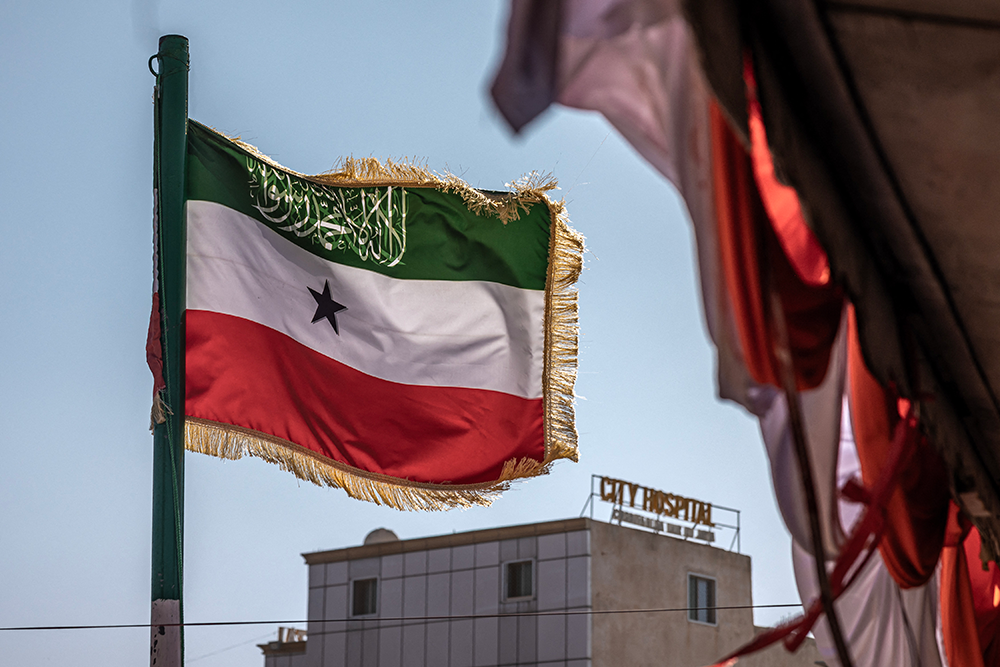
Somalia has been a byword for failed statehood and violence for so long that the calm of Somaliland, its neighbour to the north-east, feels almost miraculous. In contrast to Mogadishu, the bustling streets of Hargeisa, Somaliland’s capital, aren’t patrolled by grim-faced soldiers. Government offices aren’t huddled behind blast walls and protected by foreign troops. You can wander into a restaurant and enjoy camel steaks (a national speciality) without worrying about al-Shabaab terrorists.
It is a former British colony which, for 30 years after independence, was joined to what had been Italian Somaliland. It seceded after the collapse of the Somali state in the late 1980s but no foreign country formally accepted it as a sovereign state until December, when Israel broke ranks with the international community. The UAE and Ethiopia may soon follow. The former already has a major military base in Somaliland and the latter wants to build a naval port on its coast.
Importantly, the Somaliland Republic overlooks one of the world’s most strategically vital maritime choke points – the 14-mile-wide Bab el-Mandeb (‘Gate of Grief’) between the Suez Canal and the Indian Ocean. Bab el-Mandeb, on the other side of the Arabian peninsula from the Strait of Hormuz, is again being threatened with closure by the Houthis, Iran’s proxies in Yemen.
Even before Donald Trump and Israel’s war with Iran, the Red Sea littoral and the Gulf of Aden had become the focus of a new Great Game, involving Saudi Arabia, China, France, the United States, Houthi-controlled Yemen and Turkey among others.
At the end of February, Turkey’s President Recep Tayyip Erdogan quietly shipped tanks and F-16 warplanes to Mogadishu where Turkey runs the port and airport. The deployment furthers his plans for Somalia. These include a spaceport and missile-testing facility which would make the country Turkey’s equivalent of French Guiana.
For Erdogan, turning Somalia into a quasi colony of Ankara restores the proper order of things: 400 years ago the Ottoman Sultans ruled these coasts as the ‘Eyalet of Habesh’. But Turkey’s military build-up in Somalia is really part of the spread of the Middle East’s wider rivalries, resulting in the proxy-wars-cum-civil wars in Sudan and Yemen.
One reason for the different trajectories of Somaliland and Somalia is that their colonial experiences were so different. In 1884, at the beginning of the ‘Scramble for Africa’, British officials made a deal with local Somali sultans to establish a protectorate centred on the ancient port at Berbera. Its prime purpose – to ensure a steady supply of goat meat to the British Indian garrison at Aden. France and Italy immediately set up their own competing protectorates to the north and south.
Britain’s minimalist imperial footprint consisted of ten colonial officers, a few dozen Indian clerks and the small Somaliland Camel Constabulary. Somalia Italiana, by contrast, was developed into a bona fide colony from the 1920s, replete with settlers, infrastructure projects and administrators determined to reshape Somalia’s pastoral, clan-based society.
In 1960, both territories were given independence (France kept Djibouti, its Somali colony until 1977). Soon afterwards, Somaliland’s leaders joined their new republic to what had been Somalia Italiana. The union was a disaster. The dominant formerly Italian south exploited the north, oppressed its Isaaq clan majority and provoked a rebellion. The Somali dictator Mohamed Siad Barre responded with devastating repression, destroying Hargeisa. But the Somalilanders eventually prevailed. When they declared independence in May 1991, Siad Barre’s regime had fallen and the rest of Somalia was convulsed by clan-based civil war.
Somalia’s deadly chaos continued for the next 30 years, despite around $80 billion worth of international aid. Meanwhile the Somalilanders quietly rebuilt their country. The democracy they created was not perfect but its governments hand over power peacefully – a rarity in the region. However, the fact that Somaliland has been a beacon of stability and the rule of law has been insufficient for it to win it recognition from international bodies.
On the rare occasions when a new state does get the blessing of the ‘international community’ it’s usually because it has become a global cause. But Somaliland – having avoided civil strife, war and famine – has not attracted the necessary media attention. Nor has the Somaliland diaspora in the UK, whose luminaries include Sir Mo Farah and Rageh Omaar, been able to raise the country’s profile. Moreover, Somaliland has neither hosted terrorist militias nor sent troops across its borders to kill or kidnap in neighbouring countries, which limits its appeal to lawyers and human-rights NGOs.
Its democracy was not perfect, but its governments hand over power peacefully – a rarity in the region
British governments have given discreet support to Somaliland. The efficient security at Hargeisa airport, for instance, is run by British private contractors who do a lot of work for the Foreign Office.
Officially, however, the UK insists there is just one Somalia unless Mogadishu agrees to Somaliland’s departure. It is a position that requires ignoring Somaliland’s 33 years of de facto independence – longer than the period it spent united with Somalia.
The people of Somaliland need and deserve recognition, which would give their state access to World Bank and IMF credit, and also to large-scale foreign investment in its oil and gas reserves. Any reasonable reading of international law supports the Somalilanders’ case. The country meets all four main ‘Montevideo Criteria’ for statehood: a permanent population, a defined territory, a government controlling that territory and the capacity to conduct international relations.
Britain’s stubbornness is baffling because the potential gains of doing the right thing outweigh the potential costs. Yes, China would be irritated because, as the occupier of Tibet, it has a horror of absorbed states regaining independence. Eritrea and Egypt would condemn British recognition as they did Israel’s because Somaliland has a close relationship with Ethiopia, their common adversary. But these aren’t major concerns. Once London gives its blessing to Somaliland’s independence, others will follow.
The Trump administration still supports the ‘One Somalia’ policy but China’s military presence in Djibouti and America’s need for ‘critical minerals’ could shift that stance. Just days before the Iran war, Somaliland offered Trump ‘exclusive access’ to its large deposits of lithium, tantalum, cobalt and coltan: vital for munitions and electric vehicles.
Somaliland recognition would give Keir Starmer a chance to deal with the legacies of empire in a way that is the opposite of the Chagos debacle: doing the right thing by our former colony might not enrich progressive British barristers but it would benefit British interests.
.






Comments