
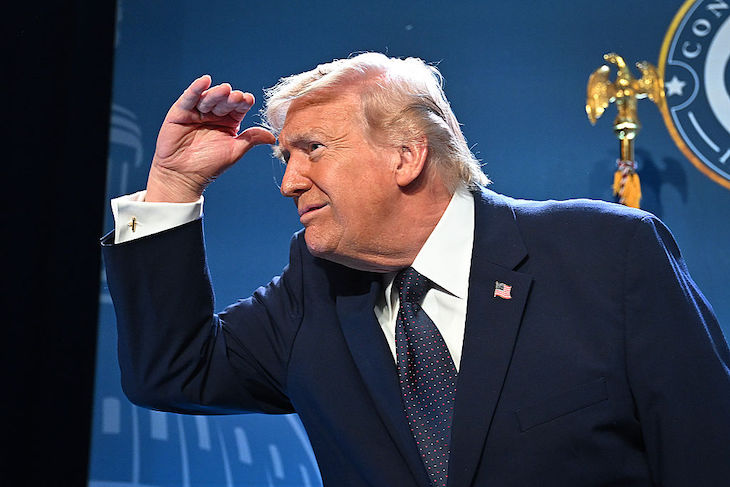
Two weeks into the war in Iran, Donald Trump’s critics have intensified their attacks not only on his conduct of the war, but on his decision to start it at all. As oil prices, global trade routes and energy markets come under strain, endless strategic and economic debates produce more speculation than answers. Does the war weaken America against China, or strengthen it? Was the decision legal? Is there a long term strategy for this confrontation?
Just as technology empowers ideological extremists, ideological self-doubt weakens many Western societies
All are important questions. Yet we must not overlook another perspective, increasingly unfashionable but repeatedly invoked by President Trump and his administration in statements and briefings. Alongside discussions of military advantage and regional security, they have revived a language that many Western policymakers prefer to avoid. A language that can sound cynical or contrived when spoken by politicians wading daily through the greasy muck of politics. It is the language of morality, ideology and civilisational conflict.
Speaking in those terms confronts something essential about the enemy being challenged. This is not simply another American intervention abroad, nor merely another “forever war” of Western imperialism. The Iranian regime is more than an authoritarian state pursuing narrow interests. Its ruling doctrine fuses revolutionary Shi’a theology with a militant anti Western worldview forged in the intellectual currents of the 1979 Islamic Revolution. Iran’s leaders see themselves not only as governors of a state but as participants in a historical, international, civilisational mission. And we are their enemy.
Israel has therefore become a natural partner for the United States in this confrontation. Few modern states maintain such a clear sense of civilisational identity or such confidence in the legitimacy of their own survival, and that clarity has allowed Washington and Jerusalem to recognise common cause against the Iranian regime.
The Israeli state was founded on the conviction that a persecuted people had the right to defend themselves and their values even in a hostile region. That ethos still shapes Israeli strategic thinking and explains why Trump has found such a natural partner in the Jewish state. A similar spirit once animated the Nato alliance. Today it is increasingly overshadowed by hesitation and diminishing belief in the values it was created to defend.
Against ideological adversaries, clarity matters. Movements driven by religious or ideological conviction rarely retreat in response to material incentives alone. They persist because they believe their struggle carries historical or spiritual meaning.
Conflicts of this kind therefore cannot be fought with strategy alone. They require an opposing conviction: the belief that the civilisation being defended is worth protecting. And in this case it certainly is.
That assumption shaped policy for a generation. The war now unfolding may finally bury that illusion
Donald Trump’s rhetoric reflects that conviction with unusual bluntness. Speaking last week about the campaign against Iran, he declared: “We had to do it – wipe out evil… they’ve been killing people in the most violent way… people have waited for 47 years for it to happen, so we have to do it right.”
The language may strike some as crude. Yet it restores something largely absent from Western strategic discourse: the willingness to describe conflicts in moral as well as strategic terms.
Despite decades of sanctions, economic strain and internal discontent, the Islamic Republic has invested enormous resources in confrontation with the Western led order. It has built proxy militias across the Middle East from Lebanon to Iraq to Yemen, financed missile development and pursued nuclear capabilities while constructing vast underground bunkers and military complexes. These were never the decisions of a cautious government seeking stability. They were the actions of a regime that views confrontation with the Western-led international order as part of its defining purpose.
This is a struggle between societies that seek stability, and movements animated by revolutionary and religious violence. The technological landscape has made this struggle more dangerous than in the past. Small militant organisations armed with cheap rockets, drones and increasingly precise guidance systems can threaten major cities, ports and global infrastructure in ways once reserved for superpowers. They cannot be ignored or brushed aside.
Yet just as technology empowers ideological extremists, ideological self-doubt weakens many Western societies. They have grown uncertain about their own right to defend themselves. Narratives of permanent guilt and endless self criticism blur the distinction between aggressor and victim, right and wrong, civilisation and barbarity. Conflicts are analysed endlessly, but their moral stakes fade into abstraction.
Israel and the United States are now attempting to impose clarity through force. Whether this leads to regime collapse or merely prolonged weakening remains uncertain. What is clear is that the scale and tempo of the campaign suggest ambitions beyond punitive strikes. It is an effort to reshape the balance of power in the Middle East and to demonstrate that barbarity will be met with the force necessary to defend our freedoms, our culture and our values.
For Trump this strategy is not only about leverage, influence or military credibility. It rests on a clear reading of ideology and survival. He has recognised the nature of the violent Islamic revolutionary regime that governs Iran and the danger it represents.

Those who fail to recognise this often do so out of hostility toward Israel, Benjamin Netanyahu or Trump himself. Some observers seem almost eager for America and Israel to fail, simply so that Trump and Netanyahu can be confirmed as reckless leaders. Their dislike of the personalities involved eclipses their judgement about the regime being confronted and the values at stake.
They mock U.S. Secretary of War Pete Hegseth’s bombastic pride in American military power during his Pentagon briefings while ignoring the character of the regime he is fighting: a regime that hangs gay men, threatens Jews with genocide and suppresses its own citizens with routine brutality. Against an adversary of that nature, confidence in one’s own power is not an embarrassment. It is a necessity.
For Britons especially such bluntness can feel uncomfortable. Britain’s political class has largely tried to keep the conflict at arm’s length, presenting it as a crisis to be managed diplomatically rather than decisively resolved.
Yet if the Islamic Republic eventually collapses under the pressure of this confrontation, Britain may discover that its restraint looked less like prudence and more like absence. Much of Europe has spent years attempting to restrain or obstruct the very actions now weakening Tehran’s power, often in the name of diplomacy or stability. In practice this frequently preserved a regime whose ambitions openly threaten the West.
Britain itself has direct cause for concern. The Islamic Republic has issued fatwas against our authors, seized our sailors, imprisoned our citizens, sponsored attacks against our own Jewish citizens, and financed terrorist networks throughout the Middle East and beyond. Its ideology declares its mission global. It seeks the destruction of Israel and openly proclaims hostility toward the United States and the societies aligned with it. Its ideology presents its mission as global. Its eschatological vision of chaos and world domination drives its dangerous insanity.
Israel and the United States are attempting to impose clarity through force
When that regime eventually falls, whether through military defeat, internal collapse or the accumulated pressure of both, history will record who pursued its weakening and who joined it in celebration of its continued existence at its London embassy. The United States and Israel have chosen confrontation. Much of Europe has chosen hesitation, negotiation and distance.
And while its downfall could benefit us all regardless of our own level of involvement, our enemies will see who faltered when it mattered, noting where to try again in future. The defence of liberty does more than secure it; it renews belief in it. When it comes to defending freedom, those who work reap the harvest, while the idle suffer hunger.
For decades Western policymakers comforted themselves with the belief that Tehran’s rulers were rational actors who could be moderated through negotiation, sanctions relief or gradual integration into the international system. That assumption shaped policy for a generation. The war now unfolding may finally bury that illusion.
In its place should come a rediscovery of moral clarity: the ability to recognise the difference between good and evil, civilisation and barbarity, and the knowledge that our freedoms never come for free. The United States has shown a renewed willingness to speak that language. The rest of the West would do well to remember it.


Comments