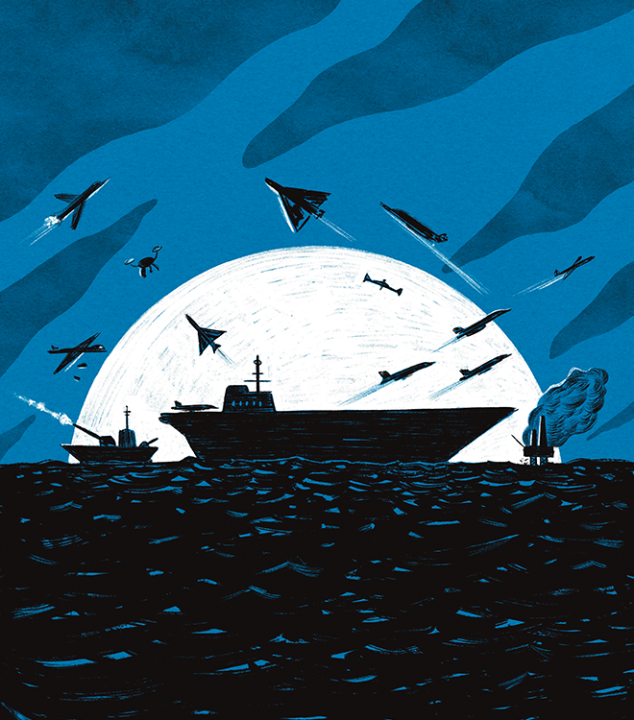
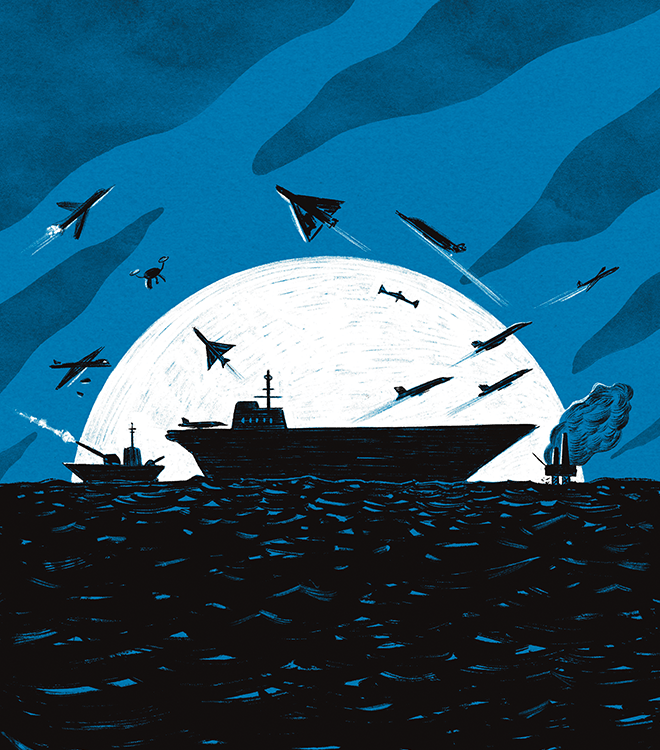
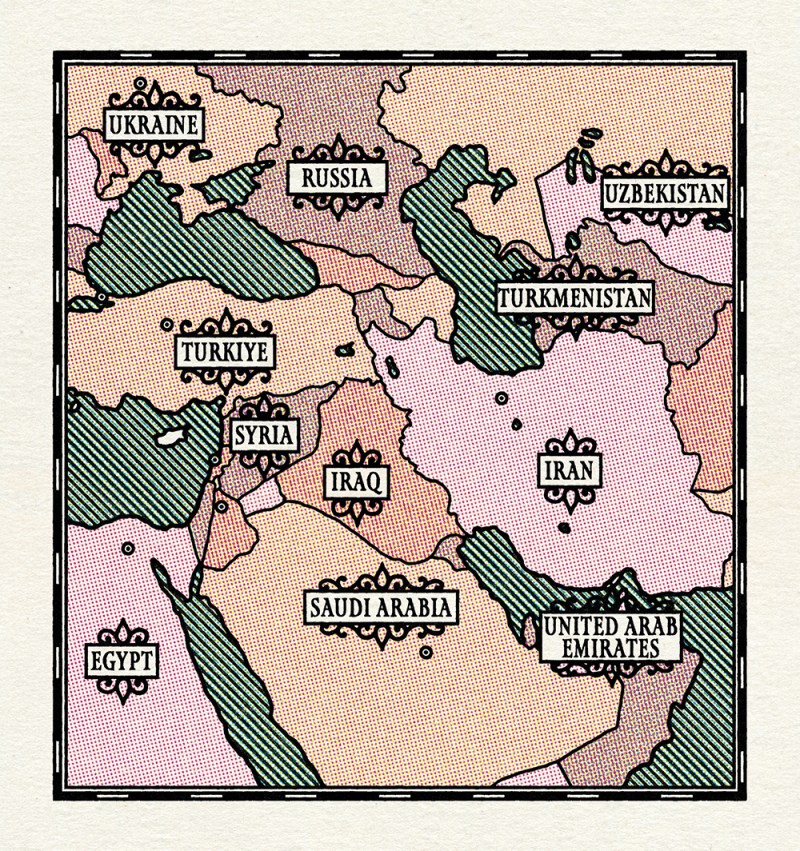
Last month, an Iranian cargo ship in the Caspian Sea was struck by a Ukrainian drone. Kyiv claimed the vessel was carrying military equipment heading toward Russia. “The regime in Tehran is a direct accomplice to Russian aggression against Ukraine, fueling Moscow’s criminal war with weapons,” Kyiv’s foreign minister said. Tehran reportedly contemplated a counterstrike on one of Ukraine’s Black Sea ports, then thought better of it. But the threat of a conflagration is higher now than at any point since the end of the Cold War.
Conflicts that are currently contained risk spilling out and engulfing whole regions, perhaps the world. If the Iran and Ukraine conflicts were to merge, we’d see a war that runs from Poland to the edges of India. Ukraine’s President Volodymyr Zelensky says that World War Three has already begun.
Iran and Ukraine are far from the only potential theaters of escalation: there is the possibility of a war in Yemen between Saudi Arabia and the Houthis, Iran’s proxy force, and a growing anger in the Muslim world about Israel’s seizure of parts of Lebanon. Not to mention the India-Pakistan border, the South China Sea, the Korean Peninsula and the Strait of Taiwan.
Rarely has the US moved so quickly toward a major foreign-policy debacle — despite repeated warnings
The danger lies in the possibility that conflicts in different regions begin to reinforce one another, overwhelming the capacity of even the most experienced statesmen to contain them. Barbara Tuchman’s 1962 book The Guns of August is a masterful study of how World War One began – the accumulation of “terrible ifs,” as Churchill called them. One of the main causes of that conflict was a misunderstanding of adversaries. Germany was convinced Britain would stay out of the war and that even if London were to involve itself, the conflict would be so brief that it wouldn’t matter. The great lesson from Tuchman is that those hurtling toward war can’t see what’s coming.
Vladimir Putin believed Ukraine would fall within hours of a direct assault on its capital. On the outskirts of Kyiv, abandoned Russian military vehicles were found to contain parade uniforms, ready for the victory celebrations on Maidan Nezalezhnosti. And Zelensky clearly misjudged his American allies when he, Donald Trump and J.D. Vance had a shouting match in the Oval Office last year. The Ukrainian President tried to push back at the idea of a lasting negotiated settlement. “You’re gambling with the lives of millions of people,” Trump told Zelensky. “You’re gambling with World War Three.”
This year, Trump took the same gamble. He too spectacularly misjudged his adversaries. The President seemed to believe that he could topple the Iranian regime in a matter of weeks. Iranians would pour on to the streets with Ali Khamenei buried under the rubble, and soon a Persian Delcy Rodríguez would be cutting deals with America.
Bachelor parties have been planned with more forethought. Rarely has the United States moved so quickly to the brink of a major foreign-policy debacle – and done so despite repeated warnings about the risks. Trump devoted barely a minute to Iran during a two-hour State of the Union address in February, just days before launching Operation Epic Fury. There was no sustained effort to prepare either the American public or Congress for the prospect of military action.
As a result, the Iranian regime has survived and become more defiant. Not only does Tehran now effectively control the Strait of Hormuz, the Islamic Republic retains its uranium enrichment program, ballistic missile capability and regional proxy network. Through its Houthi allies in Yemen, Tehran can still threaten shipping in the Red Sea, disrupting global trade and energy markets. By almost any measure, Trump’s gamble has failed.

The Iran intervention was especially risky precisely because of the wider, deteriorating global context: the war in Ukraine, the decline of Europe, the growing influence of the Gulf states, the tilting balance of global power toward China. Western commentators have been eager to cheer Ukraine’s latest counterstrikes against Russia – especially the missile attacks on commercial Wildberries warehouses, which threaten to cripple the Russian consumer economy. What’s less talked about is Russia’s response: an intensification of its bombings of Ukrainian cities. Russia is now seriously considering a mass mobilization of emergency troops.
The escalations could soon spread east. America’s air war on Iran, concomitant with the West’s considerable military support for Ukraine, has massively depleted weapons stocks, so much so that Washington may no longer have enough ATACMS missiles and other munitions to sustain its deterrence in, say, Taiwan.
Zelensky is again begging Washington for more surface-to-air missile interceptors as Russia dials up its bombardments. A hotter war along the Dnipro river raises the risk of Chinese intervention thousands of miles away.
It is facile to blame Trump for the increasingly fragile international order, although he can be criticized for much. The deeper forces reshaping world politics long predate his return to the White House. During the 1990s, it became an article of faith in many western capitals that integrating communist China and post-communist Russia into the liberal international order would encourage them to become not only more prosperous, but ultimately more peaceful and even democratic – or, in veteran Republican strategist Robert Zoellick’s memorable phrase, “responsible stakeholders.”
That optimism proved wildly naive. Well before Trump emerged on the political scene, Beijing and Moscow had made clear that they did not embrace Washington’s vision of a liberal international order. Quite the opposite. Xi Jinping’s accession to power in 2012 marked China’s most authoritarian turn since Mao Zedong and coincided with a far more assertive foreign policy. And China was able to fund that military assertiveness thanks to its integration in the western economic system. Putin, meanwhile, had long since consolidated his authority and became determined to restore Russian influence in its near abroad. Again, this is a story of misunderstanding adversaries, that same belief that opponents could be contained.
For China and Russia, full integration into the liberal international order meant acquiescence to a system underpinned by American military power. Neither was prepared to accept US primacy in its own sphere of influence. Long before Trump, the Chinese Communist party was seeking to establish predominance in East Asia, hoping over time to push the United States out of the western Pacific. Remember the 2016 ruling by the Permanent Court of Arbitration at The Hague, rejecting Beijing’s South China Sea claims? So much for China’s peaceful rise.
In 2008, Russia invaded Georgia, which had sought closer ties with both the United States and NATO. In 2014, three years before Trump’s first inauguration, Russia annexed Crimea following the overthrow of Ukraine’s pro-Russian government, signaling that Moscow was prepared to use force to defend what it has seen as its core strategic interests for centuries before even Lenin and Stalin.
Between the end of the Cold War and Trump’s election in 2016, the United States fought seven wars – against Iraq in 1991, in Bosnia, Kosovo, Afghanistan, Iraq again, Libya, and later the Islamic State in Iraq and Syria. By one measure, America was at war for roughly three out of every four years during that period. These were the very “forever wars” Trump repeatedly condemned on the campaign trail.
The truth is that Pax Americana – the notion that an activist United States should underpin the international order through its unrivaled military, economic and diplomatic power – had begun to fray well before Trump descended the golden escalator. Charles Krauthammer’s “unipolar moment” of the early 1990s was already fading as other great powers reasserted themselves and American willingness to shoulder the burdens of global leadership diminished.
The liberal international order has never been self-enforcing. Like the rule of law at home, it depends not merely on principles but on the credible capacity to uphold them. Courts, after all, require police. International institutions are no different. Without a United States both willing and able to enforce the system it helped create, the rules-based order was always going to come under strain. This is partly why Putin felt able to launch his invasion of Ukraine in 2022. He had spent more than a decade salami-slicing the old Soviet bloc countries, with little in the way of western response.
While the world has entered a more dangerous era, nuclear deterrence still imposes powerful constraints that make World War Three unlikely. Indeed, nuclear weapons remain the strongest reason to doubt that humanity is on the brink of another global conflict. Nuclear weapons have deterred direct wars between the major powers for the better part of eight decades. The same logic appears to apply in South Asia. Despite repeated crises, India and Pakistan have avoided the kind of large-scale conventional wars that characterized their relationship before both became nuclear-armed states.
The 1914 analogy reminds us how quickly separate crises can merge into an uncontrollable conflagration
The real danger, therefore, lies not in the collapse of deterrence but in a more volatile international system: multipolar rivalry, overlapping regional conflicts, drones, cyber warfare, artificial-intelligence hacking and economic subversion. This ties into the growth of asymmetrical warfare and terrorism in various forms: bioweapons on American soil; arson attacks on electrical substations and critical infrastructure; drone strikes from hundreds of miles away. Such actions are harder to monitor than mass troop movements and so their risks are harder to quantify.
Historians and politicians have a dismal record of predicting the next great upheaval. In 1913, Europe’s elites convinced themselves that commerce had rendered major war irrational. In 1988, few anticipated the collapse of the Soviet Union. In 2022, many experts doubted that Russia would launch an invasion of Ukraine. The lesson is that geopolitics has an enduring capacity to confound confident predictions. What’s needed is a degree of prudence that has been absent in these volatile times.
Tuchman’s argument in The Guns of August was that the Great War was not inevitable. Europe’s statesmen instead drifted into catastrophe through miscalculation, rigid alliances, poor communication and an abiding confidence that events remained under their control. The analogy with 1914 is instructive not because history repeats itself, but because it reminds us how quickly separate crises can merge into a single, uncontrollable conflagration – and how political leaders are blind to the dangers.
The greatest risk facing the world today is not that its leaders consciously seek World War Three. It is that they stumble into it through miscalculation in an international system that is ever more interconnected and unpredictable. Another world war is not inevitable. But the terrible ifs are accumulating.





Comments