

Is Mercury the dullest planet? Looking up at the Solar System poster above my childhood bed, the first stop from the Sun failed to excite me. Consider the competition. Venus has acid clouds. Mars has red dust. Jupiter has its big red spot. Saturn has its rings. Uranus has a funny name. And Neptune has diamond rain.
By contrast, Mercury is a grey, cratered, atmosphere-free lump of rock – the Moon with worse PR. Even worse, being close to the Sun, it is both ludicrously hot – temperatures reach 430°c – and incredibly difficult to visit. For a start, you need to avoid plunging into its fiery neighbour.

It isn’t even the most famous Mercury. How can a barren planet rival the genius behind ‘Bohemian Rhapsody’? It can’t grow a moustache. Nor has Mercury inspired any great fiction. Mars has The War of the Worlds, Saturn has 2001: A Space Odyssey, the Moon has, erm, Moon. Mercury only offers Sunshine, a forgotten Danny Boyle flick starring Cillian Murphy as a man with a big bomb (not for the last time).
Mercury made its first modern fictional appearance in ‘L’Adone’, a 40,992-verse Italian love poem from 1623, condemned by the Pope for its ability to ‘corrupt morals due to its extreme obscenity’. But it would wait until 1905 and William WalterCook’s Adrift in the Unknown; or, Queer Adventures in a Queer Realm to star. The book featured American plutocrats – Wall Street big wigs, railroad barons, and so on – being abducted and put on trial by the Mercurians. Cook was not a devotee of the latest scientific developments.
For authors of a more astronomical bent, until the 1960s, it was believed that Mercury was tidally locked with the Sun, keeping one side in permanent day and one in permanent night. Isaac Asimov and Kurt Vonnegut played with that in a couple of their less famous stories. But when it was discovered that the planet just has a funny orbit – a 3:2 spin-orbit resonance, meaning it spins three times for every two orbits of the Sun – writers lost interest. Yet just as sci-fi gave up on Mercury, it became clear that Cook was on to something.
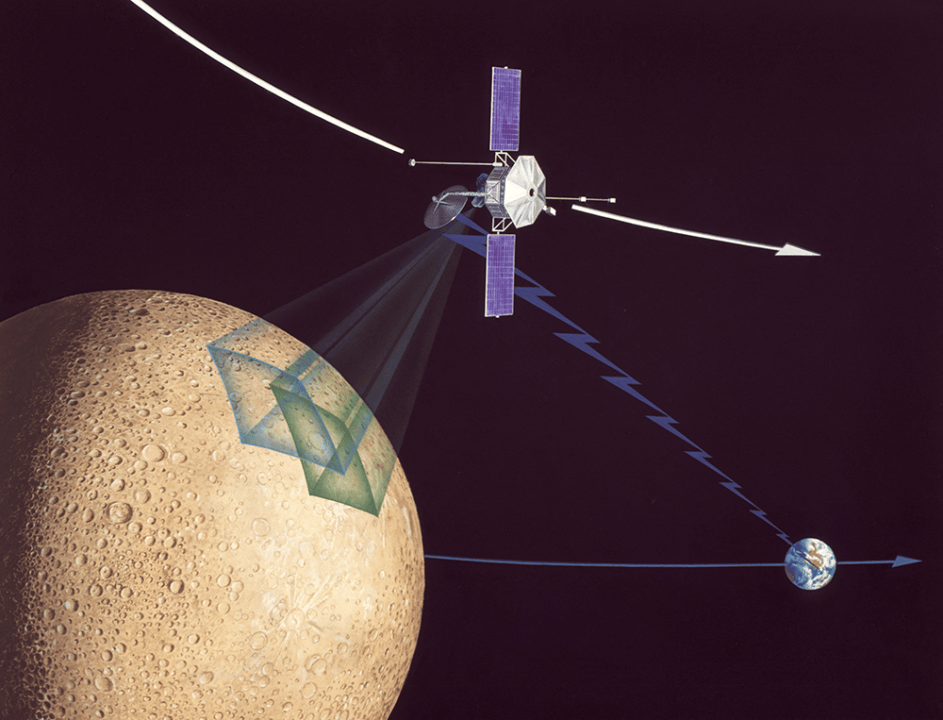
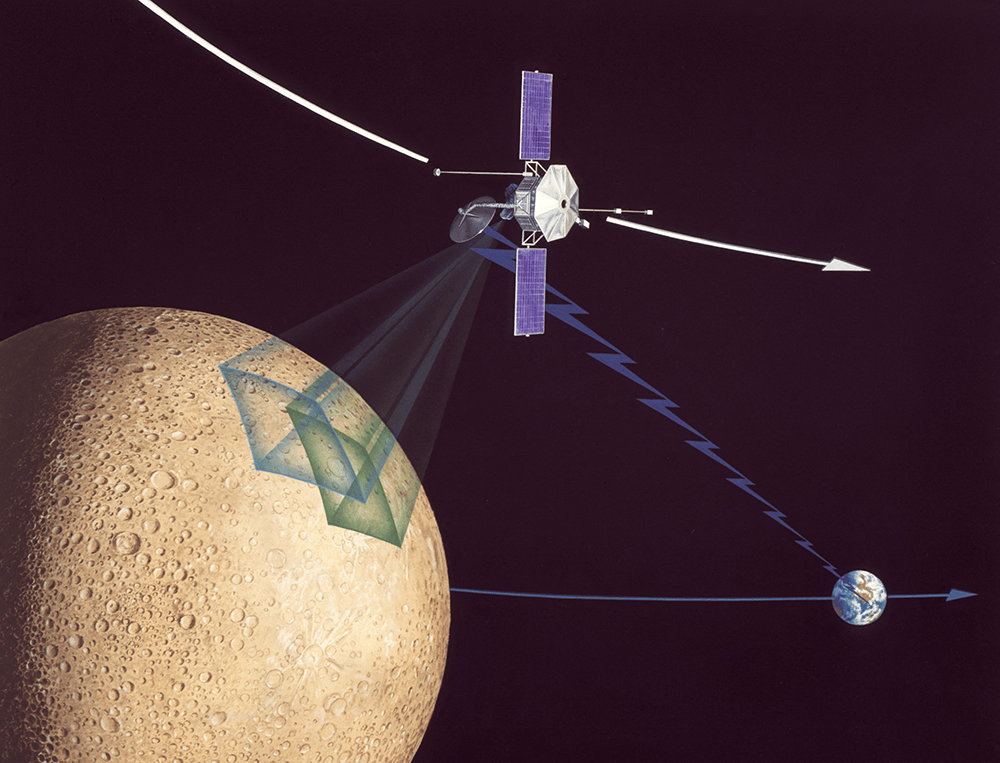
Mercury is a queer realm, not in the Freddie sense, but a planetary oddball. Nasa’s Mariner 10 flew by in the mid-1970s and found a magnetic field, unexpected in a planet so small, generated by a molten metal core constituting 70 per cent of Mercury’s mass, more than double that of the Earth’s equivalent, and extending to 85 per cent of its radius. Mercury was not dead, a 4.5-billion-year-old pebble, but active.
Four decades later, the Messenger probe made clear that Mercury was far from the Solar System’s ugly duckling. Despite being so close to the Sun, water ice is at the poles. Evidence of ancient volcanoes and gigantic cliffs was discovered alongside mysterious blue patches of the sorts of volatile elements that leave laymen non-plussed but get geologists very excited. Each new discovery raised further questions.
Hence why this week BepiColombo – a joint project between the European and Japanese space agencies – will enter Mercury’s orbit. The probe’s mission? To discover more about its peculiarities, to learn more about how planets are formed and to prove to six-year-old boys that it is not so boring after all.






Comments