
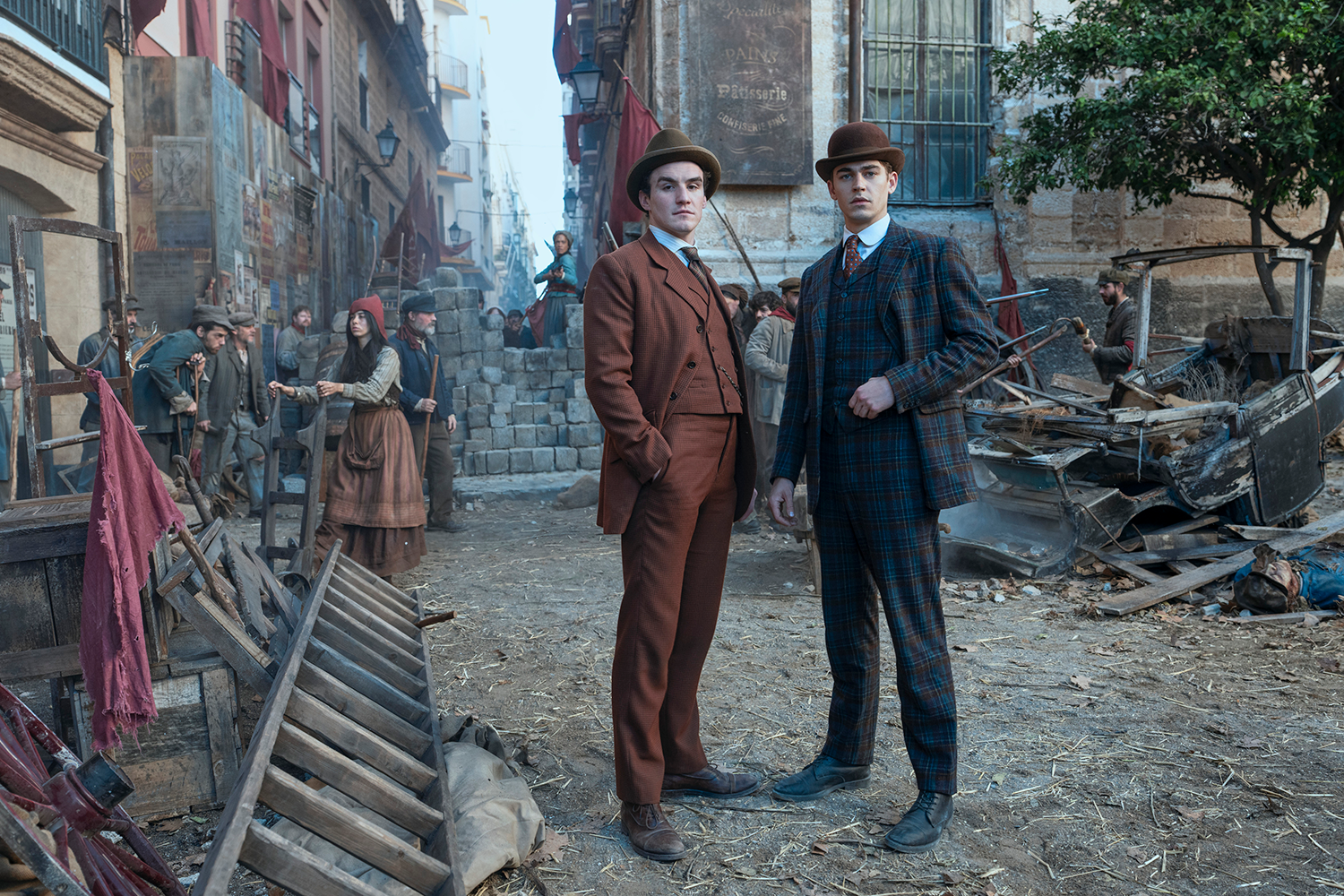
Judging from the two biggest new streaming dramas around, the taste these days runs towards the kitchen sink – not as in gritty northern blokes smoking Woodbines and moaning a lot; rather, as in the writers throwing in everything but.

A fortnight ago, I reviewed Lisa McGee’s How to Get to Heaven from Belfast: a Netflix show that doesn’t so much combine slapstick, violence, cheery banter, mean banter, mystery, media satire and dark broodings on life, as simply shuttle between them. Now comes Young Sherlock, directed by Guy Ritchie, where again anybody searching for dramatic unity will search in vain.
We first saw the young Sherlock Holmes (Ralph Fiennes’s nephew Hero Fiennes Tiffin) in Newgate prison where he’d been sent for the twin crimes of pickpocketing and being a smart-arse in court. He was then taken out of jail by his influential brother Mycroft (Jeremy Irons’s son Max Irons), who’d found him a place at Oxford – the bad news being that it was as a college servant.
By this point, we’d also seen an even younger Sherlock on the day his little sister drowned – which is why his still grieving mother is in a mental asylum. After the three episodes I’ve seen, it’s not clear where this backstory fits into the rest. Then again, there’s a fair amount of the rest to fit into.
Among the more unexpected elements is Shou’an (Zine Tseng), an initially demure Chinese princess who arrived at Sherlock’s college having been briefly kidnapped by Oxfordshire bandits – until she demonstrated a mastery of martial arts that no mere bandit gang could counter.
There’s also Sir Bucephalus Hodge (Colin Firth), a winningly named and duly villainous builder of the British Empire – and the fact that college professors keep getting murdered. In the meantime, the priceless scrolls of The Art of War that Shou’an has presented to the library appear to have been stolen.
For a while, Sherlock was fingered for all the above crimes and imprisoned once more, before making a Mr Toad-like escape dressed as a washerwoman. In order to clear his name, he then teamed up with a resourceful Irish undergraduate called James Moriarty (Donal Finn).
There’s no denying that Young Sherlock is bonkers – but no denying either that it’s a lot of fun
As the two buddies morphed into Victorian Oxford’s answer to Butch and Sundance – complete with bicycle-riding, a neat line in disguises and an unspoken love beneath the bantz – the playful prefiguring of things to come continued. A young policeman introduced himself as ‘Constable Lestrade’. An older one in a deerstalker elicited a comment of ‘wonderful hat’ from Sherlock. Episode two ended with him crying: ‘The game’s afoot.’
And all the time the show sticks firmly to its policy of when in doubt, show us Sherlock and James running for their lives or taking part in spectacular fights.
As with How to Get to Heaven, there’s no denying that the programme is what we critics call ‘bonkers’ – but no denying either that it’s a lot of fun. Had these shows been on terrestrial television a few years ago, there’d surely have been a serious editorial attempt to impose such quaint old qualities as coherence, plausibility and a plot that stands up to proper scrutiny. In both cases, though, that may well have robbed them of their irrepressible – if still mad – mojo.
‘Some things never change,’ said lead doctor J.D. (Zach Braff) early in the welcome reboot of the medical sitcom Scrubs, a deservedly popular series in the 2000s. But, as it turns out, that’s only half the truth – because some things have.
On the unchanging side, returning to Sacred Heart hospital, J.D. soon renewed his bromance with Dr Christopher Turk, his bickering with Dr Elliot Reid (now his ex-wife) and his nervous admiration for his gruff mentor Dr Perry Cox. The show, too, follows its previous pattern of serving up plenty of often quite tough jokes before ending the episode on a sentimental note – a tactic its creator Bill Lawrence deployed again in Ted Lasso. (Back in the day, Dr Cox somehow managed to surprise people every week by revealing in the last five minutes that he had a softer side.)
There is, however, a deft acknowledgment of the passage of time – not just in J.D. and Turk being unable to go for their old horseplay without hurting their backs, but also in the changed nature of medicine – and TV sitcoms – since 2010. Dr Cox can no longer abuse interns without an HR woman telling him to respect ‘our wellness programme’ or face a ‘sensitivity workshop’. One intern is paying off her college debts – and annoying everybody else – by constantly filming herself as an influencer.
Nonetheless, the overall result is another thing which is unchanged: a warmly enjoyable, utterly sure-footed show that’s almost too professional to feel as inspired as the comedy greats – but that’s unlikely to ever let you down.





Comments