As the 2026 midterm election jamboree entered its final days, the punditocracy has been treated to a couple of cathartic and possibly clarifying shudders.
As I write, Elissa Slotkin, a Democratic Senator from Michigan, is scrambling to retrieve her standing after she told an interviewer that she favored having the deep state harass people who supported Donald Trump and the MAGA agenda. She didn’t put it quite like that, of course. What she said was: “I want young people coming out of school to say, ‘Should I go work for the Trump administration?’ I want them to be like, ‘Lord, that might be buying myself a ton of problems that I don’t want, and so let me avoid participating in that.’ I want that deterrence message sent.”
“Deterrence,” eh? Slotkin’s semi-veiled – or, rather, nearly naked – threats did not go down so well. Neither did her hysterical efforts to portray herself as a victim of “far-right” criticism when her remarks went viral. As of this moment, public sentiment has turned decisively against the CIA operative turned Democratic pit bull, notwithstanding the united front put forward by the legacy media. Item: “Trump’s Vile Tirade About Sen. Elissa Slotkin Exposes Sleazy MAGA Scam.” That’s from the New Republic. Similar instances of dispassionate reporting can be found wherever the organs of the deep state are operative.
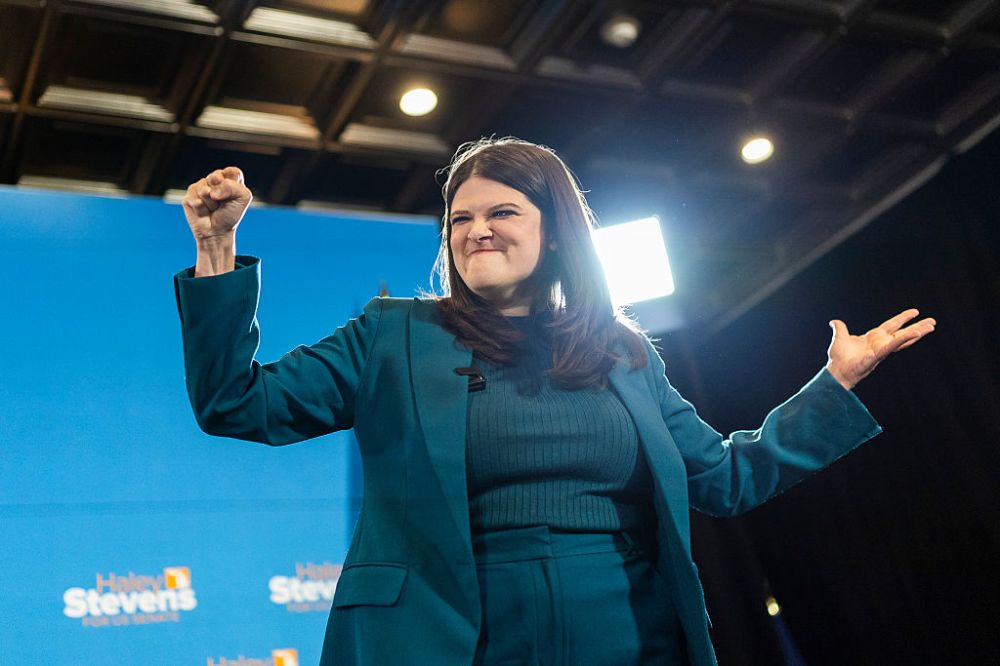
Then there was the case of Wedgewood Polling. On October 20, the company, which started operations only in June of this year, sent a frisson through the polling establishment and the pols who batten on the polls, when it released an open letter admitting – bragging rather – that its data was fake. It cushioned the admission with the inveigling word “experimental.” John Stuart Mill set the hearts of incipient left-wingers aflutter when he extolled “experiments in living.” Here we had an “experimental project to demonstrate the vulnerabilities, lack of oversight and overall low barrier to entry in the modern political polling industry,” i.e., “experiments in polling.”
Why did they do it? Oh, they wanted to “test a simple hypothesis” (see, we’re scientists here): that it is “far too easy” to fake data and have it taken seriously by the media establishment and the politicians who dip their snouts, and their pocketbooks, into that toxic trough.
That hypothesis was amply confirmed. Wedgewood was peddling a narrative that put the Democrats ahead in most races – so the New York Times bought it. MS NOW bought it. The tarnished wunderkind Nate Silver bought it. Many other polls duly folded Wedgewood’s fake data into their polls. (Notably, RealClearPolitics, one of the most accurate and above-board aggregators, did not.)
As I said, I am writing a little before the election. But I plan to pin up some of Wedgewood’s prognostications so I can compare their lies to the realities of the ballot box. Wedgewood told the world that James Talarico led Ken Paxton by two points in Texas, that Sherrod Brown led Jon Husted by four points in Ohio, that Abdulrahman Mohamed El-Sayed led Mike Rogers by six points in Michigan, that Troy Jackson led Susan Collins by four points in Maine. And so on. See a pattern here?
But isn’t Wedgewood to be congratulated for coming forth and telling the world about its experiment in polling? No. The company ended its open letter by saying: “We hope this experiment sparks a necessary conversation about data integrity, media literacy, and accountability across the political research landscape.”
It omitted the little fact that it went public with its confession only because it was caught. On October 20, a rival polling firm called FiftyPlusOne noticed some anomalies in the “data” Wedgewood was emitting, and reached out with a request for comment. “They did not respond to our request,” FiftyPlusOne said, “but instead posted a public statement on social media admitting that they had been fabricating data. They also reached out directly in social media DMs minutes before publishing their memo with an official comment: ‘Fuck you,’ plus the name of an individual not affiliated with FiftyPlusOne.” I wonder if that individual’s last name rhymes with stump, bump or rump?
Wedgewood was peddling a narrative that put the Democrats ahead in most races
There are many ironies in the case of Wedgewood. Although patently left-wing, its activities have discommoded a number of Democrats. Mallory McMorrow ran against El-Sayed in the Michigan primary. Wedgewood’s polling reported that she was flailing. As a result, said Mallory, donations to her campaign dried up, volunteers jumped ship and reporters besieged her with calls to drop out, which she finally did. Wedgewood reported that the reliably conservative state of Mississippi was “competitive.” Acting on this intelligence, Chuck Schumer dumped some millions on the state, a fool’s errand. He’s trying to get it back. Good luck, Chuck.
Some people say that operations like the Wedgewood Experiment in Fantasy are “psyops” – operations designed to manipulate people into believing certain, untrue things so that they will act in certain ways – to vote for the pollster’s preferred candidate or, if that is a bridge too far, skip voting altogether because one’s preferred candidate is declared to be toast anyway. It’s a matter of prophesying something that becomes self-fulfilling because of the rhetorical power of the prophecy.
That may well be true. But there is something else to notice about these experiments in manipulation. They all tilt leftward. Remember the Des Moines Register Iowa poll that was published three days before the 2024 presidential election? It shocked the punters because it said Kamala Harris was leading Donald Trump by 47 points to 44. Everyone had initially thought Trump would win the state handily. But here was this respected pollster, J. Ann Selzer, whose company said a sudden female surge had put the Cackler-in-Chief ahead. It wasn’t just wrong, it was complete rubbish, and Selzer retired to a metaphorical Alka-Seltzer and a Trump victory of 13 points in Iowa. I think there is a moral there.





Comments