
When you’re in contention for tournament victory, the final day of a chess tournament is knotted with tension, knowing that even a brief lapse of concentration can squander a week or two of effort. The nerves splinter your sleep, and then the game usually begins early, because the organisers need time to pack up afterwards. Over the years, I’ve met with Triumph and Disaster, but one of the more painful memories was the final round of the British Championships in 2002, where, as an 18-year-old, I blew a promising position against the Indian grandmaster R.B. Ramesh, who therefore won the event outright.
Last Sunday, 24 years after that debacle, I faced another pivotal final round at the British Championships, held on the campus of Warwick University. The night before, I found some unlikely spiritual reassurance in Bob Dylan’s nihilistic drawl on ‘Things Have Changed’, from the soundtrack to the film Wonder Boys (2000).
People are crazy and times are strange
I’m locked in tight, I’m out of range
I used to care, but things have changed.
Identifying with that indifference was a fib, of course; playing good chess requires caring quite a lot. But caring too much is no good either; you are liable to second guess yourself and overthink things. A few years ago, Hikaru Nakamura, who enjoyed a late career surge to second in the world rankings (behind Magnus Carlsen), credited his comeback to the parallel success of his career as an internet chess streamer, since he was able to adopt a more relaxed approach to his over-the-board performances. As plausible as that is, there is a sense in which top players never lose their competitive instincts. In fact, Nakamura’s utterance of ‘I literally don’t care’, on stream after losing a relatively unimportant bullet game on time against Eric Hansen back in 2021 has become a much parodied meme in internet chess lore, since the more times he repeated it, the less anyone believed it.
On the final day in Warwick, I managed to care just the right amount, playing a long but steady game to lock in a win against Simon Williams on the second board. Alas, I was out of range. I hoped to see a draw in the top board clash between Shreyas Royal and former champion Harry Grieve, which would have landed me in a playoff for the title. In fact, 17-year-old Royal, already a grandmaster and one of the country’s most promising players, won a cool and convincing game to win his first British Championship title – an early career highlight. He finished on 7.5/9, ahead of Michael Adams and me sharing second place with 7/9. Royal’s victory was well-deserved, particularly since he had beaten me a couple of days earlier.
Shreyas Royal – Luke McShane
British Championships, Warwick University, August 2026
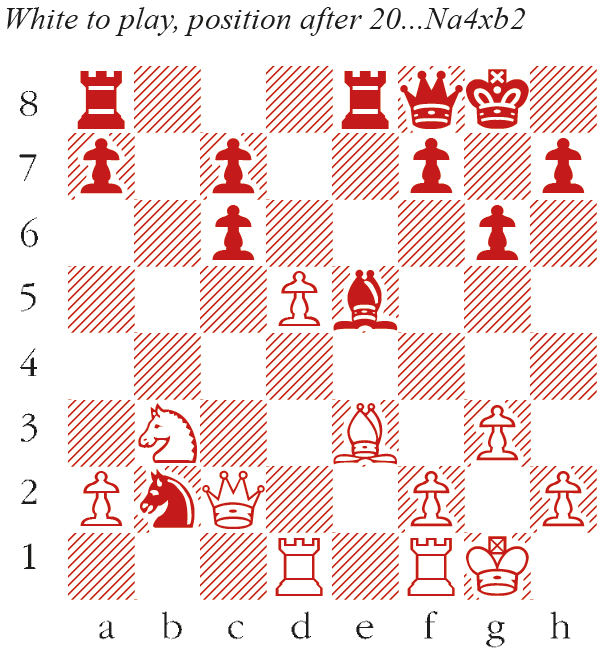
1 e4 e5 2 Nf3 Nc6 3 d4 exd4 4 Nxd4 Nf6 5 Nxc6 bxc6 6 e5 Qe7 7 Qe2 Nd5 8 g3 g6 9 Bg2 Bg7 10 c4 Ba6 11 O-O O-O 12 Re1 Rfe8 13 Qc2 Qc5 14 Nd2 Bxe5 15 Bf1 Nb6 16 Nb3 Qf8 17 Be3 Na4? As everyone knows, ‘a knight on the rim is dim’. 17…d5 was about equal. 18 Rad1 d5 19 cxd5 Bxf1 20 Rxf1 Nxb2? (see diagram) 20…cxd5 21 Rxd5 Nb6 was still ok. 21 Bc5! Qg7 22 Rd4! A powerful idea, trapping the knight.
a5 23 Qxb2 a4 24 Nc1 Ra5 25 Re1 Rxc5 26 Nd3 Rb5 27 Qc2 cxd5? 27…Qf6 was the last chance. 28 Qxa4 c6 29 Rxe5 Rxe5 30 Qa8+ Qf8 31 Qxf8+ Kxf8 32 Nxe5 Rb1+ 33 Kg2 Rc1 34 a4 f6 35 Nd3 Rd1 36 a5 Ra1 37 Rf4 Ke7 38 Nb4 Black resigns






Comments