
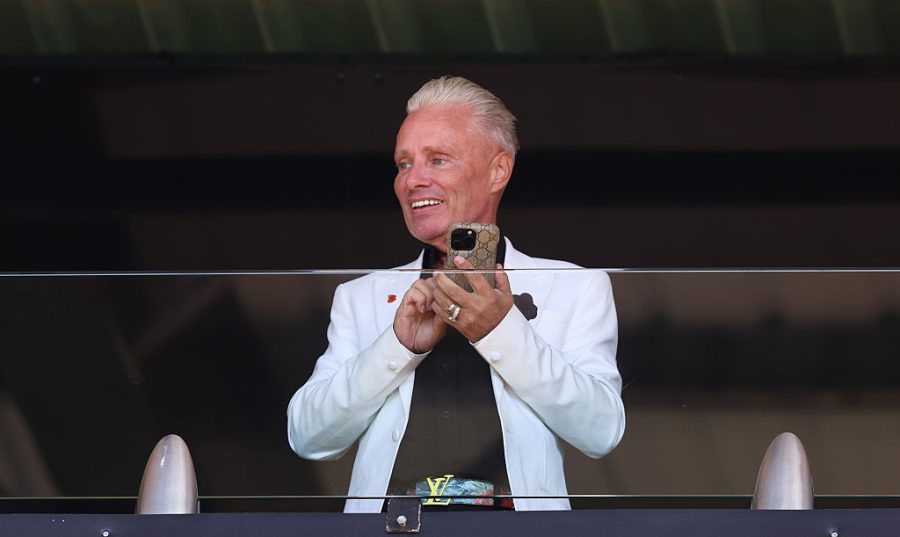
Barrie Drewitt-Barlow, 57, is the man responsible for normalising gay male couples having babies via surrogacy. He is very keen on designer babies and last year it was revealed that he had paid a Miami model £50,000 to be the egg donor for his husband, Scott Hutchinson, 32, ‘to stop our baby being ugly’.
Scott used to be the boyfriend of his daughter Saffron, but the gay couple now also have children together. Between them, they have a number of children born via surrogacy. Both men have now been charged with human trafficking for sexual exploitation, rape, and sexual assault. They have strenuously denied the charges.
I debated Drewitt-Barlow on Woman’s Hour back in 2011; the subject of the debate was surrogacy. I am a staunch critic of what I refer to as ‘Big Fertility’. He, with his then partner Tony, had set up the British Surrogacy Centre that same year. It was a debate that left the famously unflappable late Jenni Murray ‘open mouthed’ – Drewitt-Barlow told a story about how, when someone had praised his children for their good looks, he had replied: ‘Well, you get what you pay for!’
Today, baby farming is a huge, lucrative, global trade
The Drewitt-Barlows launched the British Surrogacy Centre to ‘advise and guide other same-sex and infertile couples through the process’ – signposting them to countries such as Mexico and the US, where commercial surrogacy is legal. When Elton John and David Furnish had their surrogate children, he gushed, ‘the more high profile the people using surrogacy to start their families, the more mainstream it becomes.’

The year before that Woman’s Hour debate, I had interviewed Drewitt-Barlow for a feature I wrote on the exploitative nature of the surrogacy trade. I asked him how the women reacted when giving birth, and seeing the baby before it is removed. ‘They don’t see it,’ he said, explaining that the mothers of his children had to undergo C-sections ‘because I always put it in their contract. I don’t want my children coming out of a woman’s vagina,’ he continued, pulling a disgusted face.
The couple, both wealthy businessmen, pioneered the growing and deeply unethical trend among gay men of using surrogates and other fertility procedures to produce designer babies. Their first children, twins Aspen and Saffron, were born via surrogacy in 1999.
‘We just wanted a child back then and if we could have, we would have fostered or adopted,’ Drewitt-Barlow told me. ‘But we were turned down, so I said, “Fuck it, even if we could legally adopt together, we now never would.”’
The twins were created by extracting and separating the sperm of both men so that Tony would father the male children and Barrie the females. These samples were mixed with a donor’s eggs to form embryos, two of which were transferred into the surrogate’s uterus.
Four years later, the men decided to have another child, and defrosted the last surviving original embryo, which was transferred into the uterus of a different surrogate, resulting in Orlando. However, this embryo had originally split from Aspen’s – which means that, despite the age gap, Aspen and Orlando are biological twins and share exactly the same DNA.
Egg donors are chosen from a catalogue supplied by the surrogacy service. The next time around, the Drewitt-Barlows decided that they did not mind who was the biological father. Both gave sperm samples, and the surrogate they had used for Orlando also carried these two babies.
After their first set of twins had been born, the Drewitt-Barlows successfully challenged the American authorities to become the first gay couple to have both their names on their children’s birth certificates. They became famous for this – and Barrie was almost always the spokesperson.
Today, baby farming is a huge, lucrative, global trade. Among gay men, it is pretty much normalised, and a rising number of single men are now also opting to buy babies. This is thanks in no small part to the Drewitt-Barlows, aided and abetted by the journalists and TV producers who have handed both men a massive platform – and very little critical analysis.
While there is no law against surrogacy in Britain, it is illegal for surrogates to advertise their own services, as is commonplace in the United States and elsewhere. Private surrogacy agreements are not enforceable in British courts, either. This means, for example, that a surrogate mother cannot be forced to hand over the baby if she changes her mind. But such legal niceties pose fewer barriers in less developed countries.
The last time I bumped into Drewitt-Barlow was at a lesbian and gay fundraising event in 2014, he was talking about how lesbians are ‘fat and ugly’, and saying he would never buy an egg from one. The commodification of human beings is the entire project of the surrogacy trade, and it leads to dehumanisation. Perhaps Drewitt-Barlow lost his sight of his humanity somewhere along the way?





Comments