
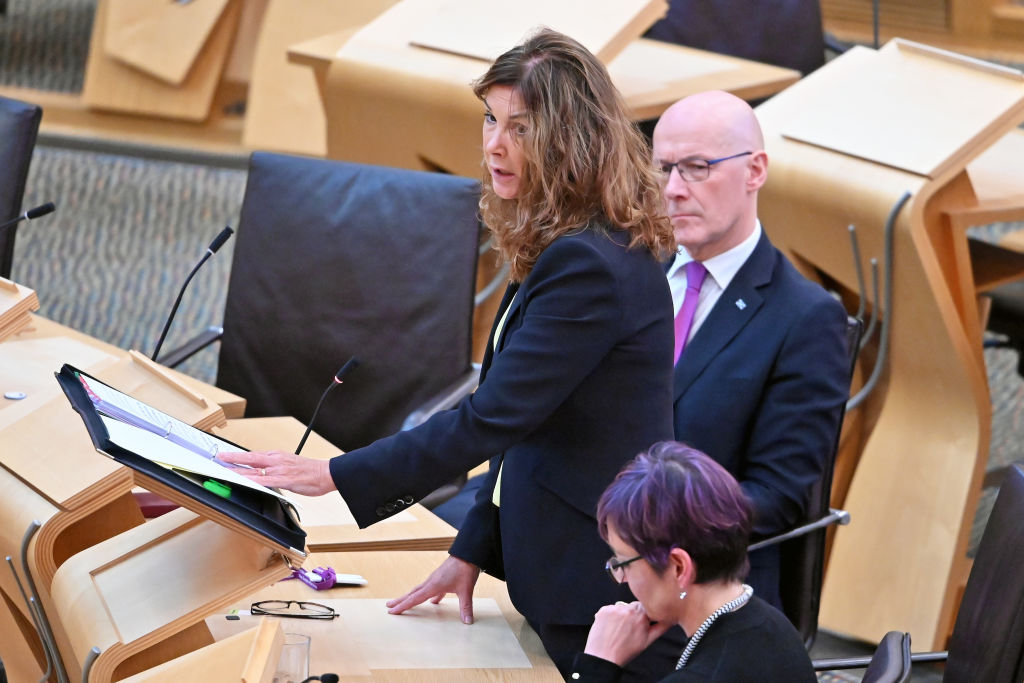
It wouldn’t be Scottish politics if there wasn’t an abstruse scandal that requires a half-hour of background information to explain. So, here goes: Dorothy Bain KC is the Lord Advocate, the title given to the head of the Crown Office and Procurator Fiscal Service. In addition to being the chief prosecutor north of the border, she is also a minister in the SNP-run Scottish Government, where she serves as the top legal adviser.
Bain was summoned to the Scottish Parliament on Wednesday to answer questions about a minute she emailed to John Swinney, who is first minister and therefore head of the ministry in which Bain sits, as well as the leader of the SNP. The memo concerned the upcoming trial of Peter Murrell. Murrell is the former SNP chief executive and estranged husband of Nicola Sturgeon, the former first minister and leader of the SNP. Murrell stands accused of embezzlement of party funds and has yet to enter a plea.
Labour and the Tories are furious about the email, the existence of which was revealed by the Scottish Sun. Much of the anger stems from the level of detail it contained. It confirmed not only the indictment of Murrell and the nature of the charge against him but the date and location of the preliminary hearing and even the exact figure he is alleged to have embezzled to the penny: £459,046.49. Bain also confirmed that she would uphold the non-involvement policy, which means the Lord Advocate has nothing to do with prosecutions that have a political dimension. Communicating her non-involvement might have been reasonable, but the granular detail she provided seems rather – well – involved.

Bain sent the minute, she maintains, ‘to advise Scottish ministers that an indictment had been served’, that ‘appropriate processes had been followed’ (i.e. non-involvement), and ‘to remind them that it would not be appropriate to make any public comment on the matter’. However, she sent the notification almost one full month before key details were made public, spurring the opposition parties to cry foul.
The ordinarily mild-mannered Michael Marra, a Labour MSP, told Bain ‘this absolutely stinks’ and said her email ‘conferred clear political advantage’ on the SNP first minister. The Scottish Tory leader, Russell Findlay, reminded her that she had been appointed by Nicola Sturgeon and said her provision of information to Swinney gave the SNP ‘clear electoral advantage’ in a way that ‘smacks of corruption’, asking her to consider her position. Bain said she was not contemplating resignation, adding that ‘any suggestion that I am corrupt or my position is compromised, I roundly reject’.
There has already been controversy over the decision to grant a postponement, reportedly requested by Murrell’s defence team, which will see a preliminary hearing originally scheduled for 20 February, ahead of the Scottish Parliament election, delayed until 25 May, after that election. The Scottish Government maintains it had nothing to do with the decision to change the timing.
It’s not the first time the office of Lord Advocate has been in the headlines for the wrong reasons. Prior to Bain’s appointment, public confidence was damaged by the malicious prosecutions of individuals connected to Rangers Football Club and the substantial sums subsequently paid out to the victims. The conduct of the Crown Office under James Wolffe, Bain’s predecessor, was called into question in February 2021 during the parliamentary inquiry into the Alex Salmond affair.
It’s not the first time the office of Lord Advocate has been in the headlines for the wrong reasons
Salmond, who preceded Sturgeon as SNP leader and first minister, was investigated for sexual harassment by Sturgeon’s government, but he challenged the process in court and it was found to have been unlawful, procedurally unfair and tainted by apparent bias. He was then charged with 13 sexual assault offences but acquitted of all by a jury at the High Court in Edinburgh. Salmond, who died suddenly in 2024, alleged a conspiracy against him at the heart of government in Scotland.
In the middle of the parliamentary inquiry, the Crown Office contacted the Scottish Parliament to demand it remove a piece of evidence from its website on the grounds that its unredacted publication could breach a court order. Salmond called upon the Lord Advocate of the day, James Wolffe, to consider his position. Wolffe’s resignation was announced three months later, with the Scottish Government saying he had privately notified his intention to resign the previous year.
We needn’t take a position on Dorothy Bain’s decision to send the Murrell memo or the Crown Office’s actions under James Wolffe’s leadership, which is just as well because most of us aren’t privy to enough behind-the-scenes information or decision-making to say anything with certainty. It is worth stating that both are well-respected figures among legal practitioners and commentators and have given many years of public service to the law. But this latest row should put beyond all doubt the need to formally separate the prosecutorial functions of the Scottish state from the political executive of the day.
Constitutional reform should generally be avoided and embarked on only to correct substantive defects rather than in response to optical concerns, but when it comes to the independence of the criminal justice system, perception is a constituent of substance. No matter how diligently or with what propriety a prosecution service goes about its duties, when it begins to lose public confidence in its political autonomy, the ends of justice are undermined. If Caesar’s wife must be above reproach – and in a liberal democracy she absolutely must – the impartiality of the Crown Office has to be a total non-issue in Scottish politics, a matter of such wide and deep consensus that anyone calling it into question instantly identifies themselves as a crank.
That is a high bar to apply to any facet of the state but when the facet in question is the one with the power to compel citizens into a process that will, at best, disrupt their lives and, at worst, cost them their liberty, the bar must be high. Severing the link between the Crown Office and the Scottish Government would also be in the interests of senior law officers. Our highly polarised political culture and the public’s hyper-cynicism towards officials and officialdom make it likely that future appointees to the Lord Advocate role will face similar stretches in this harshest of spotlights. A day might well come when an appointment is declined because of the pressure involved.
A sensible way forward would be to follow the English model of appointing a director of public prosecutions to head the Crown Office and reserve the post of Lord Advocate for a ministerial appointee whom the first minister trusts to provide sound legal advice. If it reduces the volume of complex scandals in Scottish politics, it would be as welcome on those grounds as on any constitutional considerations.






Comments