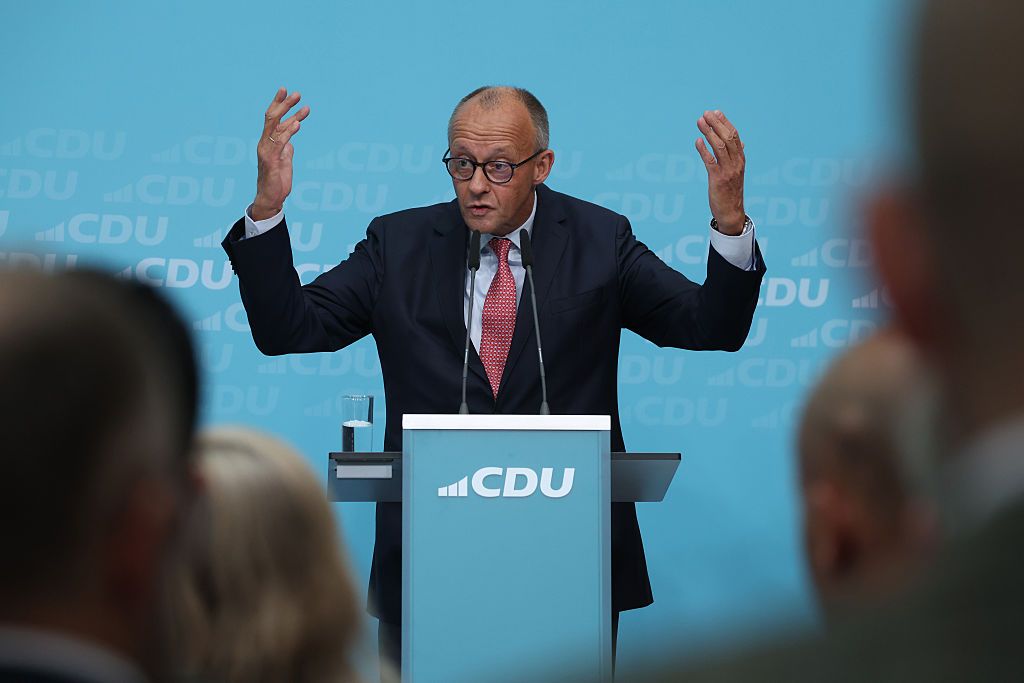
Just two weeks after the Alternative for Germany’s (AfD) victory in the state of Saxony-Anhalt, two more state elections are taking place in Germany this Sunday. Friedrich Merz’s government, already under pressure, is in for more bad news.
Mecklenburg-Vorpommern and Berlin are both heading to the polls this weekend. The former could see yet another win for the AfD, though it remains a head-to-head race between the anti-immigration party and the Social Democrats (SPD). In Berlin, polls suggest that a total of four parties are in the running for the most votes on Sunday, with the socialist Left (Die Linke) leading the Christian Democrats (CDU), AfD and the Greens. But the AfD’s relatively muted showing in this race doesn’t mean the party has had its moment: the capital, which is technically a federal state, has a young population and generally leans more to the left than other areas in Germany.
Sunday’s elections could be devastating for Chancellor Merz
As for the strength of the SPD in Mecklenburg-Vorpommern, that comes down to one person: Manuela Schwesig, the incumbent government leader in the state. While her party is struggling nationwide, Schwesig’s approval ratings remain very healthy. In the immediate aftermath of the AfD’s election win in Saxony-Anhalt, where the party won 43.8 percent of the vote, Schwesig’s team launched a new campaign slogan: “Die Frau gegen blau,” which translates to “The woman against blue,” with blue signifying the color of the AfD.
This strategy, of simply opposing the AfD rather than saying what a candidate actually stands for, backfired on the established parties in Saxony-Anhalt. But, remarkably, it seems to be working for Schwesig – who has kept the race close and even overtaken the AfD in some polls.
Schwesig is popular in her home state, but the political leaders in Berlin are dismally unpopular. A recent survey by Insa revealed that 78 percent of Germans think Merz is not the right chancellor for Germany. SPD party leader Lars Klingbeil isn’t popular either: 51 percent think he shouldn’t be the chairman of his party any longer. And 46 percent believe that the so-called “firewall” that forbids any talks and coalitions between the major parties and the AfD is outdated. It has certainly made the forming of coalitions on the state level very difficult already. The CDU, SPD and the Greens have to contort themselves and bend over backward in order to form governments, especially in the east of Germany where the AfD is strong.
How much longer this firewall can endure isn’t clear. But the AfD’s success in winning over 30 or 40 percent in federal states underlines that the party’s anti-immigration stance has attracted voters from all classes and demographics. What’s more, the AfD is leading in national polls with a gap of up to ten percentage points to second-placed CDU and its Bavarian sister party CSU, while the SPD is floundering around 11 to 14 percent.
Sunday’s elections could be devastating for Chancellor Merz. His party is at around 6 percent in Mecklenburg-Vorpommern, and there is a 5 percent threshold for parties to get into parliaments in Germany. In Berlin, the CDU has made a last-minute candidate change. Kai Wegner, the governing mayor of Berlin, was meant to defend his place in office, but he decided against a re-election bid after it emerged that he had played tennis during a blackout in January in which thousands of Berliners were left without power. He said: “Looking back, I should have said on Sunday what I did on Saturday. Yes, at some point I said: ‘I need a short break, I need to clear my head’ and the best way for me to do that is with sport.”
Instead, the CDU chose Stefan Evers as their candidate. To Evers’s credit, he has done formidable work in getting his party back into the race, but it might not be enough to keep the CDU’s place in Red Town Hall (Rotes Rathaus), the government seat in the heart of the capital. And only a stone’s throw away from that historic building, another political figure – the Chancellor himself – could be falling sooner rather than later.
Merz’s position has never been so weak. Party leaders don’t consider him an effective chancellor and voters seem to be angered by his ineptitude. Merz fought for decades to get his shot at the top job, waiting in the shadows while Angela Merkel, a well-known Merz enemy, was at the height of her power. Now he is in charge of the country, Merz seems surprisingly unprepared. North Rhine-Westphalia’s government leader Hendrik Wüst has positioned himself as a potential successor. The other option could be Bavarian government leader Markus Söder. Wüst, in particular, seems rather fresh and dynamic, but whether he would know how to claw back votes from the AfD remains to be seen.
The importance of these elections, and the rise of the AfD, were thrown into sharp relief on Thursday. Jürgen Klopp, formerly the charismatic manager of Liverpool FC, announced his first national soccer team squad since his appointment as Germany’s head coach in July. He used the widely seen press conference to make a political statement. Klopp said that he didn’t want to cede patriotism “to the wrong people. I don’t know if you can even use that word without it being misunderstood. One could call it positive patriotism.” He added, “Can someone be proud to be German and still be open-minded, diverse and friendly? I’m 100 percent certain, yes.” But while Klopp might speak for parts of the political establishment in Germany, many ordinary Germans disagree with their country’s national manager – and will be heading to the polls on Sunday to make their point.





Comments