
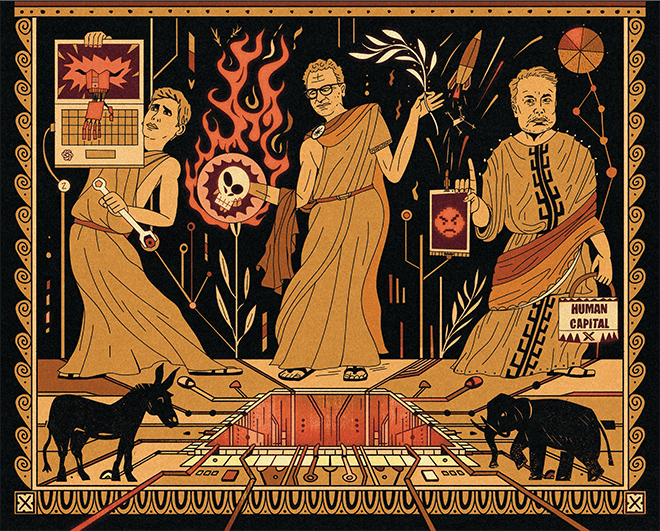
It’s hard to keep up with what might kill us first. A week ago, the tech-bros were competing to tell us that AI might wipe out humanity within a decade. This week, most of Europe seems to be warning about a Russian unconventional attack on the West.
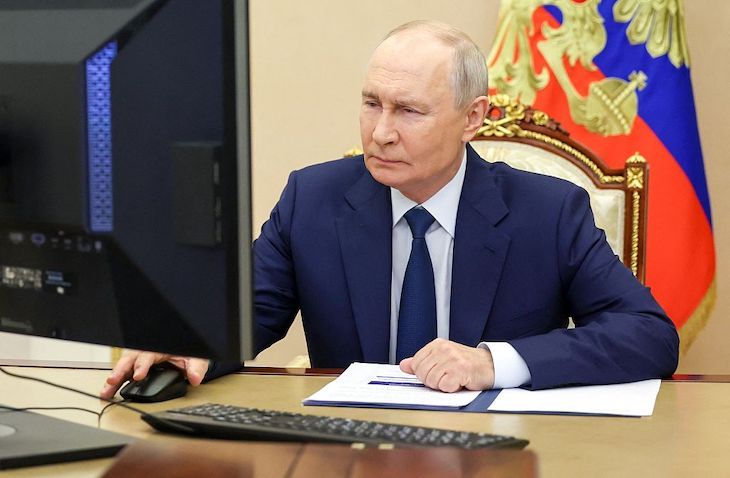
French President Emmanuel Macron today called a meeting of all the political leaders in France to share intelligence assessments of Vladimir Putin’s posture and what appear to be growing aggression from the Moscow machine.
Burnham may not be interested in foreign policy, but as legions of previous prime ministers have discovered, it has a way of becoming interested in them
‘In recent weeks, the Russian hybrid threat against Europeans and against France has intensified,’ he said. ‘The intent is to intimidate us and break our effort to support Ukraine. The result will be the exact opposite. We are not intimidated because we know that our security today and tomorrow is at stake in Ukraine.’
One participant commented afterwards: ‘I have rarely experienced such a profound sense of dread. Dread at the gravity of the situations in the Middle East and Ukraine, and at the predatory madness driving the world towards chaos.’
I know how you feel, mate.
Now the cynic in me (and in several security sources I’ve asked about this) means it is easy to conclude that Macron is trying to embarrass Marine Le Pen with all this. And the National Rally leader emerged denouncing Macron rather than Moscow. But that is to ignore the context of recent events. In a speech on Thursday, Polish premier Donald Tusk gave a speech warning that Russia is preparing to launch drone and missile strikes against countries supporting Ukraine in order to weaken Western support for Kyiv. He said they would pretend these were ‘accidental strikes’ but ones which could nonetheless ‘paralyse’ the targets.
Last Sunday, a Russian drone hit a passenger train near the Ukraine-Poland border shortly after Boris Johnson and David Petraeus had passed through.
Nato warplanes this week shot down a drone that entered Lithuanian airspace, while the FBI warned that Russia is plotting targeted assassinations across the US and Europe, after uncovering an attempt to murder a Russian dissident in Washington DC.
While Donald Trump continues to believe, in the face of all evidence, that he can do a deal with Putin to end the war in Ukraine, his spy chiefs are privately issuing stark warnings to the Kremlin about the dangers of this sort of escalation. CIA Director John Ratcliffe recently made an unannounced visit to Moscow to warn Russia against attacking a Nato member.
From our own government, however, there is a deafening silence. It’s difficult for Andy Burnham or his defence secretary Wes Streeting, to warn the public about the growing threat since the first question any journalist would ask is why, then, they have put off funding the defence spending they have promised until next year.
After meeting Burnham, Streeting and Foreign Secretary Ed Miliband, the Nato secretary general Mark Rutte urged them to set out a path to raise military spending.
A senior government source tells me they did all discuss the ‘shadow war’ with Russia, which still sees Moscow planting warships off our coast and surveying the undersea cables which are Britain’s tech lifeline to the US and Europe.
‘The Prime Minister and Mark Rutte this week had a long discussion on hybrid threats facing Europe and how Europe needs greater join up in tackling such incidents, which continue to gather pace,’ the source said. ‘They agreed it was a clear sign of Putin’s desperation as he continues to lose thousands of troops on the battlefield.’
‘Officials in Whitehall are concerned at how bad this winter is going to be for Ukraine, but momentum is gathering among allies on how the West can ensure it’s the worst winter for Putin’s military machine too.’ Officials are said to be looking at further sanctions and supporting Ukraine to scale up their production of vital weapons and interceptors to degrade Russia’s war effort far from the front lines.
But the fact that Burnham has not invited opposition leaders in for a briefing or made a public intervention by himself contributes to a sense that national security is a bit of an irritant to our new PM, who would rather talk about devolution and the cost of living. See my piece in the magazine this week on the decision to sanction Israel. A former No. 10 Tory remarks: ‘Metro mayors is all they talk about in Moscow!’
Burnham may not be interested in foreign policy, but as legions of previous prime ministers have discovered, it has a way of becoming interested in them.



Comments