
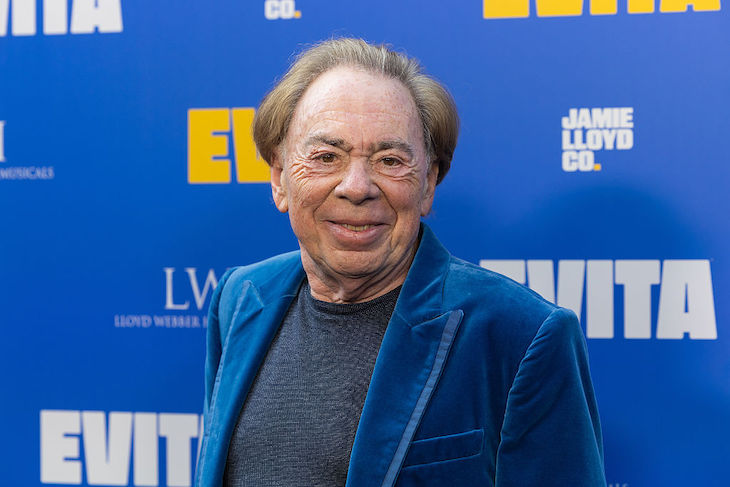
There’s something, I think, very heartening and touching in reading Andrew Lloyd Webber talk about joining Alcoholics Anonymous at the ripe old age of 78. He told the Sunday Times’s Melissa Denes: “I am a recovering alcoholic. Sixteen months ago I decided that I needed help and it’s the best thing that ever happened to me.” He waxes lyrical about his delight in going to AA meetings every day.
There may be some grumbling in AA circles about Lord L-W’s candour
Bloody good on him. Especially given that most people who nurse a lifelong addiction find it very hard to recover by the time they are approaching their eighties – if they stay alive that long in the first place. There may be some grumbling in AA circles about Lord L-W’s candour – the group’s traditions encourage you to keep membership private, for lots of sensible reasons – but I tend to think that he will do more good than harm in this regard. Besides, the age in which we live is not one that the authors of the Big Book could well have anticipated.
For those who still nurture the idea that you have to be a park-bench drinker to count as an alcoholic, for instance, it can only be helpful to have the example of an AA newcomer with a downstairs loo full of Tony Awards, squillions in the bank and a cellar full of £50,000 cases of Chateau Petrus now needing to be disposed of.
For Chateau Petrus or no, Lord Lloyd-Webber’s trajectory, to those of us who’ve had a brush with the stuff ourselves, is piercingly familiar. He realised he was losing a grip on his drinking. He decided to stop. He told everyone he’d stopped. (In Lord L-W’s case, this involved giving interviews to the newspapers, which is a whole extra level of public renunciation.) And then, after a while, bit by bit and in private, he started again.

As many have discovered, the route back out into active addiction is a greased chute; whereas the route back into sobriety is…also a greased chute, except you’re at the other end of it now. And this time, because he wasn’t officially drinking, it all went to worms. As he told his interviewer, he just about got by in his years of drinking openly – “functional” being the word that tends to be used; you’re not a drunk, but a bon viveur – but having got publicly sober, his second dance with the bottle was furtive, isolated, deceptive. “I thought,” he says, “‘But I’ve said to everybody that I’m not drinking.’ So I started to drink secretly.”
“When you’re a wine drinker, you don’t think of yourself as… well, alcoholics drink spirits […] That was the shocking thing for me, when I realised that I was drinking vodka to hide it.” It’s the need to use, rather than what you use, that defines the addict. All the fences Lord Lloyd-Webber erected between himself and the next drink tumbled down – sometimes quickly, sometimes slowly – and he describes well that agony of holding out for the midday starting gun (timing of starting gun, as ever, subject to renegotiation).
What struck me in his description of that daily compromise (he was worried he wasn’t writing, so he loosened himself up with a belt of the good stuff) and of his initial relapse after eighteen months of white-knuckle sobriety (“I started to worry that I wasn’t being creative”) is the connection it makes between addiction and creativity.
God knows, a lot of writers, poets, painters and composers have gone to their graves by heeding variants of the hoary advice that the road of excess leads to the palace of wisdom. The association between drunkenness and creativity – “the best of life is but intoxication”: Byron – is woven through Western culture, from Dionysus onwards. More or less tatty mythologies have been erected on the subject, and whole books written. Olivia Laing’s breakthrough book was The Trip to Echo Spring: On Writers and Drinking. Leslie Jamison’s The Recovering: Intoxication and its Aftermath probed the author’s anxiety that the cost of her sobriety would be the death of her talent as a writer.
Certainly, among writers, addiction runs rampant – De Quincey, Anna Kavan, Dylan Thomas, Patrick Hamilton, William Burroughs, John Berryman and Elizabeth Bishop, Dorothy Parker, Scott Fitzgerald, John Cheever, the two Raymonds (Chandler and Carver), Edgar Allan Poe, David Foster Wallace, Jean Rhys, Charles Bukowski, Patricia Highsmith and on and on and on. A quick Google – classical music not being my special area of expertise – tells me the story is much the same with composers, as I expect Lord Lloyd-Webber is very aware. Painters aren’t exactly a sober lot, either.
We can say, by way of countering the mythology, that the world has contained any number of drunks but very few John Berrymans or Dylan Thomases; any number of smackheads but very few Bill Burroughses or Anna Kavans. Being off your head all the time won’t make you into a genius. It has a much higher likelihood of making you into a bore. Yet, if we’re rigorously honest, we could also admit that many of these addicted writers would have been very different – maybe greater, maybe lesser: we have no way of knowing – writers had they not been using.
The association between drunkenness and creativity is woven through Western culture
And there is a certain fertile loosening of the instincts, a certain sideways approach to the world, that drugs and alcohol can give us. When Falstaff expatiates on the virtues of sherris-sack (“ascends me into the brain, dries me there all the foolish and dull and crudy vapours which environ it, makes it apprehensive, quick, forgetive, full of nimble, fiery, and delectable shapes, which, delivered o’er to the voice, the tongue, which is the birth, becomes excellent wit”) he does not lie. He delivers a dangerously seductive truth.
For as Lord Lloyd-Webber says, “it does slightly liberate you – but then it’s more and more and more”. Writers and composers may need inspiration: but they also need energy. Active addiction will suck that out of you. And as Denes notes in her interview, the sober Andrew Lloyd Webber is “the most productive he has ever been”. Long may it continue. But even if it doesn’t, there are more important things than art.




Comments