
We live in a time of ifs and wills. If Reform and Restore split the right-wing vote in Makerfield, will Andy Burnham win this Thursday’s by-election? If he does re-enter the Commons, will he challenge Keir Starmer for Labour’s leadership? If he does so, will it be a contest or a coronation? If Burnham wins, will he then call an election? And if he does so, will Labour win it?
I cannot go inside Burnham’s head; as Lara Brown has highlighted, there isn’t much in it, except the Happy Mondays. But I can read polls. The two hypotheticals that have been done with Burnham give Labour a slim lead. In our current era of multi-party politics, that could be enough to eke out a slim majority or at least to be the largest party in a hung parliament capable of cobbling together a government. This is before a Burnham-bounce – stop laughing at the back – from a nation rejoicing at Starmer’s departure.

An election would give Burnham the opportunity to seek his own mandate, unshackle himself from a 2024 manifesto that he has publicly dissed and which has proven unworkable in government. It would also be – unless this undisguised rent-a-minister turned municipal bus botherer proves to be a prime minister of Augustan abilities – his best chance of winning before he falls victim to the entropy, events and ennui that do for all premiers in Weimar Britain. Come to the cabaret, Andy!
Yet calling an early election would also be odd. Starmer may have long since spaffed any backbench goodwill available to him, but Labour still have a nominal majority of 160-odd. Prime ministers call early elections when they believe they have a chance of extending slim or non-existing majorities, not when they inherit a landslide. Those MPs that Burnham will soon need to put him in No. 10 will not be keen on a candidate whose first order of duty is to march them towards the guns.
But these are not normal times. Burnham will be aware that Gordon Brown was forever a bottler after he fluffed his best chance of going to the country. Similarly, James Callaghan led the voters to the church and jilted them at the altar in 1978, wasting his chance to see off Margaret Thatcher before the Winter of Discontent. In both cases, they worried they would end up only with Labour as the largest party in a hung parliament. But they would have had a mandate of their own. With Labour’s backbenches as mutinous as they are, how much would worse would be swapping a few washed up social workers and lanyard enthusiasts with red rosettes for their equivalents in the Lib Dems, Greens, SNP or Plaid Cymru?
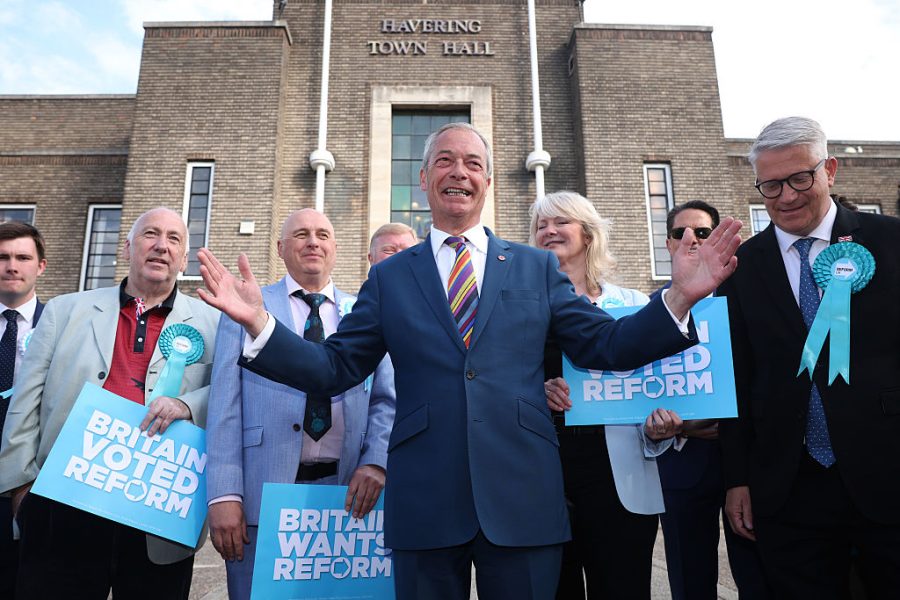
But the most attractive reason for Burnham to go early is the same as that prompted him to stand in Makerfield, a seat where 24 of the 25 wards went to Reform at last month’s local election. An election this autumn would catch Nigel Farage on the hop: candidates unselected, plans for government very far from finalised, his momentum teetering. Even if Reform emerged as the largest party, a victory for a left-wing alliance would be a setback. For the last two years, it has seemed as if Farage was marching towards Downing Street; fluff this chance, and suddenly the nation would be facing three, four, five more years of Labour. Would Farage stick around for that long?
An early election could be disastrous for Reform; in the spirit of A. J. P. Taylor, Farage’s career would have reached its turning point and failed to turn. But in a potential disaster, there might also be an opportunity. Burnham’s popularity could crater as quickly as Starmer’s; his election campaign may prove as self-destructive as Theresa May’s in 2017. Labour’s lead might evaporate, Burnham’s tentative premiership implode, and Farage be packing his bags for Downing Street – a few years ahead of schedule. Even those readers of a Farage-sceptic persuasion might prefer a Reform government to any putative Burnham/Polanski/Davey/Swinney hotchpotch.
But Reform’s critics are right to suggest the party is unprepared for government. Most of the roles of their self-styled Shadow Cabinet remain unfulfilled. Farage is too busy launching his Substack to be thinking of Stepping Stones 2.0. Candidate selection is being taken more seriously than in 2024, but that star team of outsider talents that Reform have promised remains to be seen. England does not yearn for Michelle Dewberry. Would they be as hopeless as Labour?
A Reform government that dissolves on impact with power could be as catastrophic for right as the Liz Truss experiment, doing for mass deportations, scrapping net zero and leaving the ECHR what she did for tax cuts and free markets. Which is why a Burnham victory – for all the natural costs that another few years of left-wingery would entail – might be a blessing in disguise.
A general election would be a clarifying moment for the right
Five more years of Labour is five more years that Reform has to plan and optimise. Five more years to select talented candidates. Five more years to write policy papers. Five more years to work out a succession plan if Farage wants to spend more time fishing. Five more years to absorb the truth that 2031 might the right’s last real chance to win power and fix the country. Mucking it up would be historic national catastrophe. Under Burnham, things will get worse. But giving Reform time would improve their chances of making them better.
A general election would also be a clarifying moment. Reform would end up as by far the right’s largest party. Farage would have 250 or more MPs behind him; the Conservatives would be reduced to low double figures, with a decent chance that Kemi Badenoch would lose her seat. The current uncertainty as to which party is leading the right would be over. With leading Tory luminaries such as Nick Timothy and Neil O’Brien also out, according to Electoral Calculus, the remaining rump would descend further into irrelevance; anyone wishing to influence the next right-wing government would have to hold their nose, do a Danny Kruger and pledge themselves to Farage.
Being leader of the opposition de jure as well as de facto would be a significant achievement for Farage. Then again, with the divisions that have already emerged within Reform’s parliamentary party when they can still be put in a single minibus, 250-odd poorly-vetted, newly-elected Robert Kenyons might prove a combative handful. Expect 30 or so to defect to Restore. But a Conservative Party led by one of the election’s few survivors – a Katie Lam or Jack Rankin, say – might be far more willing to work with Farage than a leader who still believes he can be ignored or overhauled.
All of this is just idle speculation. Obviously, one hopes that if an election was called tomorrow, the electorate would come to their senses and row in behind the Tories and our indefatigable Gloriana. But one must think through all the options, just in case the polls are right and Burnham grows a hitherto unseen pair of cojones. The game commences, for the usual fee, plus expenses.


Comments