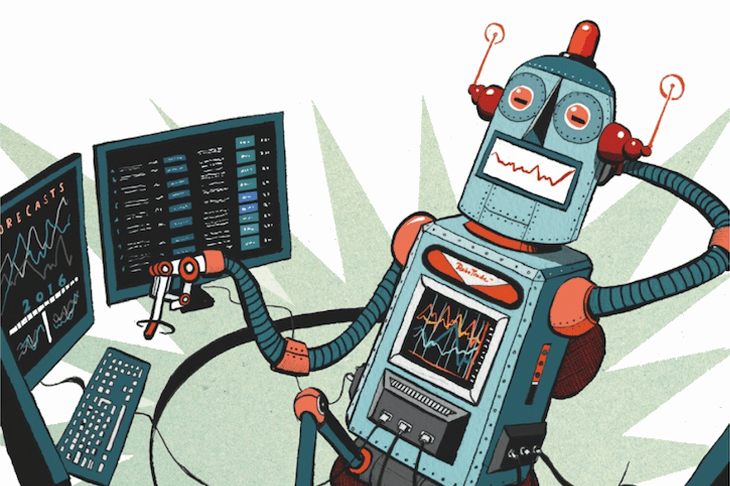
For decades the road to success in the developed world has been straightforward. A university education, increasingly treated as a sort of white-collar trade school, offered people the chance to acquire specialist knowledge which could be used to secure a position lingering at a desk for 40 years. For those of us who grew up watching machines replace men on the assembly line, acquiring a degree was the way to escape this fate. In the digital age, however, the automation of cognitive labor has forced many professionals to confront a threat that once seemed confined to workers on the factory floor.
A new revolt against technological progress might come from the very people who encouraged it when they thought their qualifications placed them beyond its reach
Earlier this week, Gallup reported that 27 percent of US employees worry that technology will make their jobs obsolete. This figure is more than double the 13 percent recorded when Gallup began asking the question in 2017. The educational divide in replacement anxiety has nearly vanished, with educated workers rapidly approaching the 29 percent of non-college graduates who fear technological displacement. While the share of non graduates expressing this fear has nearly doubled since 2017, the share of graduates fearing the same has grown over two-and-a-half times since then. While these figures measure fear and not redundancies, they nevertheless suggest that the college degree is losing its power as insurance against economic change. As late as 2020 the word on everyone’s lips was not “artificial intelligence” but “automation” – something that would primarily affect physical labor. How things have changed. Professionals are now realizing that the future might happen to them as well.
For blue-collar workers, this is hardly an unfamiliar feeling. From the industrial disruption of the 1970s through the battles over NAFTA and a newly-competitive China, workers have had to repeatedly confront the dilemma that the skills they relied on to sustain their families could no longer command the same wages, or even keep them employed. Whether those jobs were lost due to offshoring, automation, or foreign competition, the message was devastatingly clear: a cheaper option was now available, and they were no longer needed. When they complained, these workers were criticized as a hindrance to progress: after all, everyone wanted cheaper goods and more efficient manufacturing. Yet, as communities declined and families were blighted by poverty and addiction, knowledge workers told those left unemployed to “learn to code” – a heedless bit of non-advice repeated so often that it became an internet meme. Now, it appears that it is the knowledge workers’ turn.

As tradesmen work to construct new data-centers and frontier-lab executives warn of the danger that their own products pose, the professional faces a similar dilemma to the coal miner or autoworker decades ago. New technology may enrich the nation while simultaneously diminishing his place in it. The assurance that new professions are likely to emerge, eventually, is cold comfort to a person wondering whether he can retrain himself fast enough to avoid falling into the “permanent underclass.”
The reality now dawning on workers in tech, finance, law, and medicine is something that blue-collar workers have understood for decades. You can follow every step in the process of corporate success and still discover that the market has changed its mind about the value of your labor. Even without mass unemployment, that realization can alter politics. People who are accustomed to advancement may become more defensive when they begin to fear decline. Whether the professional class will respond to that insecurity with greater sympathy for the displaced industrial workers, or insist that their own livelihoods deserve special protection, remains to be seen.
The Rust Belt shows what happens when people lose faith in a system they believed would meritocratically reward their efforts. A professional class that feels similarly betrayed is unlikely to accept its declining prospects gracefully. The next revolt against technological progress might come from the very people who encouraged it when they thought their qualifications placed them beyond its reach. The question they now must ask is whether “learn to code” was ever a real answer, or merely something easy to quip when someone else was the subject of misfortune.






Comments