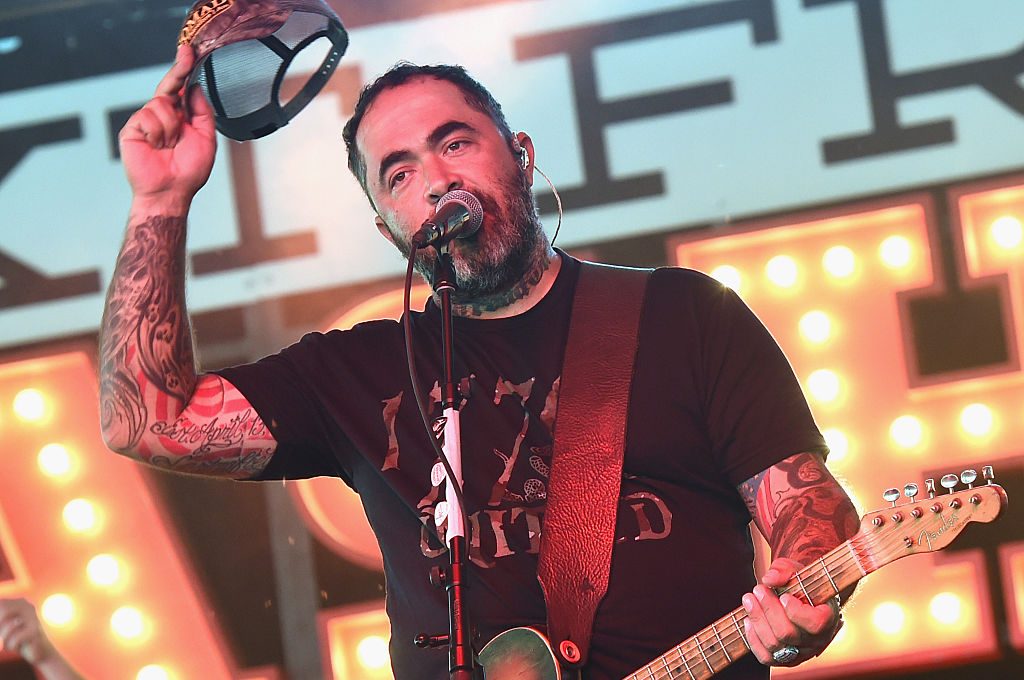
As all regular readers of Culture Shock know, we cover a lot of the goings on in country music. Not only am I personally a fan of the genre, but it is one of the few remaining subsections of art that isn’t outright hostile to conservative and traditional values. There are music executives in Nashville and the corporate media who would like to subvert the genre away from its roots in telling the stories of working-class people and reflecting on the hardships and joys of a simple American life.
There are also a lot of country artists who reject this shift and are committed to retaining the integrity of the genre — including some who choose not to speak about the issue publicly or who talk less about the political element of these changes and more about the genre’s sonic shift toward overproduced pop music.
One man who has not been quiet about his qualms with the direction of country music — and more generally, the country — is Aaron Lewis who, ironically, did not get his start as a country artist. You might know him as the former lead singer of Staind, the mid-1990s to 2000s rock band with hits like “It’s Been Awhile” and “Outside.” With Staind’s record deal coming to an end and Lewis feeling “burnt out”, he decided to embark on a solo career in country music.
His newest album, The Hill, comes out tomorrow. I interviewed him about the album, his songwriting process, politics and the country music industry last month.
“I didn’t want to constantly get compared to what I had just finished,” Lewis said of his shift to country music over the phone from his home in Kentucky. “At the moment I’d gladly finished. I was burnt out. I write real songs about real shit that I have to live and process through every time I sing them.”
Lewis said that country music seemed like the next obvious step for him because, growing up in Vermont, it was the soundtrack to his childhood.
“It was everywhere. Everywhere I was, there was a radio playing country music. Whether it was my grandfather’s car or the house or in the boat. It’s the soundtrack to every single good memory that I have as a kid,” Lewis explained. “So when I was contemplating what I was going to do, it was the only thing that I could go to that wasn’t a complete reinvention of the wheel. It was something that was already in me.”
Lewis’s first single, “Country Boy,” released in 2010, went platinum and earned him two CMA nominations. He had continued success with a mix of original songs and covers of country classics, but really broke out in 2021 with a political anthem that he wrote about wondering if it was he or the rest of the world that had gone crazy. “Am I The Only One” debuted at number one on the Billboard Hot Country chart and at fourteen on the Billboard Hot 100.
Am I the only one who can’t take no more
Screamin’, “If you don’t like it, there’s the fuckin’ door”
This ain’t the freedom we’ve been fightin’ for
It was somethin’ more, yeah, it was somethin’ more
Am I the only one, willin’ to fight
For my love of the red and white
And the blue, burnin’ on the ground
Another statue comin’ down in a town near you
Watchin’ the threads of Old Glory come undone
The mainstream reaction to the song was as predictably idiotic as the backlash years later to “Try That In A Small Town” and “Rich Men North of Richmond.” Mother Jones writer David Corn asked if Lewis was trying to incite another riot at the Capitol à la January 6. Others wrote to his label executive, Scott Borchetta (of Big Machine Records, who is credited with helping to discover Taylor Swift), slamming him for releasing the song. Borchetta, to his credit, replied that his job “has never been to tell my artists what to sing and write about.”
“As much as me and Scott Borchetta do not see eye-to-eye politically, he has never backed down from allowing me the same freedom of speech that anybody else is supposed to have,” Lewis reflected. “There was an open letter written to Scott Borchetta calling for my cancellation and he wouldn’t do it.”
True to form, Lewis’s new acoustic album The Hill contains more of these quintessential protest songs, including “Let’s Go Fishing” and “Made in China.”
“Let’s Go Fishing” is a sort of singalong tune about how to cope when it seems like everything around you is going to hell in a hand-basket. Lewis admits, “I’m not going to try to sugarcoat anything and say that the song’s not political, it’s totally political.” He draws on current events and news stories to get his point across. He points out that expressing patriotism now can get you labeled a white supremacist or a domestic terrorist; but he adds, with a hint of optimism, that what the system is doing to Americans is so blatant and unforgivable that people are going to “snap out of it.”
You got to work two jobs and rob a bank
To put food on the table and gas in your tank
And everybody knows who’s to blame
But I ain’t gonna worry about none of that shit today
So let’s go fishing, let’s go wishing
On a star in the dark in the middle of the night
The world’s gone crazy and the shit ain’t right
Let’s go running a little backwoods-hiding
It’s all so fucked up I can’t stand it
Let’s go Karen, let’s go Brandon
And let’s go fishing
Lewis explains: “Being wide awake allows me to not just see the bad stuff going on. Because I’m paying close attention and because I am wide awake, I’m seeing all the good stuff that’s going on, too. The ‘let’s go fishing’ thing is kind of a reminder to just slow down for a second and take a pause. Take a breath, look around you, see all the things that are going in our favor too.”
It’s a refreshing message as some conservative musical acts who are political activists first and musicians second try to merely cash in people’s hunger for music that speaks to their concerns or values. Of course, Lewis is a legitimate artist, not an outrage farmer. He is not afraid to sing about politics if that’s what’s on his mind, but he’s not doing it for the sake of attracting an audience or drawing controversy. Half of the record is not about politics but “the struggles of a fifty-plus-year-old man,” as Lewis puts it.
In another early release from the record, “Over The Hill,” Lewis reflects on mistakes he’s made in his life, the wisdom he’s gained with growing older and the urge to go back and right his wrongs.
“It’s about life and what I’ve made of my life, the choices that I’ve made and how my choices have affected my life and those around me,” Lewis said. “One thing that I can solidly say is whether it’s political or whether it’s internal, it’s real and it’s honest and it’s raw.”
“Usually when I walk away from a record going, ‘Shit did I say too much? Did I expose too much of my inner workings?’ That’s usually a sign that I wrote a good record and I did what I was supposed to do, which was utilize that opportunity to get some of my innermost, deepest thoughts and feelings out,” he added.
This leads him to his gripe with the country music industry, as the Nashville machine and country radio churn out pop hits that are guaranteed to sell records but don’t say much of anything. As I wrote in the September 2022 issue of our magazine, “You’d be forgiven for thinking that all mainstream country really has to offer is saccharine, trope-filled pop music with a Southern accent.”
Lewis agrees. “It’s such overproduced, bubblegum, meaningless shit. It means nothing. It’s just this perfectly put-together piece of garbage. It’s so well put together that nobody even notices that the song itself is shit.”
“I might be sounding a little bit harsh, but for the most part, there aren’t very many artists out there that expose their soul in the country industry,” Lewis adds. “There’s not very many artists out there that write their own songs. So how the hell are they supposed to expose their soul? It didn’t come from them. It didn’t come from their hurt, their pain or their struggles in life.”
Lewis notes that he hasn’t received much love from country radio since he released “That Ain’t Country” in 2016. The song references country legends and old songs about heartbreak and despair and asks where it all went wrong.
“The only thing that’s making it country is that the person singing it is singing it with a twang. Other than that, there’s not much country about it,” Lewis says of modern country radio tunes. “It’s the program directors that are responsible for having all that stuff dominate the radio, so I guess they took it a little personally.”
Lewis’s success in the industry without the assistance of country radio is proof that the people want an authentic voice and sound. And because Lewis is not beholden to a fickle fan base, finicky radio programmers or a wavering record executive, he says he will never feel compelled to apologize for anything he says in his music, no matter how offended people may claim to be. The only time he ever apologized for something he did in his music career, he tells me, is when he sang some lyrics to the National Anthem in the wrong part of the song. Otherwise, he has no patience for cancellation attempts from the left.
“Mob rule is not the United States of America. Period, the end,” he told me. “To the left, it’s either you adhere to our narrative and our objective or you are an outcast. You have no voice to participate. You have no opinion. You’re a deplorable. And you know what? Fuck you.”
The mob-like behavior of the left is becoming more prevalent within the country music industry as it is infiltrated by artists who fundamentally don’t share the values of their fan base. Maren Morris, a glorified pop singer who recently threw a temper tantrum as she declared she was “leaving” the genre, tried to “cancel” Jason Aldean’s wife for opposing sex changes for kids. She was lauded in mainstream media and continued to get play on country radio, but country fans stood by the Aldeans. Morris insisted it wasn’t she who was wrong, but the fans.
“People are streaming these songs out of spite. It’s not out of true joy or love of the music. It’s to own the libs,” Morris insisted. “And that’s so not what music is intended for. Music is supposed to be the voice of the oppressed — the actual oppressed. And now it’s being used as this really toxic weapon in culture wars.”
Morris is of course welcome to her opinions, but country fans aren’t required to like them, nor are they required to listen to her music. That’s one major difference between the left, that has a near monopoly on the entertainment industry, and singers like Lewis. They’re not trying to force anyone to share their opinions and instead are really speaking on behalf of the silent majority in America who feel like their views aren’t represented in the mainstream — mostly because they aren’t allowed to be. Lewis’s protest music is not directed at everyday Americans who are trying to eke out a living, but the people wielding power who use it to hurt their fellow man.
“The album really lays out freedom in both directions,” Lewis explains. “I don’t care what you do. I don’t care how you live your life, that’s your choice. But don’t impose it upon me. I don’t have to agree. That’s taking it too far.”





Comments