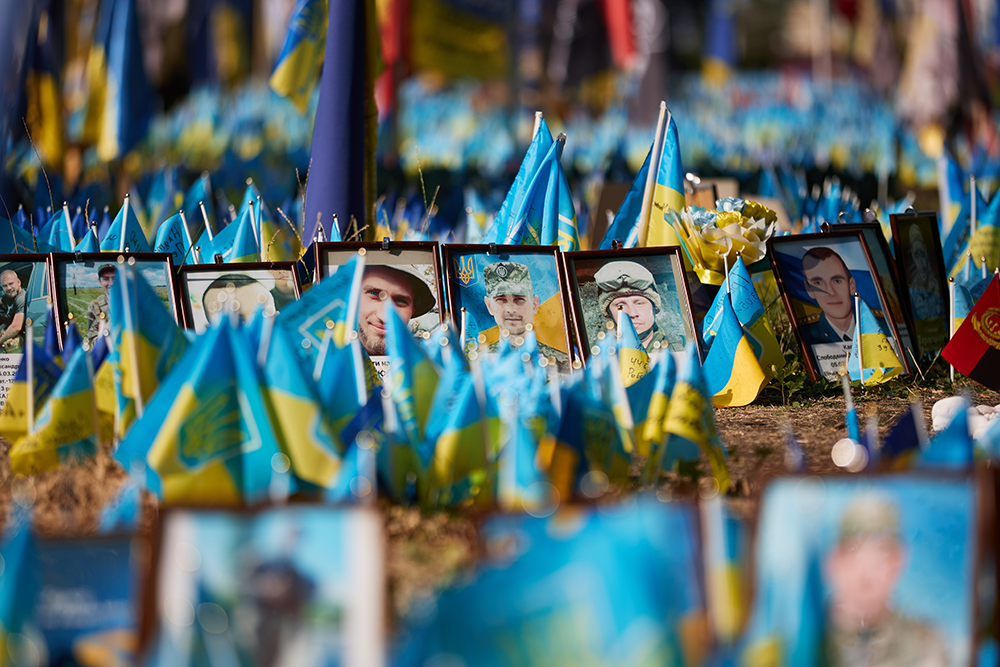
On 3 April we mark 1,500 days since Russia invaded Ukraine; on 11 June, the conflict will have lasted longer than the first world war.
At that point in 1918, the German army was in complete collapse amid the success of the final Allied offensive, as the Kaiser’s disillusioned troops were forced back through the battlefields of the Somme. By contrast, the Ukrainian conflict remains locked in a bitter and bloody war of attrition.
The Ukrainians have displayed an inspiring level of resilience; indeed, in recent months they have made small territorial gains. But the outbreak of war in the Middle East has, for the moment, strengthened Vladimir Putin’s hand. Whereas tightening US sanctions constricted Moscow’s oil revenues last year, the blockage of the Strait of Hormuz has seen demand for Russian oil surge and sanctions eased. Ukraine’s indebted allies are distracted by the energy crisis. Four years ago, Volodymyr Zelensky was fêted as a second Winston Churchill. European leaders pledged to give him whatever he needed to win, for however long it took. For Ukraine today, however, it is all too quiet on the West’s front.
Most popular
Steven Edginton
Invented claims of lynchings and racist violence are irresponsible — and dangerous

Since returning to the White House, Donald Trump has curtailed the flow of weapons to Kyiv and sought to end the war as swiftly as possible. The American President retains a strange partiality for his Russian counterpart. Reports suggest that the Pentagon hopes to divert weapons intended for Ukraine to the Middle East, taking munitions originally purchased by Nato partners for Kyiv. But what Trump misses is that the wars against Iran and Russia are indissoluble fights against a united foe.
While Russia has not openly encouraged Iran’s nuclear ambitions, the two countries remain partners. The Iranian Shahed drones that rained down on Britain’s bases in Cyprus and across the Gulf have long been used to terrorise Ukrainian troops and cities. Moscow is understood to have supplied Tehran with intelligence as to the whereabouts of US bases in the Gulf. As Geoffrey Cain argued in these pages recently, Iran, Russia and China – with North Korea in tow – form an anti-western posse.
Trump has criticised Nato partners for failing to deploy ships to the Strait of Hormuz, arguing that the US is fighting to disarm a rogue state which threatens the civilised world. He claims he is fighting on behalf of the wider West and is owed our gratitude. But Zelensky could argue that Ukraine has been doing the same for four years, at a greater cost.
With their experience of the horrifying new world of drone warfare, the Ukrainians have much to teach us. Teams of their military experts have been dispatched to Qatar, the United Arab Emirates and Saudi Arabia. But what Ukraine offers all of us in the West is something perhaps even more valuable: an example. In the 250th anniversary year of the Declaration of Independence, a country is fighting for its liberty against an empire bent on domination. Putin rejects the very idea there should be an independent Ukrainian nation. Tens of thousands of patriotic men and women have sacrificed themselves to prove him wrong.
Ukraine’s steadfastness in defence of its independence, and its values, should cause other European nations to rouse themselves from impotent squabbling to recover the strength to confront malevolent revisionist powers. Instead of pining for a perfect America to restore a lost world order, they should commit to a stronger defence of freedom.
European countries may lament the impact of Trump’s war on their economies, chastise him for failing to live up to the standards of his predecessors, and fear what the next flare-up will be, following the President’s imposition of tariffs and his threats to Greenland. But for all Trump’s vagaries, he does respect strength; it is the failure of Nato members to match American military spending that has so disillusioned him with the alliance.
Ukraine’s steadfastness should cause other European nations to rouse themselves from impotent squabbling
Britain, in particular, remains alarmingly unable to project strength. Why should Trump listen to Keir Starmer when the Prime Minister cannot explain how he will reach his target of 3.5 per cent of GDP on defence? Or when General Sir Richard Barrons – one of the authors of the recent Strategic Defence Review – believes Britain’s army could only ‘seize a small market town on a good day’? Our posturing remains unserious.
The UK has shown solidarity – with more than 200,000 Ukrainian refugees taken in and housed, and £11 billion in tanks, missiles and drones donated. But the conflict has not accelerated the significant strengthening of our defences now required. As Tim Shipman has previously revealed in this magazine, we are still on track to fall to 21st in Nato on spending on conventional forces as a proportion of GDP, and unable to fight off the air threat posed by Russia.
That Russian threat persists. Ukraine is unlikely to see the sudden breakthrough this summer that ended the first world war. The best way to mark this unhappy anniversary is for the West to reaffirm what we pledged at the war’s outset: to ensure a defiant people eventually triumph over terror, and to so arm ourselves that adversaries know their adventurism will not prevail. Slava Ukraini – now, more than ever.





Comments