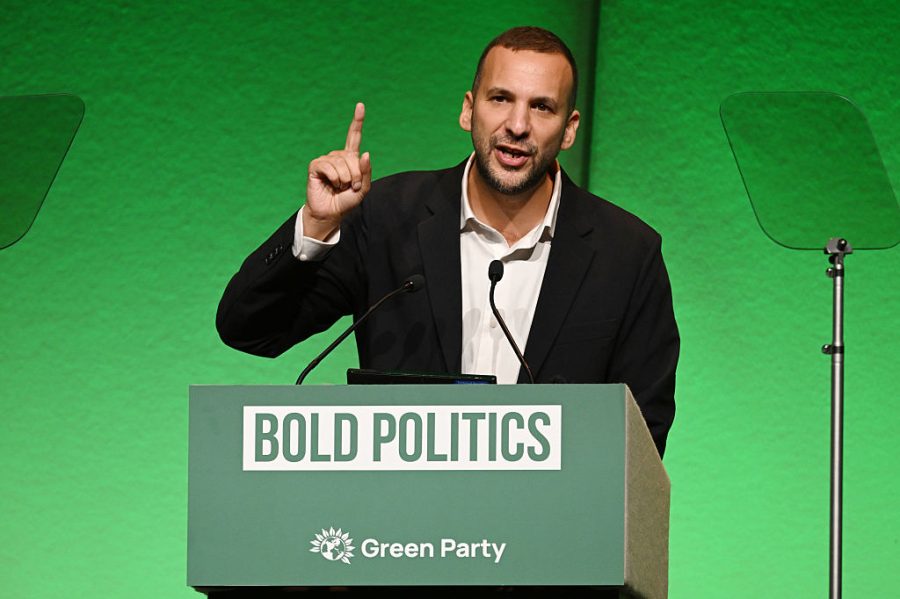
It is remarkable how a country can adjust to diminished expectations. Think of Japan post-Fukushima, or even post-war Britain under rationing. By December 2029, Britain, governed by the Green-Your Party coalition under prime minister Zack Polanski, will have quickly learned how to make do with very little. Let’s wind forward four years.
Four years from now, Polanski’s new government has spent its initial months in power congratulating itself on an historic decision to decommission all North Sea oil and gas sites and accelerate the phase-out of nuclear power. ‘A Christmas gift to the planet,’ ministers call it as they do the rounds on Good Morning Britain, Newsnight and PoliticsJOE.
Yet, energy, it turned out, had been rather useful. Even before the shutdown, British households were straining under high electricity costs. Back in mid-2024, the UK already had some of the highest domestic energy prices in Europe, ranking fourth highest on the continent. Families paying close to 30p per kWh were ready for someone, anyone, to try something different.
Such changes were defended as a cure for the moral rot of consumerism
When the grid began rationing households to pre-ordained ‘usage windows’, the public accepted it with the weary good manners of a people long accustomed to apologising for being inconvenienced. Rooms were lit briefly each evening; entertainment ended once families retired to blankets and solar-powered torches. Officials described this as an ‘opportunity to rediscover low-impact living’.
There wasn’t a sense of panic, only the dull realisation that celebrating Christmas in near darkness may soon become routine. Yet wasn’t this more traditional? Many even envisaged readopting a medieval biphasic sleep pattern – waking briefly in the middle of the night, before dozing off again until dawn.
Meanwhile, Chancellor Gary Stevenson’s wealth tax – a 1 per cent tax on assets over £10 million – pitched as a means of funding the transition to a low-carbon future, has triggered a 1970s-style capital flight, with wealth creators fleeing Britain for the Pearl of the Gulf, the Land Down Under or curiously, Tel Aviv. But who needs the super-rich and their enormous tax receipts anyway? They would surely be more than made up for by Polanski’s managed approach to small boat migration, allowing asylum seekers to work and contribute to the economy as soon as they stepped off the dinghy. Unrelated, festive NHS strikes are brewing amidst concerns about overstretched public services.
Most popular
Steven Edginton
Invented claims of lynchings and racist violence are irresponsible — and dangerous

The fragile pound didn’t react well to Polanski’s new government. As it fell, imported goods rose sharply in price. This is particularly felt that December, when the British tradition of treating oneself to a few foreign comforts – a bottle of something French, a box of Italian pastries or Belgian chocolates – was suddenly out of reach. BBC Good Food, now healthily funded by a triple-locked licence, has exploded with austerity holiday recipes from Nadiya Hussain, rehired by the BBC with great fanfare.
Supermarkets are doing their best, stocking ‘local, seasonal alternatives’, mostly stunted root vegetables displayed in a celebratory manner. Ministers have rationalised this surprisingly as an opportunity to ‘Buy British!’. A Christmas dinner sourced within ten miles of your home sounds appealing, but even for those with vivid imaginations, it was hard to feel festive with a meal consisting heavily of turnips.
Gift-giving has taken on a different character. The government’s ‘circular economy’ has discouraged anything imported or reliant on significant energy to manufacture. Knitted socks and mild chutneys are the best many could muster. People reminisce fondly about the days when the Amazon man would hurl a package at your front door whilst sprinting along the kerb like one of Santa’s reindeer, before the corporation tax receipts finally drove the Bezos billions out of the country.
Such changes were defended as a cure for the moral rot of consumerism. Critics compared it to wartime thrift. The more charitable accepted that there was nothing inherently wrong with less consumer spending – a comfort to the ever-growing ranks of the unemployed.
The Prime Minister’s festive broadcast, livestreamed on Bluesky, is delivered from a Downing Street that looks colder than usual. The streetlamps twitched intermittently. Polanski thanks the public for their ‘patience during the country’s ecological transition’, praising their resilience for adopting simpler festivities. Britain, he says, would soon be a ‘global example of green modernity’. He does not once use the word ‘Christmas’. Nor does he suggest that conditions might improve by the next one. This omission has been noted.
Privately, even some of the most established civil servants have conceded that the energy system had been creaking for years. Old briefing papers, occasionally leaked and briefly discussed in between blackouts, showed that officials had long warned that British industry paid far more than its continental rivals. No one felt any great urgency about this.
What is unsettling people isn’t simply the cold or the darkness, but the speed with which it had arrived. North Sea rigs were dismantled with impressive efficiency; the few remaining nuclear stations went quiet with barely a goodbye. When shortages followed, spokespeople referred to ‘teething problems’ and ‘behavioural adjustment’, as if the flickering lights were more a matter of mindset.
The markets offered no such reassurance. Sterling’s slide had become a regular item on the 1 o’clock news, sandwiched between asylum seeker human interest stories and reminders to stagger appliance use. By Christmas week, economists who enthused about the new economic order on election night are speaking with weary restraint, noting that the exodus from Mayfair and Canary Wharf had accelerated just as wealth taxes and energy costs peaked. It was, ministers said, an unfortunate coincidence – though one that seemed to arrive quite predictably, just in time for a green Christmas.






Comments