Unlike, seemingly every other journalist, I have never been wined, dined, charmed, sued or threatened by Jeffrey Archer, the energetic athlete, teacher, MP, novelist, peer, fundraiser, fantasist and jailbird who died last week. But Archer, in some ways, played an even more outsized role in my life. In 1991, aged 11, I picked up A Twist in the Tale, an entertaining collection of his short stories. And there, in ‘Check Mate’, I encountered sex – or at least the suggestion of sex – for the first time in any medium.
There was a strange wholesomeness to literary sex education
By today’s standards, the scene was relatively innocent. The captain of a local chess club finds himself captivated by a beautiful young woman at a tournament. He invites her home for more games of chess. If she loses, she strips. If she wins, he writes her a large cheque. I won’t spoil the ending, which is no less believable than the rest of the story. But this was heady stuff for a pre-adolescent at an all-boys’ school. Might it be a good idea, I wondered, to swap after-school rugby for chess club? That way, I’d be better prepared if I ever found myself in a regional, round-robin chess tournament with a beautiful woman, a chequebook and an accountant from Woking.
A Twist in the Tale proved a gateway drug. What other filthy gems might be lurking in the bookshelves at home? Song of Songs from the Old Testament? The rest of the Archer canon? The only plot point I can remember from Kane and Abel, Archer’s breakthrough bestseller about the American dream, is Abel Rosnovski rolling around in a lifeboat with Zaphia en route to New York. Might I get to do that myself one day, wondered my thirteen-year-old self? The answer was no.

Archer was a relatively prudish novelist. But it wasn’t long before my friends and I graduated onto harder substances. To our delight, Sebastian Faulks’s Birdsong was a set text at school when we were fourteen. There was a running joke whereby someone would have his copy of the novel thrown on the floor before the start of an English lesson. Without fail, it would land on page 59, ink smudged, spine broken, Isabelle urging Stephen to meet her upstairs in the Red Room. Apparently, Birdsong was also about the trenches in the First World War.
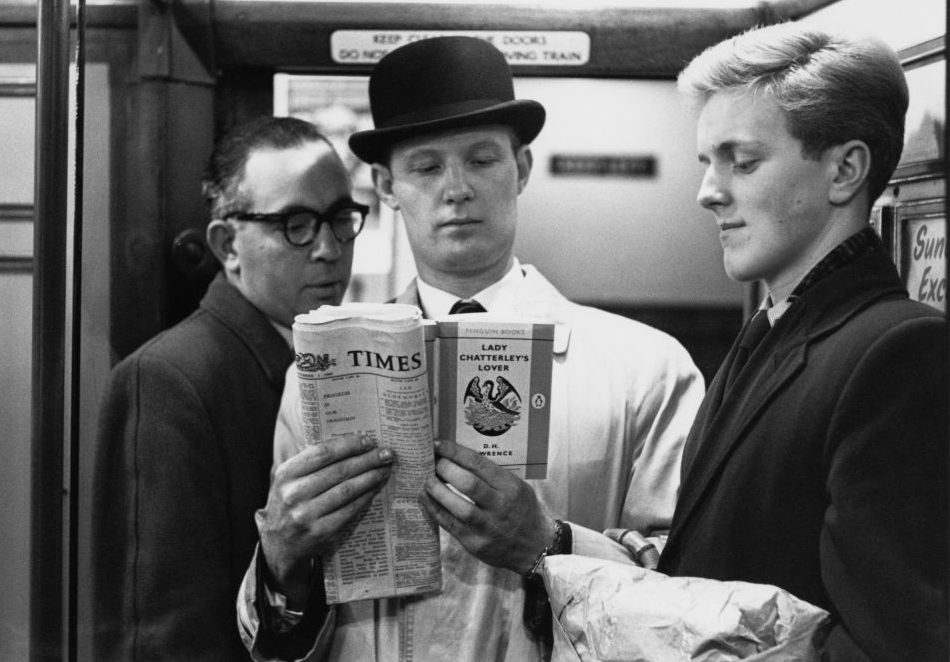
So far, so smutty. But looking back decades later, I think there was also a strange wholesomeness to this literary sex education. It was certainly more engaging and informative than PSHE lessons, which barely existed back then; it was also far less shocking than pornography, which obviously did exist, but was less accessible and ubiquitous than it is today. These scenes were a source of communal amusement and curiosity, not private shame. Even Queen Camilla, it was recently reported, gleefully recalls reading Lady Chatterley’s Lover by torchlight when she was a teenager in the 1960s, hiding the contraband under her pillow. ‘The minute something’s forbidden, you want to get hold of it,’ she said.
There’s an obvious point to be made here, which is that today’s youngsters are far more likely to encounter sex for the first time through more superficially exciting media than the pages of fiction. Their lives are poorer, less imaginative – and probably a great deal scarier – for it. Perhaps they would read more novels if the format retained its near-monopoly on readily available raunch.
Less obviously, in the pre-internet era we accidentally became expert skim readers, able to spot an approaching sex scene a dozen pages before it appeared. Was that a flash of the telltale words ‘hotel room’? A sliver of steamy, stichomythic dialogue? A glimpse of a ‘groan’? Brace, brace, brace! This skill remained useful and transferable, long after the hormones had started to subside. Our attention spans were Stakhanovite, our working memories honed to perfection. We were our own search engines: slow, but reliable, eventually returning a handful of carefully curated results. And in the process, many of us became lifelong readers, sticking with Stephen all the way to the Somme and acquiring what Douglas Murray once teasingly described as one of the best life hacks.
Today, of course, you can Google ‘best sex scenes in novels’ – although I wouldn’t advise doing so at work – and instantly find articles from Pan Macmillan, the Telegraph and the Guardian; a video from The Sun; thousands of blogs; and a long AI summary that starts: ‘The “best” sex scenes in literature vary wildly depending on what you are looking for.’
Therein lies the problem. In the best books, as in the best moments of life, you often have no idea what it was you were really looking for – until you stumble upon it.





Comments