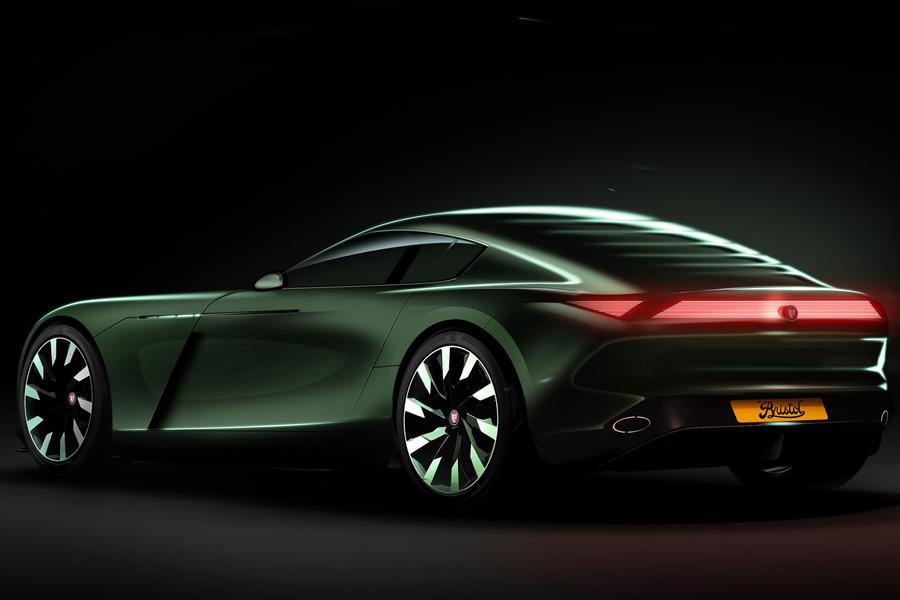
The revival of Bristol Cars is gratifying news. The reborn Bristol is planning to sell five more of the hand-built two-seater Fighter models for close to a million a-piece, it’s been reported, before offering all-new and potentially fully electric models.
Bristols aren’t for everyone, of course. Just look at them. Squint and they could be handsome, but rarely beautiful, I think. A bit like a Habsburg prince, or indeed princess, something about their proportions is not quite right. But I love them. Always have done, ever since I saw Jeremy Clarkson being merciless about the Bristol Blenheim on Top Gear, back in the days when the programme still actually reviewed cars.

And I’m not alone here. Even if the world’s least convincing farmer isn’t a fan, famously, Richard Branson, Liam Gallagher and Bono are or have been proud owners of Filton’s finest. Peters Sellers had one too and perhaps even Tina Turner if the internet is to be believed. And then there’s the fact that they were ludicrously expensive.
Spun out of the old Bristol Aeroplane Company after the war, Bristol never made a lot of cars but that was never the point. What they did make was hailed for its commitment to excellence. Tony Crook, a former racing driver who owned the company for decades before 2002 called the cars a ‘gentlemen’s express’ and set the tone by being altogether sniffy about who he would or wouldn’t sell his cars too. (Rather reminiscent of Basil Fawlty promoting his gourmet night by stipulating ‘no riff-raff’ in the advertising.)
After years of staring dreamily through the windows of the marque’s cramped old showroom on the corner of High Street Kensington and Holland Road – you remember, the place where the illuminated red sign that always had at least one letter in darkness – I finally had my own brush with Bristol when I went to interview its then owner in about 2009 or 2010, not long before they went bust.
He boasted audaciously that their Bristol Fighter model – a sleek gullwinged two-seater sports car that could apparently do 210mph and brought mind a Jaguar E-type mated with a 1990s Mazda MX-5 – was in fact faster than the Bugatti Veyron, then the world’s fastest car. How so? Because at top speed, he said, the Veyron would run out of fuel within 20 minutes whereas his Fighter could keep going…When the chutzpah’s that good you don’t care if it’s true or not.
And I got to test drive a 525bhp Bristol Fighter – one in very bright orange, no less; a car which I calculated had more power than all the cars I’d ever owned put together. Was it good? Better than that – thrilling, even though I could scarcely press the accelerator in West London and had been warned in no uncertain terms not to prang it because it was personally owned by the boss or a close chum of his. Yet that happy hour cemented the appeal, even if I personally leaned towards the stately profiles of Bristol’s deceptively pacy grand tourers, like the 411 from the 1970s, reportedly regarded by some motoring journalists at the time as the greatest cars in the world.
A bit like a Habsburg prince, or indeed princess, something about their proportions is not quite right
Back in the showroom, with its two or three very tightly parked cars, the salesman, Richard Hackett (now chairman of the firm) – blazer and tie, neatly dressed hair, Alan Wicker without the moustache – invited me to get behind the wheel of a second-hand Bristol Britannia.
Now, the Britannia is not obviously beautiful. To imagine it, take a 1980s’ Ford Capri and squeeze it together at either end. But this one was in an eye-catching shade of royal metallic blue and when you got inside – and once Alan swept the door shut – in that moment you got it.
The visibility – permitted by those slim frames that also made it look a bit odd – was remarkable and you could see precisely where the bonnet ended; whoever had designed the car knew their business. And with your hands on the delicious steering wheel you felt a like god. I almost bought it there and then.
Which would have been absurd since it was £25,000 (rather a lot for 25-year-old-car even then) and I was a penniless heck living in London with no off-street parking. But that didn’t stop me wasting quite a lot of my employer’s time in the coming days trying to work out how I could possibly afford it. In fact, I still wish I had. Could I have dispensed with my flat and lived in it like Maggie Smith? But this helps explain the secret of Bristol’s sometimes beguiling appeal. And if like avocado in the 1970s, they are an acquired taste then once you’ve acquired it you never look back.
Like tailors on Savile Row, Bristol offers something uniquely different and British in an otherwise vanilla world of beige cars. Like Morgan, they are, among the last survivors of the generation of plucky, idiosyncratic car companies that emerged in the first half of the twentieth century. The Wolsleys, the Alvises and the Gordon-Keebles (okay, they date from the 1960s) have all gone, but Bristol survives.
It’s therefore good to have them back. Let’s hope that after several failed attempts that this time Bristol really does get off the ground. Because like the Ravens at the Tower of London, a world without the gentlemen’s express unthinkable.





Comments