
Just under a month after three drones were discovered in quick succession at Leipzig airport, the German government took the unexpected step of publicly naming the country behind the incidents. Standing alongside foreign minister Johann Wadephul on Tuesday afternoon, the German minister of the interior, Alexander Dobrindt, announced: ‘The German government has concluded that Russia is responsible for the hybrid attack in Leipzig on 4 August.’
According to Dobrindt, the German government was able to conclusively determine Russia’s involvement thanks both to a police investigation and findings made by the intelligence services. The incidents, he said, also bore the hallmarks of previous hybrid attacks attributed to Russia – both in terms of the type of drones used and the fact that ‘low-level agents’, potentially hired remotely via the internet, were tasked with carrying them out. With high numbers of diplomats and envoys expelled by various European governments following the invasion of Ukraine, Russia has increasingly relied on untrained third parties, recruited remotely, to carry out such acts.
Leipzig pushes the boundary between Russian chaos-sowing and strategic sabotage
The details of the incident on 4 August are alarming. The first drone, equipped with an explosive device, was found at Leipzig close to an Antonov cargo plane. Expressing solidarity with the German government yesterday, EU chief Ursula von der Leyen confirmed that the explosives found on the drone were ‘military-grade’. Only a faulty detonator stopped it from exploding near the plane – believed to have been carrying ammunition for Ukraine – and causing huge damage or loss of life. A second drone is believed to have collided with another cargo plane nearby, while a third drone was found near the airport ten days later.
In response to the findings, Dobrindt and Wadephul announced that the last Russian consulate in Bonn would be closed, as would the Russia House cultural centre in Berlin. The German authorities have long suspected that both venues have acted as hubs for the Russian spies in the country. Closing them down will hamper Moscow’s espionage and propaganda efforts.
Wadephul additionally announced a tightening of entry controls for Russians looking to enter Germany on short-stay visas, as well as plans to restrict the freedom of movement until now granted to Russian diplomats. He also vowed to increase pressure on Russian shadow fleet oil tankers passing through German waters in the Baltic sea.
The fact that Germany has identified Russia as being responsible for these drone attacks is unsurprising. After all, there have, by some counts, been approximately 200 cases of sabotage and other hostile activities attributed to Moscow across Europe since Russia invaded Ukraine in 2022.
What is noteworthy is that the government of Friedrich Merz has chosen to accuse Russia publicly. Trailing the government response last week, the Chancellor said that the perpetrators of the attack ‘will pay for this’. Having talked up Tuesday’s announcement, Merz was, in the event, not present to hear Dobrindt and Wadephul point the finger at Moscow. This is supposedly so Berlin can keep its powder dry and leave room for a harsher response as and when more Russian hybrid attacks come – but it doesn’t help the perception that has formed in Germany over the past year or so of Merz having a propensity for being full of hot air.
Merz’s decision to publicly name Russia reflects the escalation in the greyzone warfare that Moscow is carrying out on European soil. For several years now, the Kremlin has sanctioned sabotage activity abroad as a way of sowing chaos and spooking the populations of countries supporting Ukraine, ultimately attempting to create pressure on Europe’s governments to drop aid for Kyiv.
The Leipzig airport incident, however, pushes the boundary between Russian chaos-sowing and strategic sabotage. Leipzig is an important European freight hub, including for deliveries of military and humanitarian aid for Ukraine. A successful attack on the airport would have disrupted far more than supply chains to Kyiv. It has already, in the past, been the target of suspected Russian-linked sabotage attempts – most notably in July 2024, when a package held at a DHL facility at the airport caught fire. Back then, however, the government of Merz’s predecessor Olaf Scholz resisted any public accusations.
Germany’s decision to point the finger has, this week, triggered a huge swell of support from allies in Europe and further afield, also willing to accuse Moscow by name. Canada’s Mark Carney called the attack an ‘egregious attempt by Russia to weaken our resolve and our collective defence’. Nato chief Mark Rutte, meanwhile, spoke of an ‘increase in malign activities’ and declared that ‘the dangers Russia poses are clear’.
The Kremlin, meanwhile, has reacted swiftly, promising a ‘mirror image response’. Russian foreign minister Sergei Lavrov today announced that all three branches of the German Goethe Institut cultural hub would be shut down in Russia. There is every chance the government will also force the closure of the German consulate in St Petersburg.
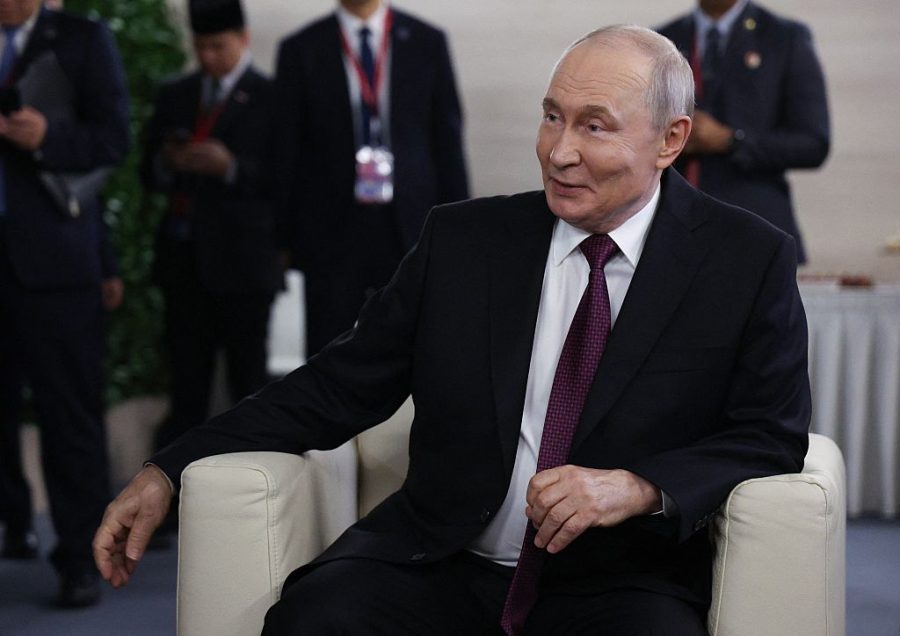
Speaking at a summit in Kyrgyzstan on Tuesday, Vladimir Putin called Germany’s finger-pointing ‘a grave mistake’. ‘Where is the evidence?’ he challenged, before claiming Berlin’s announcement was an attempt to influence the outcome of elections happening in the east German state of Saxony-Anhalt this weekend.
The Russian president will be very well aware of the somewhat contradictory mix of fear and sympathy that exists in attitudes towards Russia in the former east Germany. The far-right Alternative für Deutschland party, currently on track to emerge as the largest party following Sunday’s vote, has consistently exploited this feeling to pedal an anti-establishment, anti-Ukraine and Nato message. The fear among voters that the war in Ukraine could spread to Germany is far more potent than in other European countries, or indeed Britain.
Von der Leyen yesterday called attacks such as the one at Leipzig airport ‘the new normal’ for Europe. ‘We must step up,’ she added. Russia, it appears, is certainly becoming more reckless about the risks of bringing violence to Nato territory. But does this week also mark a different kind of new normal for Europe? One in which its leaders feel braver and bolder about calling out Putin’s aggression against their countries? It almost certainly won’t be long before we find out.





Comments