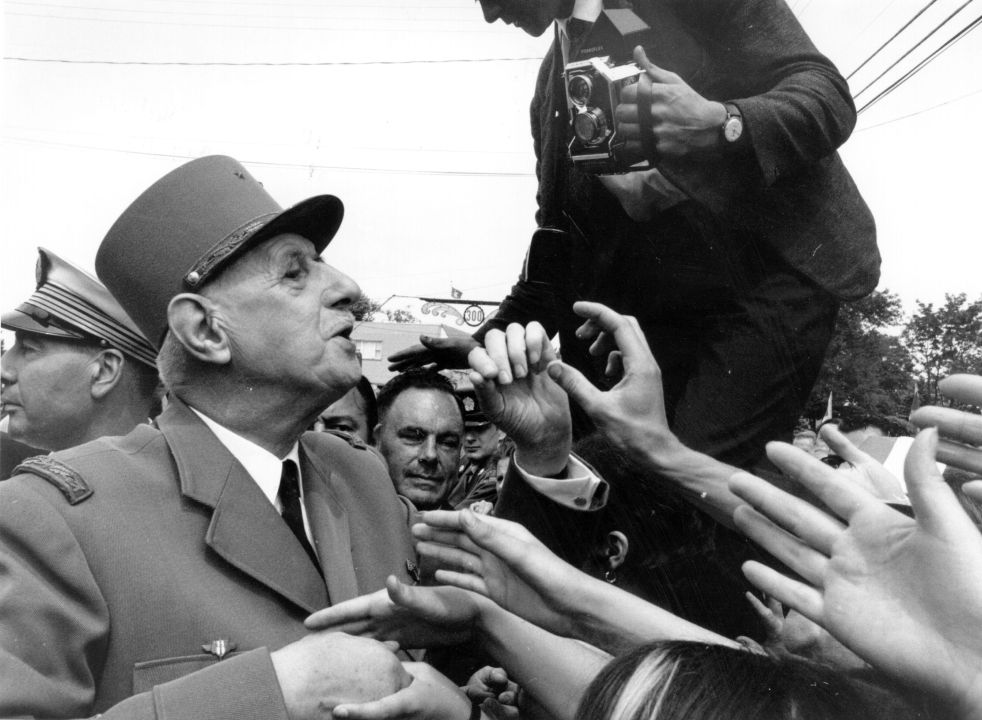
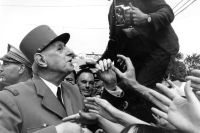
It turns out that this summer’s cinematic hero is not Spiderman or even Odysseus, but the French wartime leader Charles de Gaulle who has knocked both Marvel and Homer into a kepi (the French military hat he favored).
De Gaulle, a two-part, six-hour epic directed by Antonin Baudry has been a surprising hit in France and is in demand from all the major international markets, including those of Latin America, India and China. The buzz is remarkable for a foreign-language film starring a person who, although a national hero in his homeland, is not a global household name.
How has this happened? Firstly, although the wartime story of the stubborn and solitary General is admittedly a cracking tale, the $85 million production has been marketed in a way unusual for historical epics. After a slow start, producer Pathé dumped its usual promotional methods and went wholly digital first. Pathé connected with YouTube influencer Inoxtag, who hosted De Gaulle “watch parties” and discussions with Baudry, and also TikTok’s Spotlight Hub, which pushed reviews and trailers to a young audience, and latterly reposted on FilmTok. This paid off; in France, some four weeks after the opening weekend, admissions were up by 114 percent. Cinemas have been packed with young people lapping up de Gaulle and his penchant for belted uniforms, Citroëns and Gitanes.
The other reason it’s done so well with la jeunesse is because de Gaulle (wonderful Simon Abkarian) is portrayed as a politician for today, not a dusty, faded figure. Baudry shows him as a radical, funny and above all independent man on a journey more interesting (and certainly as tough) as fictional trips belonging to either Spiderman or Odysseus. The tone of the film – which does not cover de Gaulle’s later Presidency and his problematic handling of both the Algerian crisis and the May ’68 student uprisings – might be seen as hagiographic. But can you blame Baudry? The war years are de Gaulle’s finest, and there was a nation’s fate at stake.
Louis XIV may well have said “L’Etat, c’est moi”; but when Germany invaded France in June 1940, it was de Gaulle, a junior minister in the French government for all of 12 days, who assumed the role. Shamed by French capitulation, and powered by almost superhuman personal conviction, de Gaulle boards a small plane, and accompanied only by his aide-de-camp, a single pair of trousers and four shirts, flies to London. Upon arrival, over dinner at a colleague’s London residence, his hostess asked him how long his mission would take. “Madame,” he replied, “I am not here on a mission. I am here to save the honor of France.”
I have traveled throughout the French overseas departments and territories, each of which has a Boulevard Charles de Gaulle
I have been deeply enamored with the General (never Monsieur de Gaulle), for a long time. I find it a thrill to acknowledge those initials, CDG, on air routes destined for the French capital; when in Paris, I always pay tribute to his striding, uniformed statue on the Champs-Élysées. I have traveled throughout the French overseas departments and territories, each of which has a Boulevard Charles de Gaulle. The General and I are possibly the only people to have visited all of these far-flung places, although unlike him I did not travel with a carpenter commissioned to make a bespoke bed at each stop since I am not two meters tall. The deeply formal General had a family life, although he always addressed Madame de Gaulle as “vous”, and was apparently never seen undressed, or indeed, without a tie. There is a moment in the first film where I had to cover my eyes, since it shows the General in the bath. An artistic step too far, surely.
At the first screening in the UK, at the Institut Francais in South Kensington, we dressed up for the occasion; my husband (who is also two meters tall), wore a tie. I am encouraging him to address me as “vous”, although I think I may have some way to go on this. As well as formal, de Gaulle was chronically frugal. As President, he stumped up for not only his own electricity bills but also the cost of having his grandchildren to tea at the Élysée Palace. Compared to the excesses of politicians today, (building their own ballrooms, commissioning planes, triumphal arches, etc.), de Gaulle’s parsimony is notable.
And while we are on the subject of America, perhaps another reason why the film resonates is because it shows a politician who refuses Washington’s thrall. De Gaulle was extremely wary about the US styling itself as a super power; after the war, he insisted on France having its own nuclear deterrent, withdrew France from the integrated military command of NATO and encouraged Europe to keep out of American interventions such as Vietnam.
He died at La Boisserie, his austere country house in the small village of Colombey les Deux Églises . He stipulated he was not to have a grand funeral. The coffin, draped in the Tricolore, was carried by 12 local young men to the tiny village church. Meanwhile 250km away in Paris, the bells of Notre Dame tolled for a requiem mass attended by President Nixon, the (then) Prince of Wales, Harold Macmillan and Anthony Eden, alongside other leaders from over 80 nations.
Not for de Gaulle a giant monument in The Pantheon. He is buried in Colombey at the local church beneath an unadorned stone which simply reads “Charles de Gaulle 1890-1970″. The only indication to his life’s work is the Tricolore which always flies there.


Comments