Parisians have suffered through four scorching heatwaves this summer, but none compares to the deadly canicule of early August 2003 when temperatures reached 40 degrees. About 15,000 perished in France during that heatwave, most elderly and frail and living alone in sweltering apartments without air conditioning.
One of them was a 93-year-old English lady with a famous name. Diana Mosley, one of the glamorous Mitford sisters, had been exiled in France for more than a half-century. When the heatwave struck Paris in early August ’03, she suffered a slight stroke. The intense heat relentlessly persisted for ten days, hitting a peak of nearly 40 degrees on 11 August – the day Diana Mosley finally succumbed in her Left Bank apartment.
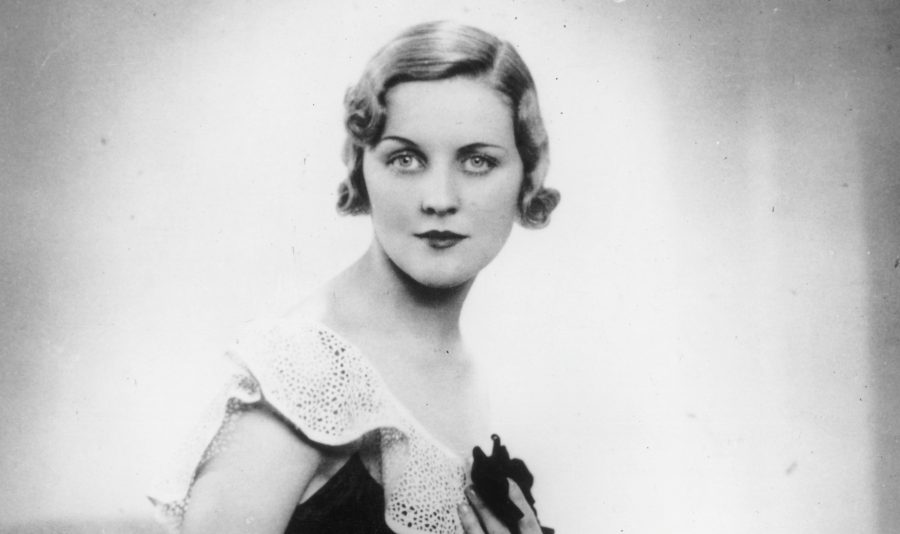
Her death was a sad end to a colourful and turbulent life that spanned the previous century. Born into the English aristocracy in 1910, Diana Mitford (nicknamed ‘Honks’ by her sisters) was the most dazzling beauty in London’s Bright Young Things set in the late 1920s. Famous for her porcelain skin, wide smile, and icy blue eyes, she spoke with the archaic ‘Mitford accent’, characterised by a languid drawl, clipped vowels and swooping cadences. Novelist Evelyn Waugh was madly infatuated with Diana and dedicated his 1930 novel Vile Bodies to her ‘with love’.
Once admired as the most beautiful woman in England, Diana was now the most hated woman in the country
At 18, she married brewing heir Bryan Guinness, later Baron Moyne. The charmed couple stayed in Paris at the Guinness family’s sumptuous apartment in Rue de Poitiers. The marriage ended suddenly when Diana, a young mother of two small boys, deserted Guinness for Sir Oswald Mosley. Her affair with Mosley (whom she called ‘Kit’, though he was known to friends as ‘Tom’) swept Diana into the tumultuous sphere of fascist politics. Along with her rebellious sister Unity Mitford, she passionately embraced fascist ideology, visited Nazi Germany, and became a close personal friend of Adolf Hitler. In 1936, Diana and Mosley were secretly married in Berlin at the residence of Joseph Goebbels. Hitler attended the ceremony and presented Diana with a photo of himself in an eagle-emblazoned Nazi frame.

After Britain declared war on Germany, Diana and Mosley were arrested and incarcerated in Holloway prison. At age 30, she was separated from her newborn baby, Max Mosley, whom she was still breastfeeding, and her toddler Alexander Mosley (her two boys with Bryan Guinness were away at school). Once admired as the most beautiful woman in England, Diana was now the most hated woman in the country.
After the war, the Mosley couple moved permanently to France. The choice of Paris was in part sentimental. Diana had been schooled at Cour Fénelon in Paris and had her first romantic dalliances in the French capital. The move also belonged to a tradition for illustrious figures in Britain driven by infamy into exile in France. Oscar Wilde had fled scandal to Paris where he died in 1900. When the Mosleys arrived in 1950, the Duke of Windsor and his American wife Wallis Simpson were already living in exile in France.
They became close friends of the Duke and Duchess whose country estate Moulin de la Tuilerie south of Paris happened to be near the Palladian-style pavilion purchased by the Mosleys. The Windsors and Mosleys had much in common. Both couples were married in scandalous circumstances, both were suspected of Nazi sympathies, and both had met and cultivated Adolf Hitler.
The Mosleys actively entertained at their French country house, called Temple de la Gloire, and built a social circle of writers and artists. They were pariahs in official British circles, however, and banned from functions at the UK embassy in Paris. Diana kept busy by writing book reviews in the British press and published her memoirs in 1977. She also penned a biography of Wallis Simpson with whom she spent many hours when the Duchess of Windsor was on her deathbed in Paris.
Diana outlived everyone around her, including Oswald, who died in 1980. Following his death, she remained at the Temple de la Gloire but with creeping old age and deafness (and the removal of a brain tumour) she found it increasingly difficult to remain in a large house outside of Paris. In the late 1990s, she moved into the city, taking an elegant apartment in Rue de l’Université in the affluent seventh arrondissement – a stone’s throw from the Paris residence where in her dazzling youth she had stayed with her first husband Bryan Guinness.
In her final years in Paris, she gave interviews about her life and attended art exhibitions with her loyal factotum, French writer Jean-Noël Liaut. He was the biographer of fashion designer Hubert de Givenchy from whom Diana bought her smart outfits until the end of her life. She also immersed herself in French novels, especially Flaubert and Proust, which she read in French.
Diana remained devoted to Oswald Mosley’s legacy, and was stubbornly unrepentant about her admiration for the Nazis. ‘They’ll go on persecuting me until I say Hitler was ghastly,’ she said in an interview towards the end of her life.
She survived most of her Mitford sisters. Unity, who had attempted suicide by shooting herself in the head, died at age 33 in 1948. Novelist Nancy, who like Diana spent most of her life in Paris, died in 1973, followed by journalist Jessica in 1996. Only Deborah (called ‘Debo’) survived Diana. Married to the Duke of Devonshire, Deborah died in 2014.
Diana did not live to witness the tabloid sex scandal surrounding her son Max Mosley, who died in 2021. Her grandson Louis Mosley, son of Alexander Mosley, today is chief executive of American firm Palantir’s UK division.
After 53 years of exile in France, Diana Mosley finally returned home permanently. She was buried in the St Mary’s churchyard in Swinbrook, near Asthall Manor where the Mitford sisters were brought up in Oxfordshire. Her gravestone stands next to the headstone of her infamous sister Unity. It reads, ‘Diana Mosley, née Mitford, 1910-2003’.



Comments