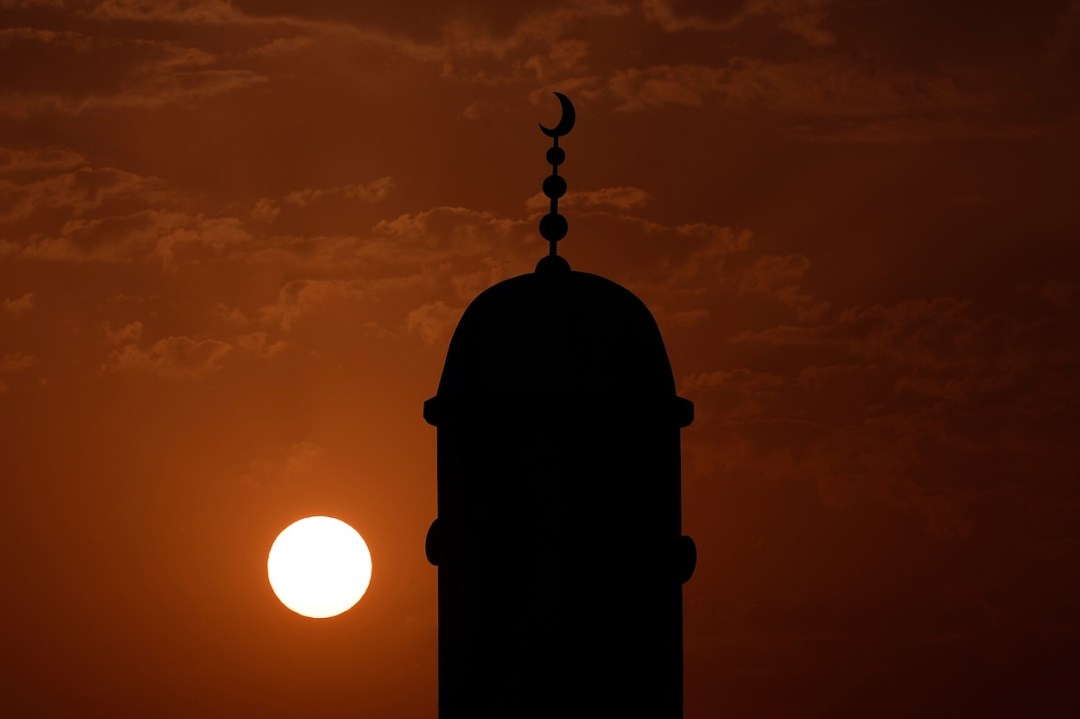
Another mosque in France has been shut down, this one in a bleak north Paris suburb that usually makes headlines for criminal gangs and drug trafficking.
The Attaqwa mosque, surrounded by council housing and warehouses in a grim section of Aulnay-sous-Bois, was closed by authorities this week for allegedly propagating radical Islamist ideology and inciting terrorism. Videos posted on social media also showed an imam at the mosque exhorting Muslims to strike their small children if they don’t pray.
The mosque’s closure is the latest salvo in the French state’s decade-long campaign against extremist imams whose inflamed sermons are promoting jihad and glorifying martyrdom on French soil. The crackdown began following the wave of terrorist attacks that struck France throughout 2015. In November that year, 130 people were slaughtered in Paris, most of them gunned down while attending a rock concert at the Bataclan theatre.
The government immediately shut down three mosques, including two in Paris, as well as four clandestine prayer rooms in Nice. Surveillance of mosques and Muslim associations was also intensified, and deportation orders let to the expulsion about 200 radicalised Muslims including 40 foreign imams.
‘We cannot lose this war because it’s fundamentally a war of civilisation,’ declared then French prime minister Manuel Valls. ‘It’s our society and our civilisation that we are defending.’
The war turned out to be a long and frustrating battle for the French state. Five years later, another wave of Islamist attacks shocked the nation. In October 2020, a radicalised Muslim decapitated French high school teacher Samuel Paty in broad daylight. A mosque in the Paris suburb of Pantin was accused of playing an instrumental role in Paty’s murder by sharing a video on social media that incited hatred towards him. The mosque subsequently expressed regret over the video and condemned the killing. Two weeks after Paty’s death, in Nice, an Islamist terrorist stabbed three people to death in a church.
The French government ordered a fresh crackdown on 76 mosques throughout the country. The mosque in Pantin involved in Paty’s murder was closed. France’s interior minister warned that mosques serving as ‘breeding grounds of terrorism’ would be shut down. Nearly 25,000 mosques, Muslim associations and schools were subject to inspections and controls. Several hundred of these organisations were shut down, including 20 mosques and prayer halls.
The deeper question behind these battles is the compatibility of certain forms of Islam with French society and its values. For the French state, its legal powers to control extremist mosques are at stake.
Historically, the French Republic faced the same tensions with the Catholic Church. The French Revolution confiscated Church property and subordinated the clergy to the state. At the end of the nineteenth century, the Third Republic accelerated the secularisation of French society by removing religious instruction in the school system. In 1905, the famous ‘laïcité’ law separating church and state marked a truce with the Church. The law guaranteed freedom of religion but withdrew state funding from religious institutions.
Despite the French Republic’s secular drive, the nation’s heritage remained profoundly Catholic. In recent decades, the challenge has been the increasing presence of Islam in French society (with more than 6 million Muslims representing roughly 10 per cent of the total population). Radical forms of Islam, in particular, are regarded as aggressively hostile to the French Republic’s fundamental values.
Controlling mosques is complicated by foreign influence and financing from countries including Qatar, Saudi Arabia, Egypt, Morocco and Turkey. The French state exercises some indirect control through a structured relationship with imams at the Grand Mosque of Paris, which was established in 1926. The French government also negotiates agreements, notably with Morocco, to train imams in France with a ‘juste milieu’ approach that rejects radical Islamism and gives instruction in French values of openness and tolerance. French law also requires transparency about the funding of mosques, and imams can no longer be on the payrolls of foreign states.
One oddity of the French system is that Alsace was exempted from the 1905 ‘laïcité’ law separating church and state because the region was part of Germany until the first world war. This explains why foreign money from Turkey, Qatar, Morocco, Kuwait and Saudi Arabia has poured into Strasbourg to construct mosques. The Strasbourg local council, too, contributed €2.5 million (£2.14 million) to build the city’s Grand Eyyûb Sultan Mosque, but the funding was invalidated by a French court in 2022.
For the French government, the main challenge is not established forms of Islam in large urban mosques. The problem is the constellation of small mosques and underground prayer halls that preach radical Islam. There are roughly 2,500 Muslim places of worship in France, many of them located in small buildings. The Attaqwa mosque in north Paris, for example, operates in a drab low-rise building run by a local Muslim cultural association.
Many extremist mosques in France are controlled by Salafists whose goal is to extend the influence of Islamic theology and morality, sometimes by taking over more moderate mosques. There are about 115 Salafist mosques in France. Their imams have become clever at avoiding legal consequences by using cryptic language during sermons. Other extremist mosques are controlled by the pro-sharia Muslim Brotherhood which has a political agenda which influences French institutions. There are about 155 mosques and 50 other places of worship with links to the Muslim Brotherhood.
Progressives in the left-leaning media criticise the French state’s crackdowns as excessive measures that violate fundamental rights to worship. They seize on high-visibility issues – such as the banning of the burka – as proof that the French are ‘Islamophobic’. For the French state, however, Islamism is a theological movement with a relentless agenda of moral domination that is hostile not only to the French Republic, but also to western values more broadly.
Five years ago, France adopted a law against ‘separatism’ – or defiant self-exemption from French laws and values — to give authorities more powers to monitor, prosecute and deport radicalised non-citizen Muslims. Despite these efforts to arm itself with strengthened legal instruments, the French state still finds itself challenged in its determination to eradicate radical Islamism. Imams keep preaching jihad in France, and the French state keeps closing mosques.
Tackling radical Islam cuts across partisan lines
In the northern suburb of Aulnay-sous-Bois with its large North African population, the Attaqwa mosque has been shut down for only six months because French law stipulates that duration as the maximum period allowed. What’s more, the mosque’s lawyer has already legally contested the shutdown order. He has indicated that the government’s allegations about the mosque are ‘insufficient, imprecise and unsupported’. These legal tactics sometimes work. In 2022, the French state shut down a mosque near Bordeaux for spreading radical Islam and preaching non-compliance with French laws. A French tribunal later annulled the closure. Last year, an order closing a mosque in Marseille was similarly suspended by a court.
The issue of extremist mosques likely won’t disappear as France enters a hotly contested presidential election campaign. Tackling radical Islam cuts across partisan lines, as socialist, centrist, and conservative governments have cracked down on extremist imams. The only exception is France’s far-left parties, which exploit clientelist arrangements with Muslim community leaders to mobilise voters under their control.
Marine Le Pen’s hard-right party has promised to shut down all extremist mosques if she is elected French president. It is undoubtedly one reason, among others, for Le Pen’s wide lead in the polls ten months before the vote.




Comments