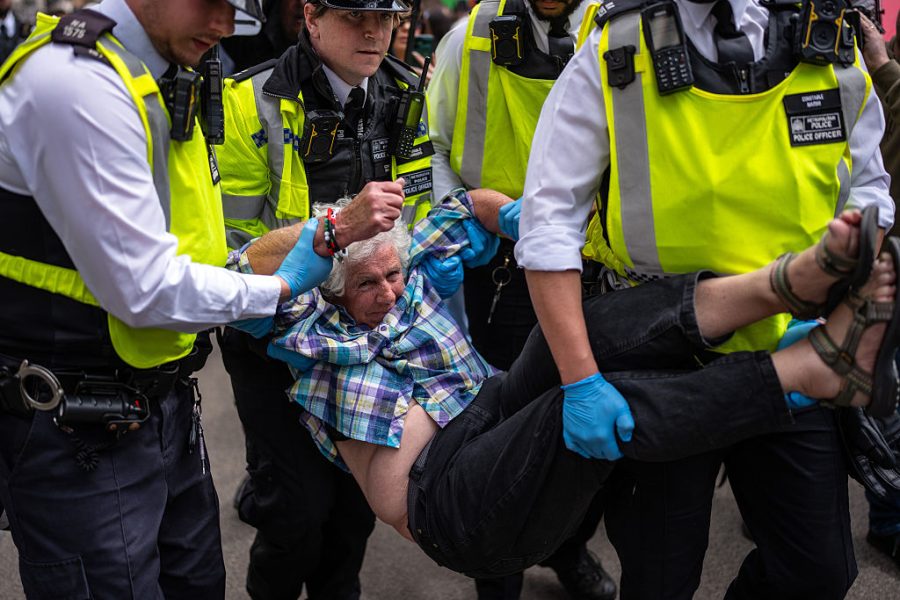
In a sensible but hard-hitting judgment this morning, the Court of Appeal upheld the ban on Palestine Action, overturning the decision of the High Court made in February this year that the proscription had been unlawful. The result of the decision is that over 700 cases which had been pending in the criminal courts may now proceed to trial. Many activists who were arrested at demonstrations in the last year may also now face court.
In giving judgment, the Lady Chief Justice Sue Carr, sitting with four other senior judges, pulled no punches. She made clear that Palestine Action was a group which the Home Secretary had reasonably concluded was concerned in terrorism: it was not a civil disobedience protest group comparable to the suffragettes.
Palestine Action’s campaign was not pursued with restraint and there was a very real risk of injury to property and members of the public. She described the group as a ‘covert organisation’, operating with secret cells, and noted that its activities had accelerated in seriousness.
The increasingly preposterous Zack Polanski said it was ‘gut-wrenching to see four young people jailed for direct action’
The court also accepted that the then Home Secretary Yvette Cooper had been advised by experts who had concluded that there was a risk of further escalation in Palestine Action’s activities. That assessment of future conduct was ‘highly material’. Palestine Action had already engaged in 158 direct action events, 28 of which had involved serious damage to property. Many of the issues considered by the Court of Appeal had not been adequately addressed by the High Court. The shift in tone was clear.
The judgment rightly recognised that the decision to proscribe was a matter of national security: an issue where the Home Secretary had ‘special constitutional responsibilities and institutional competence’. The judgment also acknowledged that it is the government which has the democratic authority to take decisions in relation to national security ‘because it is important that those doing so should be responsible to the public for their effective protection’.

In considering the approach taken by Cooper and whether she had been wrong, the Court of Appeal determined that the decision had been consistent with her proscription policy; that it was proportionate; and that it did not breach human rights laws.
One does not have to look very far to see why Cooper concluded that Palestine Action’s activities had a terrorist dimension. Three incidents were identified in parliament. In addition to its well-publicised attack on RAF Brize Norton and an incident at a Thales facility in Glasgow, there was also an attack on the premises of Elbit Systems near Bristol.
On Friday, four individuals were sentenced for causing criminal damage to that factory at an estimated cost to insurers of £1 million. One of the defendants was also sentenced for inflicting grievous bodily harm on a female police sergeant, fracturing her spine with a sledgehammer. When proscribing Palestine Action, Cooper referred to this incident, although the full facts were not then in the public domain.
When sentencing the four individuals, the trial judge Mr Justice Johnson noted that they had used extreme force and aggression to break in, deliberately using a large vehicle as an instrument of destruction, driving the van through two security fences and through the shutter of the loading bay. The judge concluded that there was a ‘terrorist connection’ to the offences because the defendants had caused serious damage to property in a manner designed to influence the government for the purpose of advancing a political or ideological cause. Having concluded that the offending had a terrorist connection for the purposes of the Sentencing Act 2020, the judge was required to treat that factor as an aggravating feature.
Nonetheless, as legal commentator Joshua Rozenberg has noted, this finding made relatively little difference to the sentences imposed. This was because, ‘in a strikingly generous assessment of the offenders’ motives’, Mr Justice Johnson concluded that, although the terrorist connection was an aggravating factor:
In measuring the increase to the sentence on account of that factor I take account of the fact that you did not intend to injure any person, and that part of your motivation in taking action was to prevent the death and suffering of Palestinian civilians, including children.
Indulgence towards the aims of those who engage in violent direct action is becoming worryingly normalised in the UK. Following the sentencing on Friday, the increasingly preposterous Zack Polanski said it was ‘gut-wrenching to see four young people jailed for direct action against an arms supplier to Israel’, as though destroying property, assaulting police officers and taking the law into one’s own hands could be equated with non-violent protest. The fact that a further 107 people were arrested outside Woolwich Crown Court for supporting Palestine Action during that hearing highlights the scale of the current problem.
It would be optimistic to expect that the Court of Appeal’s decision today will significantly reduce the number of people who fail to distinguish between supporting the Palestinian cause and supporting a group that engages in violent disorder. As was made clear at the time it was proscribed, the ban does not prevent public expressions of support for Palestine, or opposition to Israel and to the Israeli Defence Force, or demonstrations targeted at Elbit – a point repeated by the Court of Appeal.
Unfortunately, much of the damage may already have been done. Combined with reports of assaults, arson attacks and abuse directed at visibly Jewish people, it is no surprise that some Jews feel under threat and are questioning their future in Britain. At times, the country has seemed increasingly lawless.
The tolerance shown by many to the activities of Palestine Action reinforced that perception. One can only hope that the authorities are now able to take a firmer grip on the problem.




Comments