
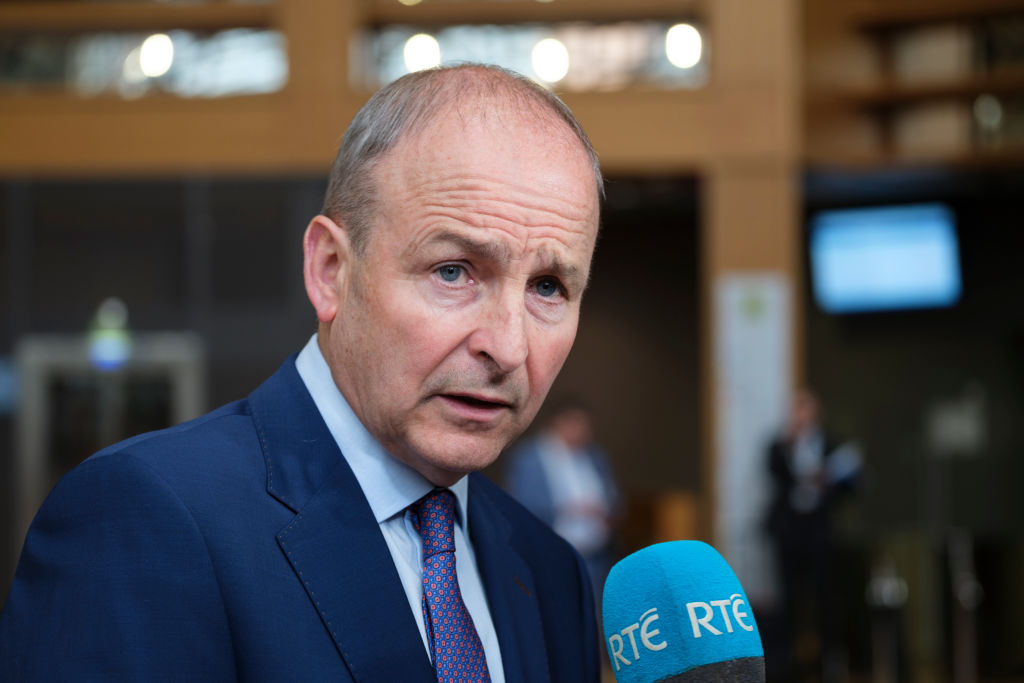
Micheál Martin, now in his second stint as Ireland’s Taoiseach, is by our standards a political veteran, having led Fianna Fáil for the past 15 years. But like our Prime Minister Keir Starmer, after finding domestic politics ever more challenging, he is finding solace on the international stage.
Micheál Martin’s response was simply not the way allies or partners act towards each other
Last week, Martin lived up to the Irish desire to be the ‘Most Oppressed People Ever’. In the Dáil he gave the Irish government’s official response to the final report from Operation Kenova, the investigation into the handling by British security forces of the agent within the Provisional IRA codenamed ‘Stakeknife’.
After some windy words about openness and transparency, the Taoiseach described ‘the British Army’s knowledge of the Provisional IRA’s activities’ as ‘utterly abhorrent and shocking’. He proudly declared that ‘the position of my government and every government I have served in is that we must have absolute openness and accountability’, and observed that ‘the identity of Stakeknife is clear to everybody here and I have previously stated that the agent should be officially named by the United Kingdom government.’ Martin went on to identify Stakeknife as Freddie Scappaticci.
Let us be clear on one issue. As they say in Ireland, even the dogs in the street know that ‘Stakeknife’ was the now-deceased Scappaticci, a senior member of the Provisional IRA’s Internal Security Unit, colloquially known as the Nutting Squad because informers were often shot in the back of the head. However, the British government continues to rely on the long-standing doctrine of ‘neither confirm for deny’ and has not formally identified Scappaticci on generalised grounds of national security.
The government may well be wrong in its apparent determination to remain silent about Stakeknife’s identity. There seems little operational justification, given the near-universal acceptance that Scappaticci was the agent in question. Earlier this month the House of Commons Northern Ireland Affairs Committee recommended that he formally be named.
‘It is not normal practice to name agents of the state, but in this one instance it is appropriate, proportionate and strongly in the public interest for the fovernment to name the agent known as Stakeknife… we are strongly of the view that, for this single case, naming Stakeknife would help to build trust and confidence in the agencies of the state among all communities… a discrete decision to name in this instance would also indicate to agents guilty of conduct beyond acceptable limits that they will not be protected or shielded from the consequences of their actions.’
The committee is probably right, and Whitehall’s ongoing stonewalling is likely ineffectual at best, and actively damaging at worst. But a committee of the House of Commons, required under the Standing Orders ‘to examine the expenditure, administration, and policy of the Northern Ireland Office… and other matters within the responsibilities of the Secretary of State for Northern Ireland’, has a specific locus and duty. It is doing its job.
For a head of government to make the same demand and involve himself so directly in the politics, security and intelligence of another country is an entirely different matter. London and Dublin have been at best wary neighbours since 1922. One of the few benefits of the Anglo-Irish Agreement signed 40 years ago last November was that, while it outraged and alienated Northern Ireland’s Unionists, it went some way to improving relations between the governments of the United Kingdom and Ireland. But there are always stresses and strains.
As a general rule, governments should be very circumspect about becoming involved in the internal affairs of other countries, though Ireland for many years did not see this as applying to its own circumstances. It was only through the conclusion of the Belfast Agreement in 1998 that Articles 2 and 3 of the Irish constitution were altered to remove explicit territorial claims to Northern Ireland.
That circumspection should be even greater when it comes to sensitive matters like intelligence and security. Within their own jurisdiction, intelligence agencies must never be handed blank cheques and there should always be oversight. There are also respectable arguments that the Security Service Act 1989 and the Intelligence Services Act 1994 do not provide the most robust scrutiny mechanisms possible. But anyone weighing in on these areas in a formal way should always ask if they have all the context and all the information: is there anything they might not know but which might make their intervention counter-productive or damaging?
Micheál Martin’s response was simply not the way allies or partners – which is what we might hope the UK and Ireland would be – act towards each other. His strident moral tone was carefully calibrated to diminish Sinn Féin. But its sly references to ‘collusion’ was a jab at the British government. The Taoiseach could have delivered his government’s considered response in a hundred different ways. The one he chose should tell us a great deal about his attitude to the legacy of the Troubles and the blame game which arises from it.


Comments