

The Catholic Church has always been remarkably relaxed about sin. It becomes distinctly jumpy, however, when it encounters any challenge to the Church’s designation of what is sinful.
Human beings (it suspects) are and always will be sinners. The Church has no problem in dealing with sinners: they should confess. Absolution may be available, dispensed by a priesthood who have privileged access to the Almighty, and can intercede.
It isn’t really the commission of a sin that worries the Church. It’s the rejection of a doctrine
‘We will tell you what’s unclean in the eyes of God. We also offer a laundry service to which we hold the monopoly.’ To a cynic it might occur that this a shrewd way of drumming up trade. Be that as it may, you can see at once that to the Church an outbreak of sin is a problem that also represents an opportunity. For all his indignation, Martin Luther failed to understand that the sale of indulgences was not a radical departure from received doctrine: it was only that the Church was taking things a bit far.
I am not so cynical as to doubt that any general proliferation of sinfulness would be a source of genuine sorrow for many Catholic friends. What, however, is calculated seriously to unsettle believers is any move to declassify as sinful what the Church has deemed to be a sin. That people should persist in behaviour deemed sinful is mildly regrettable. But that people should deny this behaviour is even a sin is monstrous.
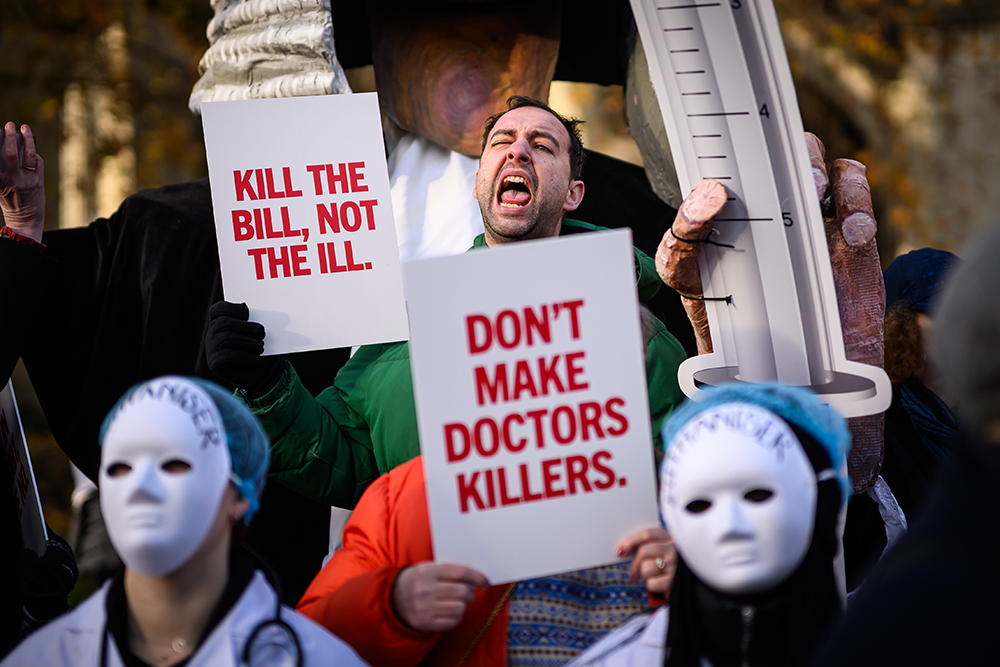
Which brings me to the subject of this column: assisted dying. The bill now before parliament is itself dying, assisted towards its deathbed by many opponents, but none more determined, more vociferous or more sly than religious believers, notably (I believe) the Catholic Church.

I can only guess at the importance of religious doctrine in the campaign to kill the bill, because the more cunning among the devout play down their faith-based opposition to it. Instead, often professing a desire to improve the legislation, they have loaded the measure down with so many amendments that it has become a poor, mutilated thing.
Indeed, to my mind a now objectionable thing. I no longer believe it is worth keeping alive. The measure which those among the public (a substantial majority) who’ve supported the private member’s bill thought they were supporting would have been a measure that got the state, the police and the law off the backs of those poor souls who see death approaching and, suffering as they are, wish to hasten the end.
The bill we’re now looking at, however, brings all these incubi piling in. Encrusted with committees, boards of assessors, social workers, doctors, reviewers, lawyers, psychiatrists and a plethora of other bureaucratic hurdles, it will inflict new pains upon the terminally ill and new miseries upon relatives or friends whose only object was to help a person they loved go quickly, quietly and painlessly, according to his or her wishes. The bill will perish and its opponents will feel they have ‘won’. In one way they have. They have upheld a doctrine. They will never stop a practice.
A long time ago my cousin, a lovely, joyful, bubbly woman reduced to a pitiful wreck by a wasting illness, and wretched beyond belief, asked her grief-stricken father, my uncle, to help her get to Dignitas in Switzerland. He begged me to accompany them. Supposing that if my help were in any way instrumental I might be breaking the law, I anyway agreed. The Crown Prosecution Service tends to look away in these cases, juries would be reluctant to convict, and, balanced against the small risk I’d end up in court and even smaller risk I’d be convicted, my affection for my cousin (who’d been my lodger in London when we were both young) outweighed the risk. If charged I’d have claimed I only went in hope of changing her mind, and to comfort her if she didn’t.
But before we could buy the tickets, she killed herself – because she could.
Her case was not on all fours with the cases of those this assisted dying bill was aiming to help, but it made me think hard about helping anyone to end their life. Principal among my conclusions was that we can all argue, with varying degrees of passion, about whether anyone should; but of one thing we can be sure – people always will. And that brings me back to the Church.
Where are the Christian voices inveighing against the police’s reluctance to arrest? Where are the newspaper columns decrying the CPS’s disinclination to charge? Where is the Church when judges let defendants go unpunished – even uncriticised? The Vatican knows that Dignitas will have despatched plenty of dying Catholics; knows a majority in Britain support assisted dying; may grumble about all this but is well aware that the practice will always be with us.
All this they know, and on the whole they look the other way. Because it isn’t really the commission of a sin that worries them. It’s the rejection of a doctrine.
Change the law? By legislative example reclassify the sin itself as no longer sinful in the eyes of the state? From the pulpits, all hell then breaks loose. Never mind what people actually do, never mind that most of the population are not Catholics, but how dare an elected government in a mature democracy challenge Catholic doctrine!
This bill will fall, and now deserves to. In other countries the law will increasingly reflect public opinion, but here in Britain we’ll genuflect politely to the priesthood, leave the laws against assisted dying in place, and carry on ignoring them. Later rather than sooner our law will catch up with international practice and – as with abortion, as with the decriminalisation of homosexuality, as with IVF – our successors will wonder what took us so long.
The Church is not seriously trying to stop anything, and won’t. And I should be relaxed. But oh how I hate the hypocrisy.





Comments