
Humor has become serious business. A nation of anxious primates trapped in a silicon casino of likes, retweets and dopamine-soaked drudgery, America is suffering from what the comedian Norm Macdonald called a “crisis of clapter.” Terrified of saying the wrong thing, needing punchlines to be spoon-fed – what was once the funniest place on Earth has become a tight-lipped, tongue-twisted society where jokes are rewarded with polite applause instead of genuine laughter. It’s the old stink of a well-mannered aristocracy, and very un-American indeed.
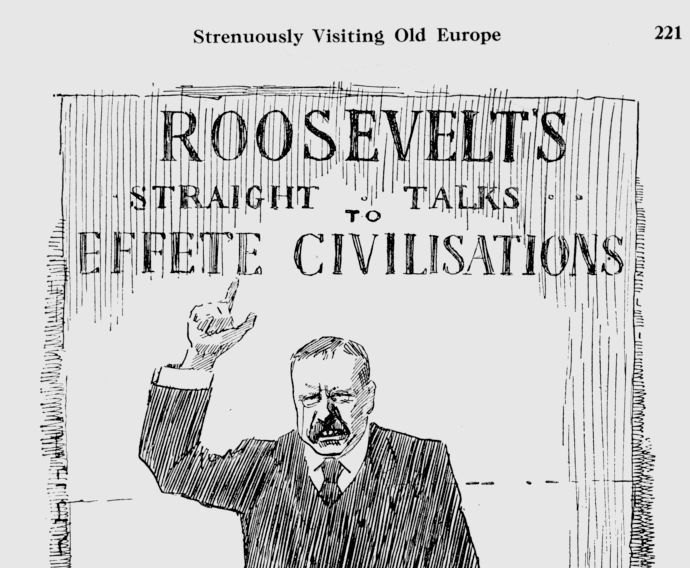
From his beginning, the ugly American – wild-eyed and rabble-rousing – rankled the Old World. A pandemonious lot of yahoos set loose upon a land of virgin forests and free-for-all plenty, Americans were insubordinate, with a sense of humor to match. As Matthew Arnold, disgusted by a people with too many kings and not enough crowns, wrote:
If there be a discipline in which the Americans are wanting, it is the discipline of awe and respect… In truth everything is against distinction in America, and against the sense of elevation to be gained through admiring and respecting it… The addiction to “the funny man,” who is a national misfortune there, is against it.
The tall tale – distinct enough to, for the first time, qualify as an original art form – gave shape to a new kind of nation. Unlike the satirical critiques of the British essay or the witty comedies of French theater, the American tall tale was funny without a point. It wasn’t social commentary. It didn’t exist to prove genius. It was laugh-at-me tomfoolery. As Mark Twain saw it: “To string incongruities and absurdities together in a wandering and sometimes purposeless way, and seem innocently unaware that they are absurdities, is the basis of the American art.”

Meant to be heard rather than read, the tall tale was a kind of story that – pretending not to know – brags big, falls flat, gets in its own way, speaks past the point, wastes the audience’s time and doubles back to waste it again, concealing its punchlines and playing dumb all the while. Twain contrasted this with the self-important European habit of advertising comedic effect with “whopping exclamation points” and explanations in parentheticals.
It was a “very depressing” thing, he explained, to find joy in the sublime, the beautiful, the useful and the orderly and yet be unable to find it in the incoherent, the elusive and the unexpected. The American sense of humor, in his view, was animated by a frank affinity for the imperfect, making sense of a people who preferred the patchwork pursuit of a more perfect union rather than the sterile fixity of a perfect one to start.
This democratic sense of humor was not some dainty old comedy of manners – a museum of wrongly-held forks, counterfeit airs and the thousand other fragile trinkets of aristocratic life, all such cultured amusements of a buttoned-up society where social climbing was a passion. No – the American creation was instead what historian Henry Steele Commager called “comedy of circumstance,” that made fun of every man, who “at one time or another aimed too high, adventured too boldly, boasted too loudly.” It mocked rich people like poor people, made fun of smart people in the same way as dumb people – because in the US no man is allowed to stay king. Only here was humor let off the leash, divorced from the polite understanding that jokes ought to leave the order intact. In Europe, mockery operated within a fixed aristocratic structure – as a pressure valve in a system not designed to change its fundamental hierarchy. Here, ridicule was integrated into a self-correcting democratic project – an informal mode of checks and balances powered by short memories, mixed company and freedom.
Monarchy, oligarchy, theocracy, Plato’s philosocracy – every way of government the human species has thought to design was, in the beginning, born of utopian aspirations; and in the end, kept alive with nothing less than first-rate hypocrisy. Believing we could perfect it all, we sought to codify a world without error – by purging its flaws, cleaning its mess and setting it all in stone. But in 1789, a new generation of men on a new continent chose to work with our flaws and use the mess and admit that our Constitution could not stay unamended forever.
Few of their ideas were original. Most of their genius took up no more than a dozen seats at Independence Hall. But so different was the character of all the men in Philadelphia and New York and Boston and Virginia from any nation of men so far conceived that the old idea of democracy, long trapped on paper, at last found a people funny enough to make it work. A people who laughed at pretension, heckled certainty and made a sport of nonconformity.
But now: a Botox-bleached nation of caped crusaders wearing noise-canceling headphones, deaf to anything but our own theme music and the imagined sound of unseen eggshells cracking beneath, Americans are slipping back into the Old World habits we once escaped. Democracy and humor are dying of the same disease.
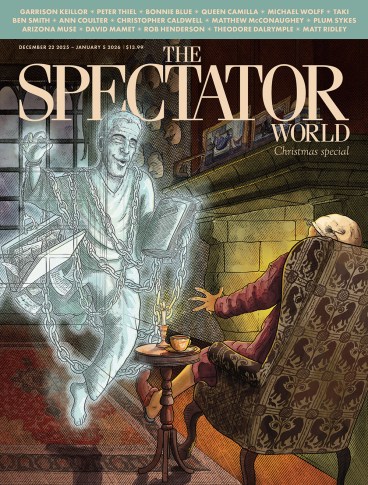
This article was originally published in The Spectator’s December 22, 2025 World edition.



Comments