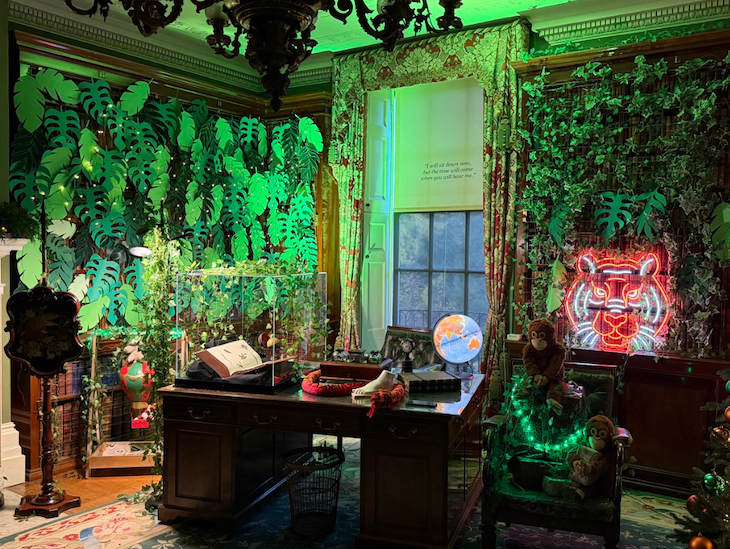
If ever you wanted an example of how the National Trust appears to be run by history-hating fools, take a visit this Christmas to Hughenden Manor in Buckinghamshire.
When, oh when, will they go back to this noble, obvious mission – that originally guided them for decades?
This late 18th-century gem, refashioned in the 19th century, was home to possibly the greatest Conservative prime minister of all, Benjamin Disraeli. Extraordinarily, the house remains as a time capsule to Dizzy’s time there – and he’s buried in the neighbouring church.
Well, it did remain a time capsule, until the latest moronic makeover by the Trust, who now own the house and estate. This Christmas, from 28 November until 3 January, they’re revamping the house – not simply with a traditional Christmas theme, which would be bearable, but with an ‘exploration’ look.
And so the Trust have decked Disraeli’s house out with fake jungle greenery, toy monkeys, an illuminated globe and a huge neon tiger’s head. A bust of poor old Dizzy is humiliated with a hat that is too ludicrously small for him.
‘This Christmas at Hughenden is a celebration of wonder, the joy of discovering thrilling stories, imagination, and more than a sprinkle of seasonal magic,’ says the Trust, which proudly advertises a jungle-themed game of Snakes and Ladders in the Library. Why on earth do the Trust continue with this disastrous concealment, dumbing-down and desecration of history?
A Trust spokesman says that: ‘Throughout the year, National Trust houses get dressed up for celebrations and events. At Christmas, our teams create all sorts of displays and experiences for visitors and they’re very well-liked… The Christmas displays at Hughenden invite visitors to explore the globe with a Victorian spirit of curiosity and spectacle.’
Disraeli was a mighty statesman, a terrific novelist, one of the most original thinkers of the age and a close confidante of Queen Victoria. He was not a famous explorer. But this doesn’t seem to cross the ahistorical Trust’s mind. Instead, they appear to think their properties are ace venues for dull PR stunts.
The desecration of Disraeli’s house is shocking but perhaps not surprising. I first noticed this decline at the National Trust decade ago, when I spent months touring Trust houses, in preparation for the 2017 Charles Douglas-Home Memorial Lecture: “Betrayal of Trust: How the National Trust is Losing Its Way”.
Up and down the country, the National Trust were beginning their assault on history – and literacy. Hughenden was one of the chief offenders.
In the Trust’s official literature at the house, Isaac D’Israeli, father of Benjamin Disraeli, the Victorian prime minister, was called ‘Isaace’. Another Hughenden guidebook was littered with spelling mistakes: closely was spelt ‘closey’.
Even then, long before it became a jungle, Disraeli’s library had been ruined. Blinds at the property were printed with Disraeli quotes, such as “I will sit down now, but the time will come when you will hear me.” It’s from his maiden speech in the Commons in 1837, not that you might know that from the blind itself.
The fear of offering visitors some proper insight into who Disraeli actually was appeared to be so great that visitors to the property were informed that “Disraeli loved books and the library was the place where he relaxed and conducted his business affairs.” A library for a man who loves books? Who’d have thought it?
Elsewhere in the house, a poster described Disraeli’s introduction to ‘high soceity’. Dizzy, a master of funny, beautifully written English, would have wept.
In recent years, the Trust has appeared to become more obsessed with climate change and political issues than the historical value of the houses it owns. But for all its supposed dedication to nature, it blights the gardens and landscapes it owns. Take the tide of signs at Trust properties. Sometimes, you literally can’t sit down but for the signs. Hughenden’s kitchen garden is crammed with the bloody things.
And you’re not even allowed to enjoy the direct pleasures of nature, without being patronised by the Trust. When I last went to Hughenden, a tree stump had a sign next to it, saying, “Please do not climb on me.”
The Trust owns some of the finest houses, landscapes and gardens on the planet. Its task is enormous but simple – to preserve them. It doesn’t need to add to them – with kiddy-language signs, illiterate guidebooks and toy monkeys. It just has to keep them as they are and explain them with intelligence and wit.
When, oh when, will they go back to this noble, obvious mission – that originally guided them for decades?
Harry Mount is author of How England Made the English?





Comments