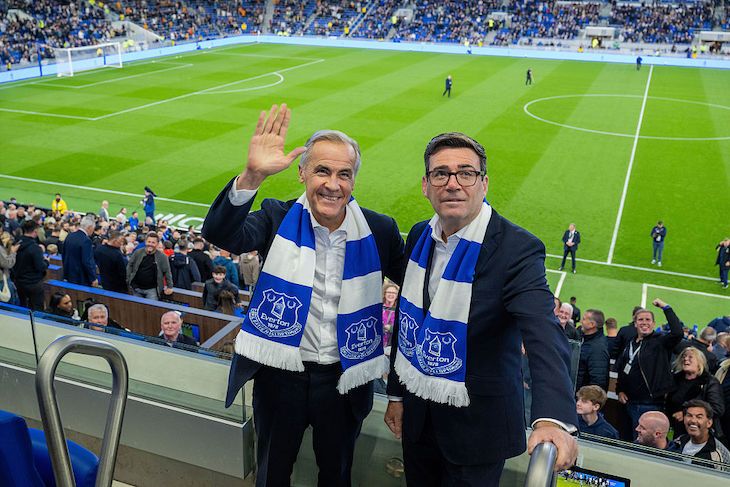
Andy Burnham has said that scrapping the continuation of the 3 p.m. Saturday blackout for televised football matches might threaten ‘the income of lower league clubs’ and urged caution as bidding for the next period of football broadcasting rights is under way. But is the Prime Minister right?
It’s an oddity that only domestic fans can’t watch broadcast games at that time, whereas fans from all over the world can
The blackout was introduced in the 1960s, when club chairmen were worried that televised matches at 3 p.m. on a Saturday would deter fans from attending matches. The ban is still in effect and means no football game can be televised between 2.45 p.m. and 5.45 p.m. on Saturdays in England and Scotland. Burnham says that if we had ‘wall-to-wall Premier League football at any time, it takes away the incentive to go and watch football league or non-league’.
The problem with this argument is that broadcasters have already shifted games out of the 3 p.m. timeslot to maximise television rights. The number of Championship games at 3 p.m. has fallen from 192 to 115 over the decade, and a similar proportion of League One and League Two games have been affected. More games are being pushed to Sunday and Monday evenings, which is worse for travelling fans than a 3 p.m. blackout. It is unfair for fans from all leagues, especially those taking their children, to travel to away fixtures at such awkward times. Manchester United fans were upset after their Crystal Palace fixture on 13 December was rearranged for 7 p.m. If this game was at 3 p.m. on a Saturday, it would benefit both travelling fans and those who wanted to watch it at home.

Supporters of the blackout also ignore the benefit of broadcast rights to lower league clubs and how more televised games allow smaller clubs to increase their fanbase. For League One and League Two, revenue is split almost equally between broadcast, matchday and commercial income, while the National League derives 15 per cent from broadcast, 29 per cent from matchday and 56 per cent from commercial revenue. The international streaming platform DAZN, which has sought to stream lower league games for years, claims that the average Championship club could see an additional £2.5 million in broadcast revenue if the Saturday blackout were lifted.
It is also worth noting that England and Scotland are the only countries that have this form of blackout. Spain, Germany, Italy and France all allow televised games at that time, and matchday attendance has remained the same over two decades or increased.
What’s more jarring is that fans from those countries can watch all the English football as well. It’s an oddity that only domestic fans can’t watch broadcast games at that time, whereas fans from all over the world can. The demand for domestic broadcasting on Saturday afternoon is evident. More fans are subscribing to overseas streamers of English football and use a VPN to circumvent the ban. There’s even more who don’t pay at all. Almost one-in-ten adults in Britain admitted to watching sport on an illegal streaming site, which is a loss in revenue for all clubs.
But even as fans have gained access to foreign streaming, through VPNs and dodgy websites over the past two decades, attendance in the lower leagues has nonetheless increased by a third.
One interesting counterpoint is that some MPs have called for the removal of the 3 p.m. blackout exclusively for women’s football to encourage the growth of the game. But surely this would have the same effect on women’s football attendance as some claim it would have on lower league men’s football? Average attendance for the Women’s Super League this season is 6,100 – about the same as League Two – and three times what it was five years ago. Yet the MPs calling for the lifting of the blackout for the women’s game don’t raise the fear that it might affect attendance.
As with the Labour-established quango to ‘regulate football’, the decision to lift the blackout should, in reality, be up to the clubs in the Premier League and EFL, and politicians shouldn’t interfere.
Claim: Andy Burnham says lifting the 3 p.m. TV blackout would be bad for football clubs Reality: False





Comments