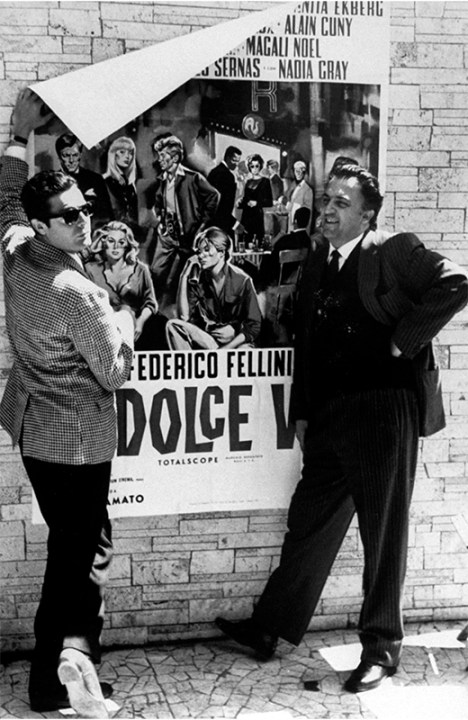
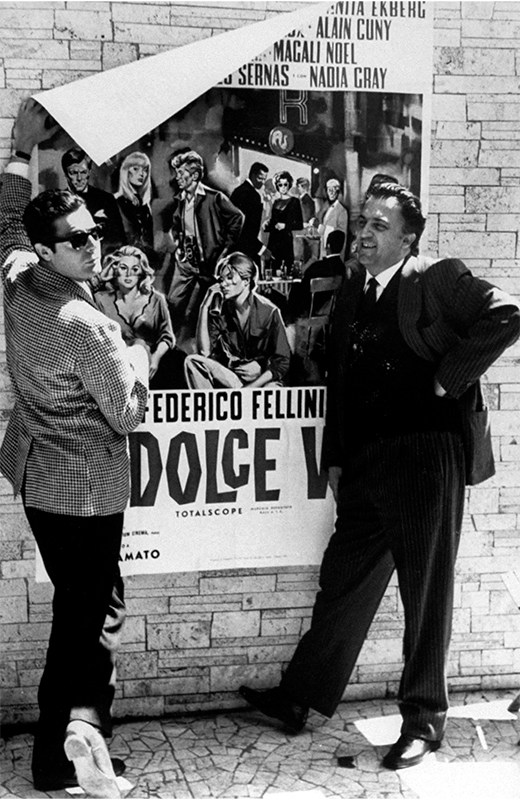
Wandering around Castel Sismondo, a vast medieval fortress in the Italian seaside town of Rimini, I wonder: could any other filmmaker inspire a museum as magical as this? Most film museums are dull repositories filled with dusty artefacts, the lifeless bric-a-brac of moviemaking. The Fellini Museum is like a set: it transports you into the director’s world.
Here’s the fountain where Anita Ekberg frolicked with Marcello Mastroianni in La Dolce Vita; there’s the Moto Guzzi Ercole that Anthony Quinn rides from town to town in La Strada. And there’s the pier where the wistful young men in I Vitelloni gaze longingly out to sea. Shuffling down long dark corridors, through cavernous halls full of flickering screens, I feel like a bit-part character in a film that Fellini dreamed about yet never made.
The Fellini Museum opened in 2021, to surprisingly little fanfare. It was big news in Italy – elsewhere, not so much. Covid and its aftermath scuppered my initial plans to visit, but finally, five years on, I’m here in the antique port where Fellini was born and raised. I want to explore the museum, of course, but above all I want to explore Rimini. I want to find out why this place was his artistic lodestar, a constant reference point throughout his colorful, creative life.
Cinema kept Fellini out of the army, and after the war he wrote screenplays for neorealist movies
Federico Fellini was born in Rimini in 1920, and though he left for Rome when he was 20, he kept returning here, in his life and in his movies. He’s buried in the local cemetery, beside his beloved wife Giulietta Masina, the star of several of his greatest films, and their only child, who died in infancy. I borrow a bicycle, and as I cycle round town, meandering between modern apartment blocks and Roman ruins, past the ice cream stalls and sidewalk cafés, I recognize countless motifs from Fellini’s oeuvre, and I realize how integral Rimini is to his suave, seductive art.
Filmmaker Luchino Visconti called Fellini a small-town boy dreaming about life in the big city, and it’s that tug-of-war between Rome and Rimini which fuels his passionate, poignant art. It’s a familiar feeling for many: the small town where you grew up is suffocating. You yearn to escape to the metropolis – you feel sure that only there will you be free. You spend your best years chasing the big bucks in the big city, only to discover that your quiet hometown held more meaning all along.
For me, and so many other cineasts, that’s why Fellini’s movies still resonate. Mention Fellini and most picture the metropolitan glamor of La Dolce Vita – debonair men and voluptuous women riding around Rome in open-top sports cars – but the film’s lesson is that the world it depicts is empty. No amount of money can repay the lost innocence of youth, and for Fellini, youth means Rimini – constricting, frustrating, yet rich with childhood memories that his adult life in Rome could never match.
The son of a traveling salesman, Fellini’s upbringing was unremarkable. He was an unexceptional schoolboy: fairly (but not exceptionally) bright; fairly (but not exceptionally) naughty. The neighborhood where he grew up was drab but respectable. His home life was humdrum, on the cusp between lower-middle and upper-working class. He loved playing with his toy theater and he yearned to be a puppeteer, but that boyish daydream came to nothing. He claimed he ran away to join the circus, but that was just a hollow boast (he articulated his bittersweet love of the Big Top in films including The Clowns and La Strada).
Rimini’s palatial Fulgor cinema features in several of his movies. Today it regularly screens his films and documentaries about his life and work. However, Fellini was no cinephile. “For Federico, the movie theater was where you went with friends to make a ruckus,” wrote his friend and biographer Tullio Kezich. “He never thought about the movies at all,” confirmed another friend, Riccardo Aragno. Throughout his life, Fellini showed scant interest in other filmmakers. There was nothing derivative about his work, and that’s what made it so distinctive. Unlike a lot of filmmakers, his sole inspiration was real life.
Fellini went to Rome to study law, but he dropped out after a few days and stumbled into journalism. Bored by conventional journalese, he discovered a talent for humorous reportage and drifted into radio, where he met Giulietta, already an established actress. From there it was a short step into cinema, where his gag-writing evolved into screenwriting (a similar career trajectory to Woody Allen, whose Stardust Memories pays tribute to Fellini’s finest film, 8½).
Cinema kept Fellini out of the army, and after the war he wrote screenplays for a raft of neorealist movies. His directorial debut, The White Sheik (1952), was a flop, but I Vitelloni (1953) was a smash hit. La Strada (1954) and Nights of Cabiria (1957), both starring Giulietta (as a childlike simpleton and then as a tragic, heroic prostitute), both won Oscars for Best Foreign Language Film, securing Fellini’s reputation as Europe’s most exciting young director. Films like Il Bidone (1955) – a stark depiction of ruthless swindlers – anticipated realistic movies by Martin Scorsese such as Mean Streets. As in the works of Dickens or Shakespeare, all of human life is here.
Fellini reached his creative peak with La Dolce Vita (1960) and 8½ (1963), both starring Marcello Mastroianni, and both regularly (and quite rightly) cited as two of the greatest movies ever made. Supremely stylish yet profoundly moral, La Dolce Vita is an Italianate Rake’s Progress about a charismatic gossip columnist who devotes his life to pleasure and ends up emotionally bereft. And 8½ was even more ambitious and audacious, a film about a filmmaker suffering from director’s block. It sounds like a storyline for the worst movie ever made, yet Fellini turned it into a surreal masterpiece, full of mesmeric, enigmatic imagery – the apotheosis of his innate, instinctive art. “Moviemaking for him seems almost effortless,” observed the late film critic Roger Ebert. “He can orchestrate the most complicated scenes with purity and ease.”
Scorsese saw 8½ just before he made his first film. The most important thing it taught him? “Always keep the camera moving.” “I am trying to free my work from certain constrictions – a story with a beginning, a development, an ending,” Fellini told Lillian Ross in a 1965 interview for the New Yorker. “It should be more like a poem with meter and cadence.” Despite its opaque plot, 8½ was a mainstream hit, winning Fellini a third Oscar – proving that, in his hands, even the most esoteric movie could be a critical and commercial success.
No one understands despair and cruelty better than Fellini. No one depicts it so unsparingly on screen
Not everyone was impressed. Pauline Kael criticized the narcissism and megalomania of his work, but those charges could be leveled at most great artists. In an era of dogmatic certainties, he remained resolutely apolitical, attacked by both left and right. Progressives condemned his political neutrality, yet his concern for the poor was beyond doubt. His sexual candor shocked conservatives, but no male filmmaker had more sympathy for women or a better understanding of their needs and wants.
He was ambivalent about the Catholic Church yet maintained a deep respect for the Catholic faith. “I believe in the necessity of God because I believe in Man, and God is the love of Man,” he said. Ideology didn’t interest him – the human condition did.
Fellini lived another 30 years after 8½, yet he never quite scaled the same heights. In 1975, he won a fourth Oscar for Amarcord, an elegiac, heartfelt evocation of his formative years in Rimini, but a lot of his later output was patchy. Color seemed to constrict him. He worked best in black and white. His decadent Roman epic, Satyricon (1969), merely felt tired and tawdry. Fellini’s Casanova (1976) was like a Carry On film without the laughs. Yet even in the twilight of his career, he was still capable of moments of pure magic. The scene in Intervista (1987) where Marcello Mastroianni and Anita Ekberg watch their younger, lovelier selves in an ad hoc screening of La Dolce Vita was intensely, immensely moving. For Fellini, it’s all about emotion. That’s why his films still inspire us, long after the world they portray has disappeared.
I end up at Rimini’s Grand Hotel, where the great adventure of Fellini’s life began and ended – a mirage of the high life throughout his youth, then his home from home on his perennial return visits in later life. Photos of Fellini adorn the walls – hobnobbing with movie stars and VIPs, living it up. Before I head for home, I recall the closing lines of I Vitelloni, my favorite Fellini movie (“We all talked about leaving but only one of us – one morning, without a word to a soul – actually left”). And I realize, belatedly, that he was talking about himself – the small-town boy from sleepy Rimini who went to Rome to seek his fortune and kept returning to try to recapture what he’d lost.
No one understands despair and cruelty better than Fellini. No one depicts it so unsparingly onscreen. Yet despite the heartbreak and betrayal, he retains an indefatigable belief in our capacity for bravery and humanity – that in the midst of so much suffering, somehow there’s still hope. That’s what drives his movies, that’s what makes them vital, and that’s why it’s the last lines of Intervista, his farewell to the cinema, that linger in my mind’s eye as the seafront recedes behind me. “I seem to hear the words of an old producer of mine: ‘At least give me a ray of sunshine,’ he would beg me at the end of every film. A ray of sunshine? Well, I don’t know. We can try.”



Comments