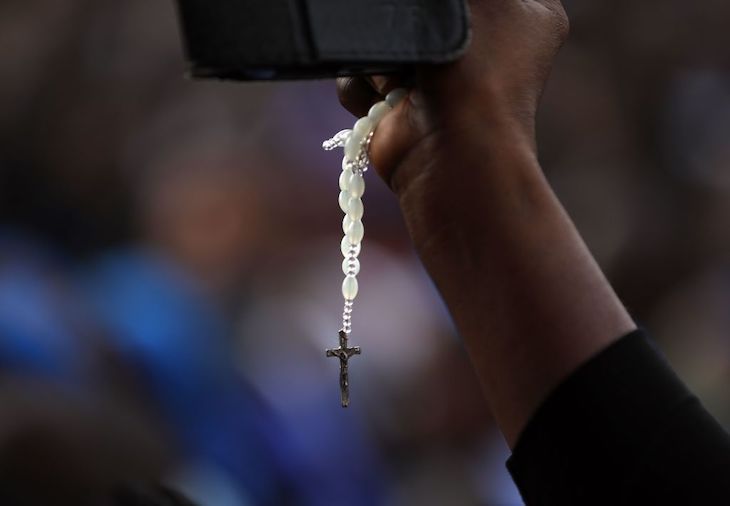
A Nigerian woman who watched Boko Haram militants kill her husband after he identified himself as a Christian will be joining a delegation today delivering a petition with over one million signatories to 10 Downing Street. The letter is calling for “greater protection for Christian communities in sub-Saharan Africa, justice for victims and help for survivors rebuilding their lives.”
The men asked her husband whether he was Muslim or an infidel. He replied that he was neither, but a Christian
In October 2014, Afordia and her husband were traveling by car in Adamawa State, in north-east Nigeria, when men in uniform stopped them. The couple initially mistook the men for Nigerian soldiers before armed men emerged from hiding and ordered them out of the vehicle. The men asked her husband whether he was Muslim or an infidel. He replied that he was neither, but a Christian. He was ordered to the roadside, where he knelt and began to pray. Seconds later, he was shot several times and killed.
Despite the trauma she has endured, Afordia remains resolute in her faith. When I spoke to her this week, there was something deeply humbling about a woman who has faced unfathomable tragedy yet chooses to live with grace and compassion over hatred.
“I remember the teaching of our Lord Jesus Christ, that it is about forgiveness and that gave me strength,” she tells me. Afordia welcomed the efforts to engage individuals and governments in speaking out and praying, believing that God is guiding people to respond. However, she stressed that the persecution of Christians was an ongoing issue and something that cannot be quickly overcome.
The Downing Street petition was coordinated by groups including the charity Open Doors forming part of an international effort to lobby governments: the Arise Africa campaign. According to Open Doors 2026 World Watch List, which ranks countries where Christians face the most extreme persecution, a staggering 90 percent of those killed last year (from a total of 4,849) for their belief in Christ, were from sub-Saharan Africa. The charity says “this rising violence is being driven largely by Islamist extremists taking advantage of political instability in the region.” According to Open Doors, an average of 12 Christians are killed for their faith every day in sub-Saharan Africa, where violence against Christians is more widespread than in any other region of the world.
Somalia, Eritrea and Nigeria all rank among the top ten countries on the World Watch List. Nigeria, Africa’s most populous nation, has 244 million people. As of 2025, its main religion is Islam with 46.3 percent identifying as such, with Christianity being second at 45.8 percent.
Nigeria’s troubled Middle Belt region demarcates the predominantly Muslim north and the mainly Christian south. Over the years, ethno-religious violence has spread across this wider region (and reached the South), with attacks by Fulani militia displacing entire farming communities.
Earlier this year in the country’s Taraba State it was reported that Fulani militants killed 70 people, attacking 35 churches. As of 1 April 2026, the total number of internally displaced people (IDP) in Nigeria is a staggering 3.8 million.
Despite the scale of this crisis, the UK government’s policy for supporting those fleeing violence in the Middle Belt has been sketchy to say the least. In October last year, President Donald Trump designated Nigeria a “Country of Particular Concern” and subsequently ordered US missile strikes against Islamic State in north-western Nigeria which he described as “a Christmas present.” But despite Trump’s fleeting intervention many of Nigeria’s Christians feel that the West has abandoned them.
This year, Easter weekend attacks in northern Nigeria killed at least 33 people. Many Christians were also kidnapped. These atrocities unfolded just a week after at least 27 were killed on Palm Sunday in a predominantly Christian village in Plateau State. Days which should have been filled with celebration and joy were transformed into scenes of murder and mayhem.
The 2014 campaign launched after the abduction of 276 schoolgirls by Boko Haram in Chibok (Borno State) mobilized significant international pressure. This was amplified by then US First Lady Michelle Obama when she posted a photograph while holding a handwritten sign “#BringBackOurGirls.” Yet things appear to have gotten progressively worse since – and the attention of the West has wavered.
In 2018, Leah Sharibu was one of 110 schoolgirls abducted in Dapchi, Yobe State, by the Islamic State – West Africa Province (ISWAP). Most of the girls were returned (five were killed), but ISWAP still hold Sharibu as a “slave for life” simply because she refused to convert to Islam. According to Open Doors, abductions have increased by 153 percent, when comparing October-December 2025 to the same quarter in 2024. Last November was so dire that schools in roughly 11 northern states in Nigeria were forced to shut down.
Not all civilian victims are Christians. Between October 2023 to December 2025, there was an increase in the numbers of Muslims killed too: Muslims from the Hausa tribe are, alongside Christians, vulnerable to attacks carried out by the Fulani militia, who have caused more civilian death and displacement (in recent years) than ISWAP and Boko Haram combined. The latter jihadist groups operate predominantly in the north-east region.
So what more can western governments do to help bring protection and justice for those facing unbridled medieval barbarism? Tiffany Barrans, CEO of Open Doors UK & Ireland told me that, for the British government to properly respond, “our diplomats, foreign service officers, and those responsible for distribution of humanitarian aid must understand how one’s religious identity can make someone more vulnerable to the violence. The Foreign Office has introduced religious-literacy training. We are now asking for it to become a core requirement for staff working in relevant roles or contexts. This learning should be applied in real decisions about programs and assistance.”
With three quarters of Nigerians trusting their faith leaders more than civic leaders Barrans said it is vital that the UK government build stronger partnerships with local churches, faith leaders and faith-based organizations in Nigeria. By doing so, they can hopefully draw on their deep community knowledge and their willingness to reach dangerous areas, arriving early when violence erupts and remaining long afterwards.
The final word should go to Afordia: “I thank God for this petition because it is an eye opener to the whole world to pray and to know the truth concerning Christians.” Is the West listening? It’s about time they did. Nigeria’s Christians need help more than ever.



Comments