The Spectator does not have partisan allegiances, but it does have household gods. There are thinkers whose work imbues our reasoning – few more important than Isaiah Berlin. Berlin’s principle that a culture of liberty would involve a recognition that there are incommensurable goods is one of the bases of a civilised society. Some freedoms – of religious belief and speech – will be in contention with society’s desire to advance or protect the rights of others. Statesmanship consists of the arbitration between these goods, and for those who believe in liberalism, like The Spectator, the bias will always be in favour of freedom.
That is why this magazine believes that in the realm of personal sexual relations, adults should be free to choose how they live and whom they love. David Cameron’s legislation to guarantee marriage rights to gay people was an extension of liberty. It was brave and right. It was also celebrated as a further step on the road to greater equality and the vanquishing of prejudice.
Here some caution is called for. Equality between gay and straight adults is a matter of basic justice, and prejudice against adults on the basis of their love for other adults is ugly. But for some the pursuit of what they see as equality and the fight against what they consider prejudice can become a restless search for the expansion of state powers to harass, censor and intimidate those who also affirm another freedom to differ. Those who want to hold the traditional beliefs of the Jewish and Christian faiths which underpin our culture of liberty; and those who wish to preserve the bright line between freeing adults and protecting children, which, once eroded, strikes at the very dignity of personal autonomy.
A mother advising a 15-year-old girl she is too young to have her gender reassigned could be prosecuted
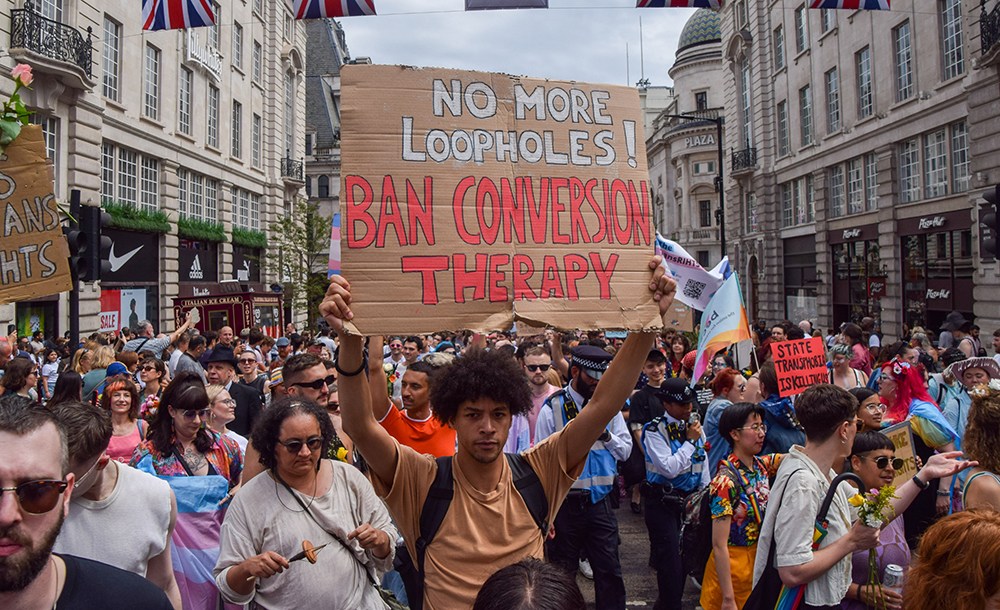
The promoters of Labour’s draft Conversion Practices Bill believe they are protecting the freedom of adults to live and love as they wish. They see it as another step on a well-trodden progressive path. The bill is presented as an attempt to criminalise the abusive coercion of individuals away from their sexuality or ‘gender identity’. But the bill’s supporters are not freedom’s friends. If it passes, concerned parents could be prosecuted for talking to their children about the risks of self-mutilation, doctors could be criminalised for warning their patients against self-sterilisation and priests persecuted for prayer. It challenges not only free discussion but comprises an assault on open discussion, family life and biological reality, imposing gender self-identification by the back door.
Opposition to the bill is widespread. Kemi Badenoch has branded it ‘unworkable’, having challenged similar legislation, while equalities minister. Kishwer Falkner, the former chair of the Equality and Human Rights Commission, has suggested it is an ‘unprecedented and unwarranted intrusion into family life’.
The evidential basis for the bill seems questionable, to put it mildly. The Cabinet Office has suggested that 10 per cent of gay people and 30 per cent of transgender people have faced an exorcism to alter their sexuality. That would suggest a level of clerical activism not seen since Torquemada supervised the office of the Holy Inquisition.
Given this effective demonisation of prayer, the Church of England has understandably warned that the bill must not ‘unintentionally criminalise’ pastoral support. Leaders within the Catholic Church have called for it to be scrapped.

There is vanishingly little evidence that England’s parishes are hotbeds of horrifying ‘treatments’ such as physically forced exorcisms or electroshock therapy forced upon vulnerable persons questioning their sexuality or confused about whether they are a man or a woman. Indeed, such coercion, were it to be attempted, is already illegal under existing laws.
What this bill will do, however, is criminalise sympathetic conversations that challenge a person’s conception of their sexuality and gender.
Conduct that is inadvertently ‘abusive’ and causes unintentional ‘serious alarm or distress’ through economic, emotional or psychological pressure could receive a five-year prison sentence. A loving mother advising a 15-year-old girl that she is too young to have her gender reassigned could be
prosecuted for expressing her beliefs. The campaign group Sex Matters has highlighted a number of cases that could fall within the prosecutor’s ambit, from a wife opposing her husband’s cross-dressing and planned transition to a coach warning a biological boy off joining a girls’ team.
Those promoting this bill are exploiters. They are taking advantage of a desire to protect vulnerable individuals to push an ideological agenda attacking the idea of biological sex differences. The bill’s strongest advocates are activists opposed to last April’s Supreme Court ruling that in the Equality Act 2010 ‘sex’ referred to biological sex rather than gender identity.
These activists wish to use this bill to criminalise those who stand against gender self-identification. Jean-Louis de Lolme, an 18th-century Genevan political theorist, suggested that Britain’s ‘parliament can do everything but make a woman a man and a man a woman’. It still can’t. But it can attempt to make pointing that out illegal.
The belief that past injustices suffered
by gay people justifies creating new statutes to make it more difficult to warn children of the dangers of mutilation is a twisting beyond reason of the principles of freedom on which a civilised society rests.
This bill should be opposed by any legislator who understands what laws are for. It is a paradigm of what its promoters claim to hate – censorship of free expression to protect an emotionally inspired belief which inevitably involves harm to innocent and gullible people and which has no basis in science or nature.





Comments