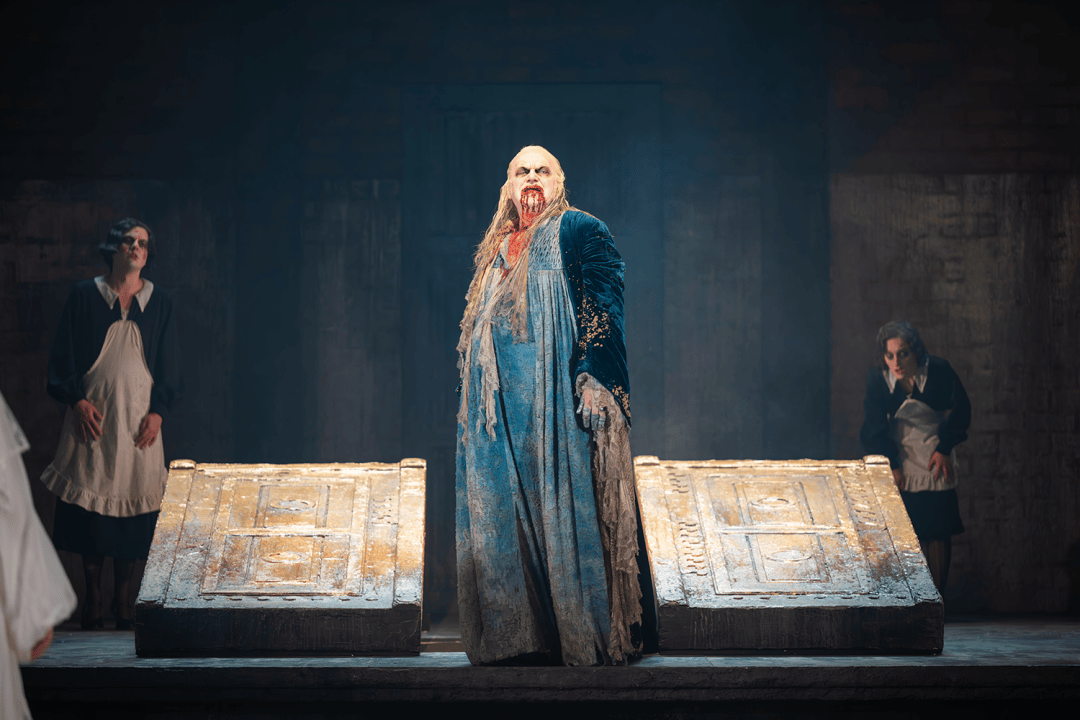
‘Popolo di Pekino!’ The xylophone clatters but the Mandarin whose proclamation opens David McVicar’s new production of Turandot doesn’t wear a silk robe. He’s a kind of ringmaster; a sinister maitre d’ in top hat and jodhpurs, and he’s speaking into one of those chunky 1920s microphones. Behind him is a sumptuous art-deco theatre in an advanced state of decay, its gilded chinoiserie as tattered and cobwebby as the crowds that fill it – the ghosts, perhaps, of flapper girls and playboys, trapped in a world somewhere between Mervyn Peake and Scott Fitzgerald. A sort of Gormen-Gatsby, if you like.
So no, it’s not China. But when was it ever, really? In every important respect this tremendous new staging has got it all. There’s eye-popping spectacle and an air of the macabre; baffling ritual and unsettling familiarity (Turandot makes her first entry as the Queen of the Night). It’s teeming with detail and musky with sex and death. Early on, the luckless Prince of Persia is stripped naked for the gaze of the ice princess (Trine Moller) before being led to his fate by white-coated executioners whose cleavers glint in the moonlight.

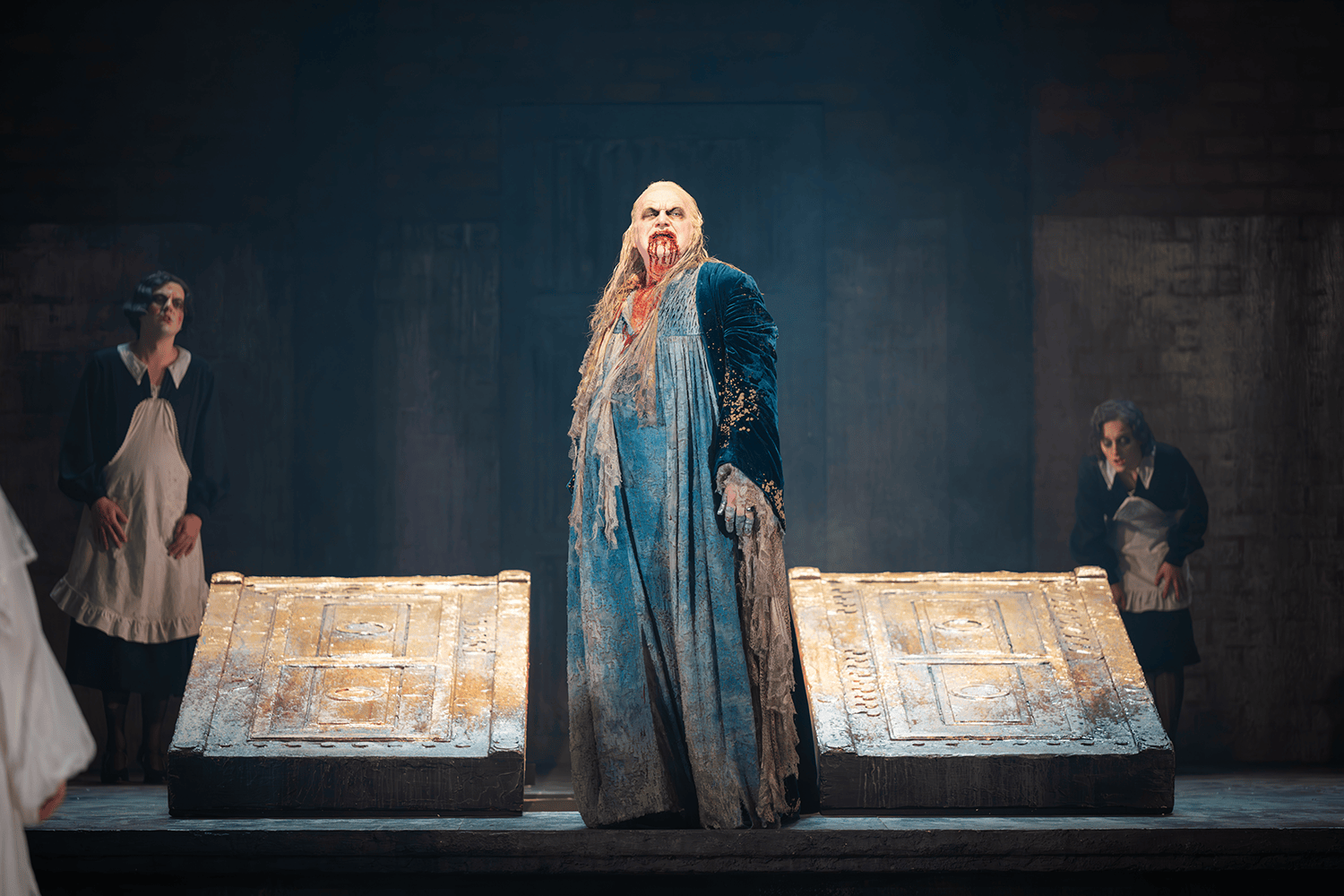
And since we’re in or around the year of Puccini’s death, 1924, it makes sense that Ping, Pang and Pong (the agile Josef Jeongmeen Ahn, Aled Hall and Luvo Maranti) should resemble the Three Stooges. But is this even our 1924, at all? Who is the creepy little girl who escorts the Princess? Why is the Emperor Altoum’s (Jamie MacDougall) mouth bloodied like a vampire’s? Turandot is all about puzzles, and this is a fantasy world that begs you to dive in and ask questions.
McVicar’s characterisation, meanwhile, is endlessly fascinating. He gives us a deeply conflicted Princess Turandot, whose self-willed repression is clearly eating her from within. You really feel the stakes for which Calaf (Victor Starsky) is playing, and Hye-Youn Lee’s Liu is more than usually forceful, too, singing with bright, courageous resolve. Vocally, the central pair are gripping. Starsky’s sunlit alpha-male tenor sounds thrillingly heroic and Moller tempers her vocal radiance with piercing moments of vulnerability. The orchestra, under Stuart Stratford, sounded positively cinematic.
To say that it works like a dream is an understatement, and in this age of strained budgets and cramped imaginations, McVicar and his designers (Charles Edwards and Doey Lüthi) deserve only praise; as does Scottish Opera and its co-producers at Irish National Opera.
Pray that it comes to England and Wales at some point, too, because it really is a feast, and McVicar crowns it with a knockout musical trump card. Most opera fans will know that when Puccini died of throat cancer, he left the final scenes of Turandot unwritten, and that the ending we usually hear was composed by Franco Alfano.
In truth, Alfano’s original completion is hardly ever used. It was brutally and crudely cut by Toscanini, who conducted the première. McVicar has reinstated it complete, and it’s a revelation. You wouldn’t mistake it for Puccini, though who knows what Puccini – who drove six hours during his final illness to hear Pierrot Lunaire – might have written, if he’d lived?
Alfano, uncut, restores the absent psychological motivation from Turandot and Calaf’s climactic love duet and takes the music in directions that are initially unsettling, and then so ecstatic that the usual straight reprise of ‘Nessun Dorma’ feels flat-footed in comparison. By the closing scene – as Moller and Starsky blazed like shooting stars above the massed choruses, with Alfano’s offstage fanfares surging up in battalions – you simply surrendered, overwhelmed by sonic glory. This is what opera is; this is what it can be. Exaltation and wonder on a damp Glasgow night.
That doesn’t leave much space for English National Opera’s new Iphigénie en Tauride, but then Lyndsey Turner’s new staging is fairly basic – bare abstract sets and blocks of coloured lighting that wouldn’t have looked out of place in the 1970s. No complaints: the robed priestesses of Diana were certainly stylish as they processed across the stage like figures on a Grecian urn. And if Turner’s direction doesn’t do much to break open the raw, immediate emotion that Gluck sought to express, it does put the focus on the musical values.
Those include energetic, period-style tautness from conductor David Bates and, as Iphigénie, a performance of commanding dignity and compassion from the reliably excellent Christine Rice. Jacques Imbrailo was an eloquent, stormy Oreste and the whole thing, unusually for ENO, was sung in French, which suggests a certain lack of commitment from the world’s flagship English-language opera company. Times are hard, sure, but would it have broken the bank to give work to a living translator or librettist?
I guess that depends how much you’ve spent on politically mandated sideshows in Manchester, and a largely redundant new staging of Tosca.



Comments