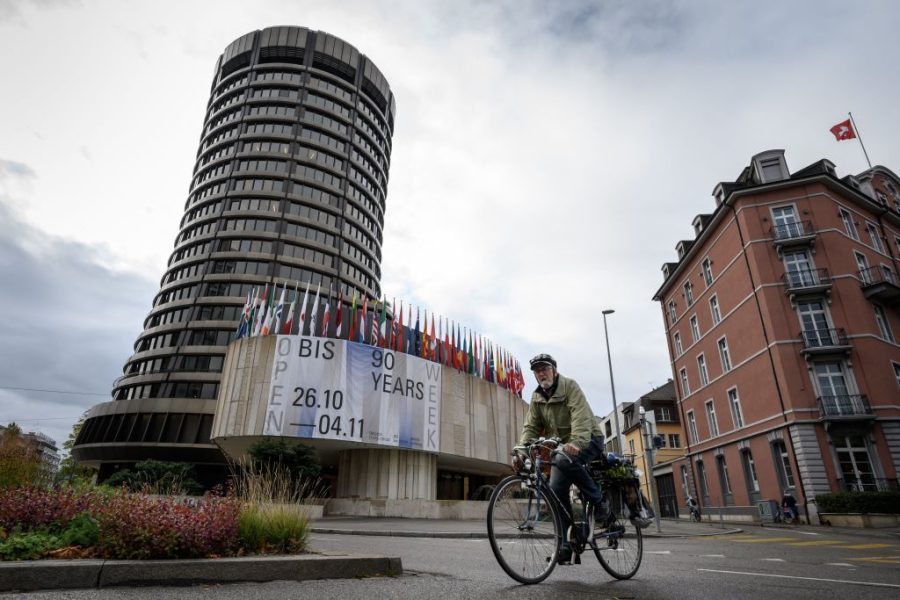
The tower of Basel loomed over Centralbahn platz like a rocket about to launch into space. It was December 1996 and I was in Switzerland on the trail of looted Nazi gold. The circular building housed the mysterious Bank for International Settlements (BIS), a central node in the web of wartime plunder.
A weak winter sun reflected off its opaque windows. The tower’s 24 floors – four underground, including a bomb shelter – exuded an air of subtle menace. The BIS, its assets and bosses, protected by a decades-old international treaty, were inviolable. Once inside, Swiss law no longer applied. The foyer, with its 1970s-style globular orange furniture, only added to the feel of a Bondian lair. But at least the BIS, unlike the Swiss National Bank, would talk to me. Andrew Crockett, the manager, and Dr Piet Clement, the BIS’s historian, gave me frank and insightful interviews about its record during the second world war.
That episode, while jaw-dropping, was only part of the story. My encounter was the start of a 30-year relationship with the world’s oldest and most important international financial institution. Outside the pages of the financial press, the BIS remains largely unknown. Yet for decades it has stood at the centre of a global network of money, power and covert influence.
The bank was a bizarre island of international cooperation in a continent in flames
The ever-agile bank has adapted to decades of economic and global crises, continually repositioning and re-inventing itself as a central point of financial stability. The BIS helped manage the financial upheavals of the 1930s. During the second world war it was a covert back-channel between the Allies and the Nazis. In the post-war years it hosted decades of behind-the-scenes planning for the single European currency and the European Central Bank. It warned about the build-up of global debt and credit that led to the 2008 crisis. Nowadays its research hubs are vital for the launch of future Central Bank Digital Currencies (CBDCs) such as the digital pound or euro. Along the way, it’s made an awful lot of money.

So what exactly is the BIS? Broadly, it has three main functions. Firstly, it is an immensely profitable bank, providing financial services to its 200 or so clients – central banks and international organisations, reporting a net profit of just over £1 billion this year so far. It provides a secure and confidential meeting place for central bankers who direct the monetary policy of its 63 members, who gather there every other month to discuss the international economy and monetary policy. The BIS also hosts the key committees which oversee the global financial system, including the Basel Committee, which regulates commercial banks.
Thirdly, the BIS is a highly regarded research centre at the cutting edge of financial advances. Its innovation hub, established in 2019, operates around the world, with partner central banks in Singapore, London, Hong Kong, Stockholm, Frankfurt, Paris, Toronto and New York.
The BIS was founded in May 1930 at the Hague Conference to channel German reparations to the Allies for the first world war – the settlements referred to in the bank’s name. Its two key architects were Montagu Norman, the governor of the Bank of England, and his close friend, the Reichsbank president Hjalmar Schacht, architect of the Nazi economy.
During the war, board meetings were suspended. But under its American president, Thomas McKittrick, the BIS continued to serve Nazi Germany. Emil Puhl, a BIS director and the vice-president of Nazi Germany’s Reichsbank, described it as ‘the only real foreign branch of the Reichsbank’. BIS wartime directors included Hermann Schmitz, the CEO of IG Farben, a subsidiary of which manufactured Zyklon B, the gas used to murder millions during the Holocaust.
The bank was a bizarre island of international cooperation in a continent in flames. Roger Auboin, the general manager, was French. Paul Hechler, his German underling, signed his BIS correspondence with ‘Heil Hitler’. Raffaele Pilotti, the secretary general, was Italian. The powerful economic adviser was a Swede, Per Jacobssen, who later ran the International Monetary Fund. Several British staff also worked there.
During the war, McKittrick regularly met with Puhl in Basel. The two men shared information. McKittrick then passed it to his old friend Allen Dulles, America’s Machiavellian wartime spymaster, at the US Legation in Berne. McKittrick even had his own asset code number: 644. Despite its service for Nazi Germany, the BIS survived the war, protected by its powerful allies such as Allen Dulles and John Maynard Keynes.
Tower of Basel, my investigative history of the BIS, was first published in 2013. Pleasingly, in response, the bank decided it was time to become more open and transparent. For the new updated edition of the book, released last month, the bank provided me with numerous interviews and briefings and hosted me for a day-long visit.
The orange furniture is gone but the BIS is now active on social media, with 227,000 followers on X. Its reports on CBDCs and other innovation hub research projects are available for download, together with its annual reports dating back to 1930. Its BISness podcast is aimed at a nonspecialist audience. A lively Instagram account introduces the bank and its staff, although it is not yet on TikTok.
The BIS still does not release precise details of the high-level meetings that it hosts, arguing that central bankers need somewhere to meet and discuss monetary policy in confidence. It does however include details of the broad themes discussed in its annual reports.
The tension between the BIS’s profitability, legal protections and its duty of public good remain. Every author wants their work to have impact. Thanks in large part to my book, nowadays those inside the tower take a notably more open approach to the world beyond Centralbahnplatz.





Comments