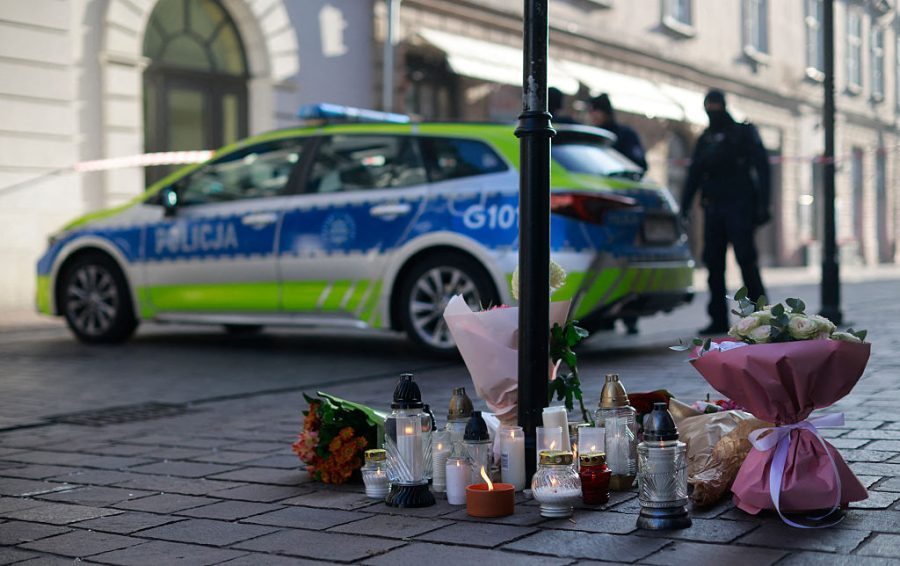
Yesterday at 2:59 p.m., the first shots rang out of a black Subaru as it drove onto an intersection just before the main square in Kraków, Poland’s second-largest city. On CCTV footage, several people can be seen falling to the ground immediately; others start running. The Subaru drives off.
Over the ensuing minutes, the Subaru made its way around the main square and through Kraków’s Old Town. It then crashed by a crossroads leading into Kazimierz, Kraków’s old Jewish quarter. The police car chasing it stopped, and two policemen – senior constables Jakub Kulik and Artur Morański – emerged pointing handguns at the driver. A 24-year-old man with a rifle got out of the car and fired at the policemen: one of them was hit once, the other three times. Despite their wounds, the policemen carried on. Only once the perpetrator was lying flat on his back, incapacitated, did the man who stopped him collapse to his knees himself.
The reaction of the Polish police was exemplary
In total, six people were killed on Saturday afternoon in Kraków by Michał O. (Polish law permits only the publication of a suspect’s first name and last initial), including a British national. Before he left the house and drove off with his father’s car, he also murdered his own family – dad, mum and younger sister. Sixteen more people have been wounded.
The tragic events of this weekend contrast with Poland’s reputation as a remarkably safe country. The places the shooter drove past – Kraków’s main square, Old Town, the churches of St Andrew and of the Apostles Peter and Paul – will be familiar to the hundreds of thousands of Brits who visit the city every year.

But the reaction of the Polish police was exemplary. It took the two policemen only 23 seconds from when the first shots were fired to begin pursuing the attacker. It took them only three minutes to begin firing back.
This is all the more remarkable given the mismatch between the two constables and the shooter, who arrived with 11 weapons in his car, including a semi-automatic rifle, and dressed in full tactical gear, including a bulletproof vest. The two policemen only had pistols on them, yet managed to bring the attacker down, enduring through the pain and shock of being shot themselves.
Poles immediately mobilised to help the two heroes. Within hours, multiple fundraisers were set up for them: most notably, Krzysztof Stanowski, owner of the Polish TV channel Kanał Zero, created one on Saturday evening. At the time of writing, the equivalent of almost £1 million has already been donated by over 90,000 people. The Mayor of Kraków, Łukasz Gibała, has also tabled a request to grant them the status of honorary citizens of the city.
Praise should also go to Michał Pędziwiatr and Mateusz Wierdak – two surgeons who happened to be lunching nearby at the time – who rushed to the scene of the attack to help those who had been shot, including the two policemen.
Polish President Karol Nawrocki has announced two days of national mourning in the country, with all flags lowered to half-mast. The Marian Trumpet Call – a bugle call played from the tallest tower of St Mary’s Basilica in Kraków – will not be played for only the third time since the second world war.
Yesterday’s event is all the more shocking on account of how unprecedented it is. The attack did not come with any hint or warning. Indeed, Poland has no history of gun violence whatsoever, at least since the turn of the century. On the contrary, before the attack, there had been calls for more Poles to be armed – Nawrocki himself had been among those who had called for there to be a ‘discussion’ around why so few Poles own firearms – with the country needing to be prepared in the event of Russian aggression. He might now instead face pressure for legislation to push in the opposite direction, much as Britain cracked down on handguns in the aftermath of the 1996 Dunblane shooting. In truth, however, there is not much farther to go in Poland, a country in which regulation on firearms is already very restrictive.
The motives of yesterday’s shooter remain unknown at the moment. While Minister of the Interior Marcin Kierwiński suggested the shooter was likely inspired by far-right ideologies, Kraków police have suggested the shooter may have in fact been far-left. In truth, the shooter was likely simply a nihilist – in interviews conducted over the last 24 hours, his neighbours called him introverted, and his former school colleagues ‘weird’ and ‘edgy’. His ideology was extremism, whatever its shape; indeed, when sufficiently radical, the far left and the far right often begin to blend into each other.
This has not stopped attempted political point-scoring. The chair of TV Republika – one of Poland’s largest TV channels – suggested live on air that the reason for the ostensibly slow police reaction was that Donald Tusk had sent all police reserves to Warsaw in connection with the crisis involving Poland’s constitutional tribunal last week. This is patently untrue: over a thousand policemen were in Kraków’s Old Town within minutes.
Right now, people’s attention ought to instead be focused on the policemen and other wounded who are fighting for their lives in hospital and on the families of those innocent people killed in the attack. If political point-scoring is a must, there will be a better time for it later.



Comments