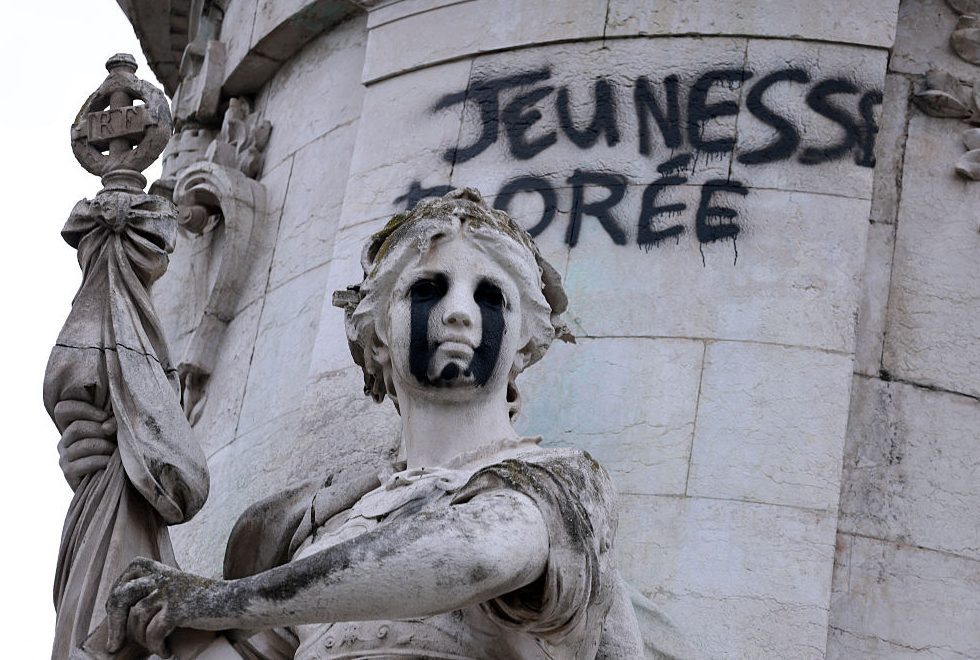
At the first sign of serious French rioting, observers typically reach for the French handbook of past revolutions – a weighty tome – to gauge which historical example it resembles. May 1968 has attracted most comparisons with France’s present plight.
But today’s crisis bears only superficial resemblance to the historic May uprising. Both have student activism as their catalyst, but May 1968 was university-student-driven rather than high-school. Both were characterised by large street demonstrations, and both have provoked considerable government anxiety because youth-led movements tend to be amorphous, unpredictable and prone to broadening into wider social crises. Unsurprisingly, the spectre of ’68 is uppermost in the minds of the boomer generation who experienced it on the barricades or from their armchairs. The romantic headiness of Parisian barricades and student sit-ins was perfectly encapsulated at the height of the crisis in the satirical magazine Le Canard Enchaîné’s 8 May cheeky headline: ‘The government has lost control of its faculties.’
Today’s crisis bears only superficial resemblance to the May 1968 uprising
And yet the differences with today are far more profound and pessimistic. First, unrest in 2026 is taking place against a backdrop of rigid parliamentary stalemate, a president sapped of all authority and national finances arguably worse than at any time outside war. In 1968, the Gaullists had a solid parliamentary majority, a respected – albeit weakened – president in General de Gaulle and a booming economy.
Second, today’s crisis has little of the utopian idealism of its forebear. Fragmented and driven by acute cost-of-living frustrations, its most distressing features are wanton violence directed at symbols of the French state – police, emergency services, teachers – then looting and destruction of everything from public buildings to shops and cars. The French Interior Ministry puts the number of demonstrators nationally on the four marches to date at 1,850,000, with 6,500 arrests, 1,300 police injured and over 3,000 shops ransacked. Far from ’68 collective utopianism, the 2026 riots smack of dystopia and ‘decivilisation’.
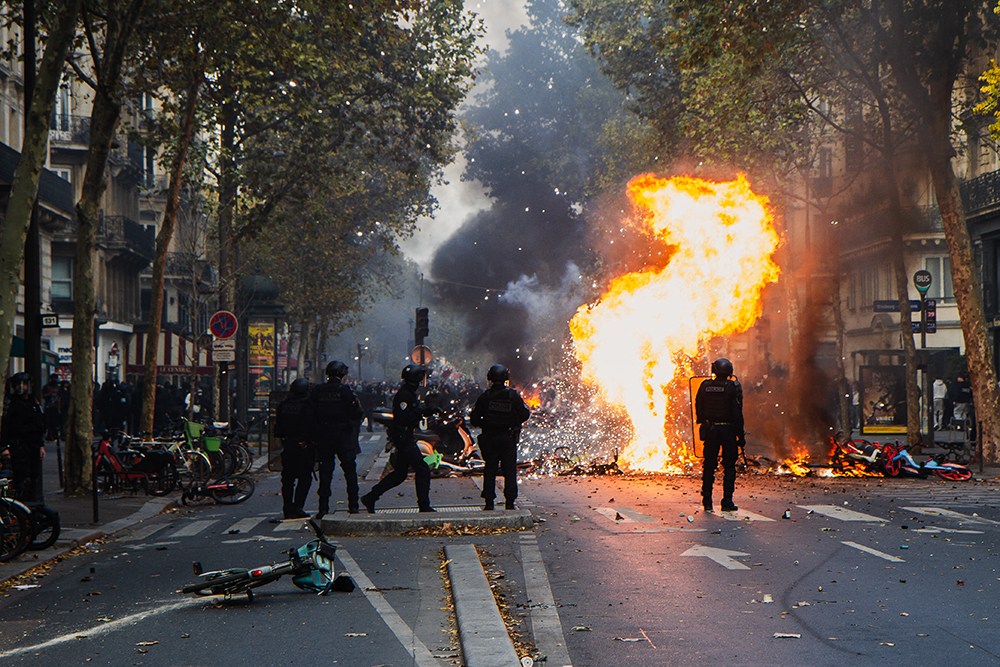
Third, the participants. The student riots of ’68 were largely just that, middle-class rich kids letting their hair down. The hundreds of thousands of peaceful demonstrators apart, a clear feature of today’s unrest is the significant presence of thousands of individuals from the international Black Bloc anarcho-ultra-left movement with seditious intent (as Macron stated). Another segment which the media are less willing to point out are hordes of youths, often from no-go zones in the banlieues, intent on teaching a lesson to the France they despise. A Justice Ministry note puts the number of foreigners arrested after the 17 October riots at 30 per cent, 75 per cent of whom have Algerian, Moroccan or Tunisian nationality, but were born in France. TF1 Info and AOL report on the profile of those arrested. As French law strictly forbids the collection of official statistics by ethnicity, the respected French political scientist and director of the Opinion department of the polling organisation IFOP controversially analysed a sample of those tried for rioting. Seventy-five per cent were found to have ‘Arabo-Muslim or African forenames’. More difficult to evaluate, but more sinister, would be the extent to which rioters were fired by Islamist zealotry.
This disparate cohort – goaded by social media – is weaponised by far-left political forces intent on ‘conflictualising’ French society – a term from the revolutionary glossary of far-left firebrand and presidential candidate Jean-Luc Mélenchon, whose stated aim is to provoke revolution ‘by the ballot box’.
Unlike traditional politicians – blind-sided by the initial high-school unrest nearly two months ago – Mélenchon immediately spotted the potential for his cause: 40 per cent of 18–24-year-olds intend to vote Mélenchon in the 2027 presidential election. His rising poll ratings now put him in the second-round run-off against, in LFI’s eyes, the ‘fascistic’ Marine Le Pen.
LFI’s leader of the 71 députés in the National Assembly, Mathilde Panot, gave notice of their strategy. In a highly criticised speech on 21 February 2026, she threatened: ‘We will never accept in our country that fascism takes power legally through the ballot box, which is what Marine Le Pen wants to do.’ This has the whiff of civil war.
Rather than to history, perhaps it is to sociology that we should turn to understand the deteriorating state of France, seen by many as descending into ‘ensauvagement’ (a savage state). Impulsivity, violent behaviour against people, property and the state is how France was chillingly described in a best-selling 2013 French essay, Clockwork Orange France, inspired by Anthony Burgess’s dystopian novel. It is this vulnerable France exposed to manipulation by unscrupulous revolutionary forces which could still secure a place in the pantheon of French revolutions.





Comments