
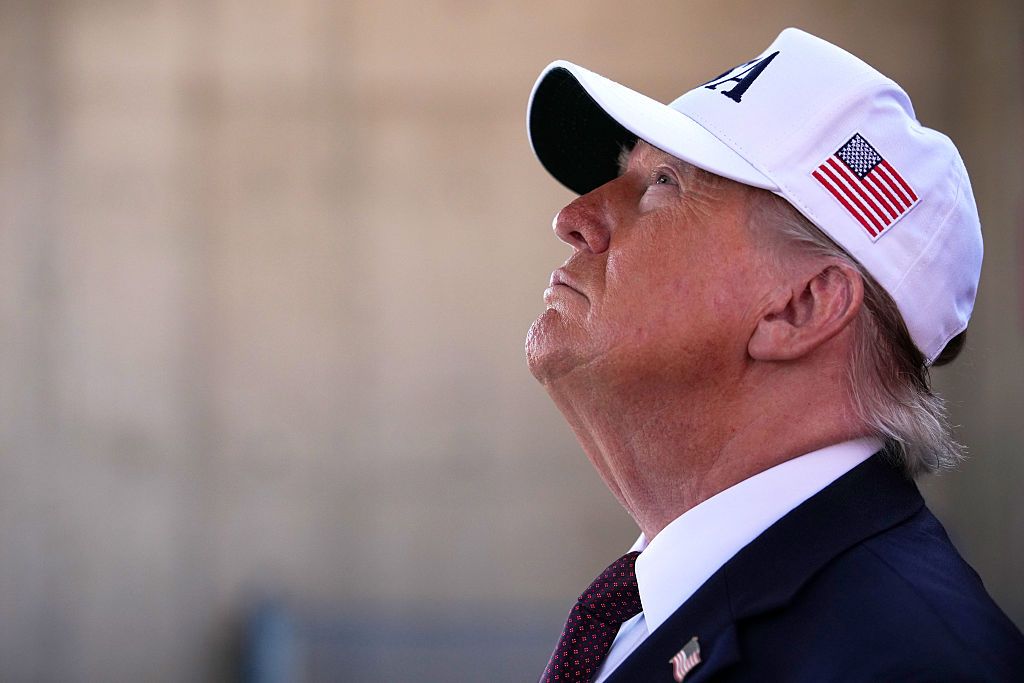
The consensus ahead of America’s midterm elections was that the Democrats would enjoy an advantage and could well take control of the House of Representatives after four years as the minority party. A few Trump loyalists, such as Natalie Baldassarre of the Republican National Convention, maintained a Berlin 1945-style optimism:
Polls may suggest one thing, but the American people get the final say, and Republicans remain laser-focused on driving voters to the polls, defying history, and protecting our majorities.
The reality was that the Democrats scored huge wins to take control of the House and the Senate; with 29 governorships, they are the majority at state level for the first time since 2010. It has been one of the major midterm reversals in post-war America, comparable with the Republicans in 1994 and the Democrats in 2006.
For international audiences, the next question is how it will affect the rest of the world. When America sneezes, Europe catches a cold, but how far are we able to vaccinate ourselves?
When America sneezes, Europe catches a cold, but how far are we able to vaccinate ourselves?
Many expect a Democratic-controlled Congress to act as a restraint on the administration. It won’t. Even without the almost fetishistically compliant submission of the 119th Congress, there are few tools available to the legislative branch. The new House may adopt articles of impeachment, either against a cabinet member or the President himself, but there is no point: the Senate, sitting as the High Court of Impeachment, needs a two-thirds majority to convict. That means a dozen Republicans would have to break ranks. They won’t.
One black mark against the war with Iran is that it began without congressional approval: under the constitution, Congress has the sole power to declare war. But the United States has only formally declared war 11 times in its history, most recently in 1942, against Bulgaria, Hungary and Romania. That element of congressional control is a dead letter, flouted by Truman, Kennedy and Clinton just as much as Trump.
Congress may legislate in ways which box in the President’s foreign policy, restoring military aid to Ukraine or rolling back punitive tariffs. But the President can veto legislation, and to override the veto, both the House and the Senate must vote by two-thirds majorities. Fewer than one in ten vetoes are overridden.
Away from Capitol Hill procedures and norms, the world of realpolitik may look different. Congress will be more able to lock horns with the administration on domestic issues, so Trump may focus his activities overseas for the final 26 months of his time in office.
He is a man obsessed with legacy, with leaving monuments behind. He has shown the physical manifestations of that in the new White House East Wing with its ballroom on top of a six-floor command bunker, the botched resurfacing of the Lincoln Memorial reflecting pool and the United States Triumphal Arch at Memorial Circle. ‘I love construction,’ he told reporters at a press conference on Wednesday.
One attempt to leave a policy legacy could be ending or suspending the war in Ukraine. If Trump does intensify his efforts, it will not be to Kyiv’s benefit. Last month, he angrily advised Ukraine to ‘get a new leader who can make a deal’. He then issued an executive order which waived the provisions of the Lindsey O. Graham Sanctioning Russia and Iran Act of 2026. The final project of the late senator for South Carolina, it contained new sanctions including 500 per cent tariffs on countries that buy Russian oil, natural gas and uranium.
Trump cancelled the sanctions and had already agreed a deal for Russia to sell millions of tonnes of diesel, some to the US. There is credible evidence that the President was involved in SpaceX’s decision to limit Ukraine’s access to the satellite network Starshield for ten days during October.
If Trump bids to end the war, it will be by applying greater pressure to Ukraine – shutting off arms sales through Nato or the flow of intelligence – or boosting Vladimir Putin’s position, perhaps by further undermining sanctions. His earnest admiration for Putin as a patriotic, powerful strongman is as obvious as his visceral loathing for Volodymyr Zelenskyy.
In the Middle East, Trump’s overwhelming desire is to reach a situation with Iran which he can sell as an American ‘victory’. That could be a sustainable re-opening of the Strait of Hormuz (which was not closed until the US and Israeli strikes began, remember). There were new but limited American airstrikes against military installations on Qashm Island this week; Trump has said there are no plans for the resumption of large-scale strikes amid talk of a peace settlement. The impression, however, is that the President does not understand why the war is still going on, nor how he might bring it to an end.
There is still a chance President Trump will withdraw further into his bubble of self-defined reality. His increasingly frequent, random and detailed exegeses on building work at the White House and elsewhere are reminiscent of the edifice complex named for Ferdinand Marcos of the Philippines, which can be traced back to Nero’s Domus Aurea. For Trump, his plans to ‘beautify Washington’ tick the boxes of creating a legacy, providing solace from a challenging political context and harking back to his roots as a Manhattan property developer.
The truth is that no one ever knows what Donald Trump will do 24 hours from now, because he doesn’t know. He could decide to launch a nuclear strike on Iran’s research site at Pickaxe Mountain, or rename the Rio Grande after his daughter Ivanka. The most important factor for the international community is that Donald Trump has not fundamentally changed: always expect the unexpected.




Comments