
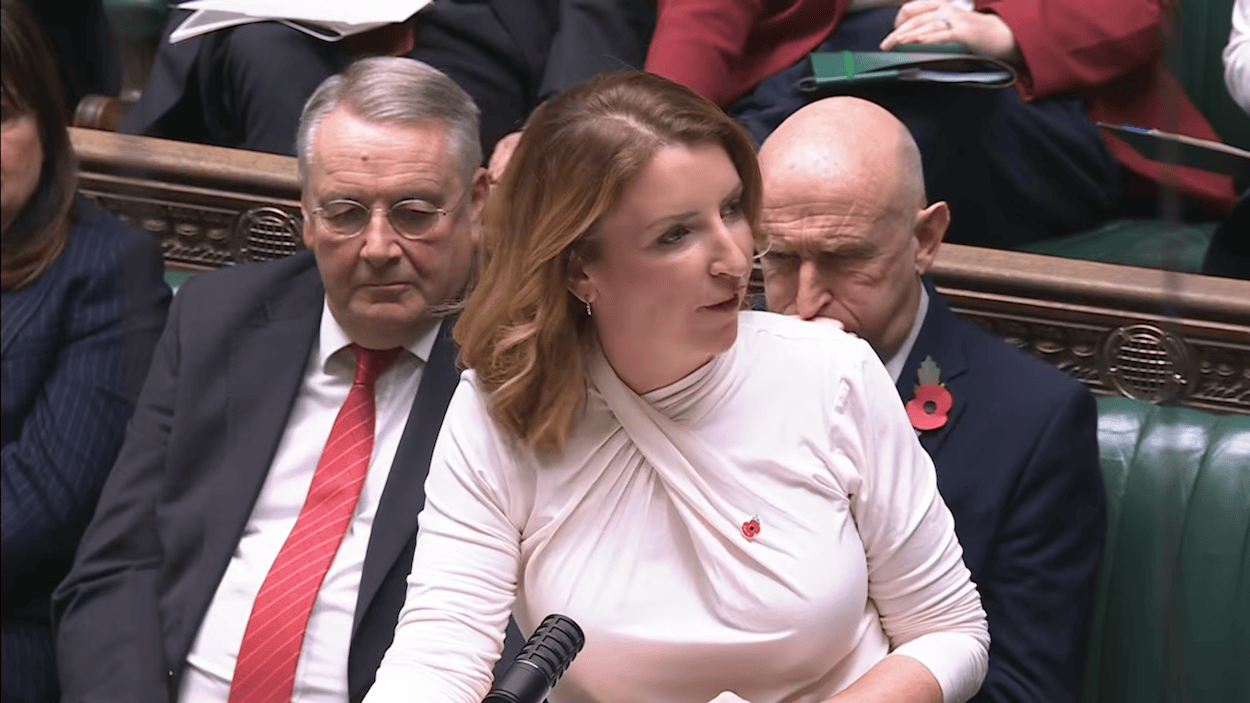
Louise Haigh’s first outing as Andy Burnham’s stand-in at Prime Minister’s Questions today was assured and pretty successful. She looked like she was enjoying herself towards the end of her sparring with Alex Burghart, who has now racked up a good few sessions on the Tory side, and was clearly even more comfortable. But the way the questions went did still serve to highlight the trouble coming for this government on welfare. Burghart asked the same thing repeatedly, but with slightly different permutations, and Haigh wasn’t able to give much of an answer, other than that this government really is committed to bringing the benefits bill down. When it might manage that, or how, weren’t details she could offer.

Burghart started by asking how much the government would be spending on working age welfare. Haigh replied that ‘he recently said it was now his job to tell the leader of the opposition when she is getting things wrong, which must make him the busiest man in Westminster’. She added that ‘this government is committed to bringing the benefits bill down and committed to dealing with the mess’ left by the Conservatives. She told the chamber that the benefits bill had grown by £88 billion in a decade under the Tories. Her opponent came back immediately to point out that the First Secretary of State had not answered the question, and that this was ‘telling’. The government is spending £183bn, he said, adding: ‘The highest figure ever. It’s higher than anything during Covid. It is higher than defence, schools and policing combined. It is nearly £10,000 for every working household in this country. So will the government commit to bring that bill down?’
Haigh replied that ‘the government has been clear the benefit bill will come down’, and then listed the steps it was already taking in order to do this. She repeated her own claim that the bill had soared by £88bn under Burghart’s party, adding that the Tories had also left one million young people not in employment, education or training, and that ‘this government is committed to tackling all of it’. The government hasn’t been very clear, though, on when the bill will come down, and Burghart used his next question to exploit the confusion following John Healey’s remarks last week about whether it would be cut in time for the next election.
Haigh, having mentioned Neets, was quick to mention the forthcoming Milburn report on how to get these young people off benefits and back into work, as well as the Timms review of personal independence payment for good measure. Haigh and Burghart argued a bit about whether the Budget was good or ‘catastrophic’ for living standards, and then Burghart returned to Milburn, joking that it ‘was a review that was so important that it was delayed until after the Budget’. He then insisted that ‘we know why the government isn’t going to fix welfare’, and one of those reasons was, he argued, that Haigh was the person who led the rebellion ‘against Keir Starmer’s very modest welfare reforms’. He asked another question, which was whether Haigh could promise that the government wouldn’t put up taxes in order to fund the higher benefits bill, given it wouldn’t be able to reform it.
By this point, Haigh started to attack the Conservative frontbench a little more, listing all the failures of the previous Tory government that she could connect each individual member to, and asking for them to apologise for those failures on immigration and on the mini budget. Both she and Burghart had prepared payoffs for the social media clips, with the Tory deputy leader saying: ‘The Labour way is more tax, more welfare and more borrowing. There is no commitment not to reduce welfare and no promise not to put up tax. Too scared to cut spending. Too weak to do the right thing… If Labour doesn’t want to do the right thing, why doesn’t it just get out of the way?’ Haigh claimed in reply that ‘as a student of history’, Burghart will be ‘well aware that few governments have delivered the scale of change that this administration has done in its first 100 days.’ Much of that change remains promised change, though, and the fact remains that in this session, Haigh could give no further details of how that promise might possibly be fulfilled, or indeed when.






Comments