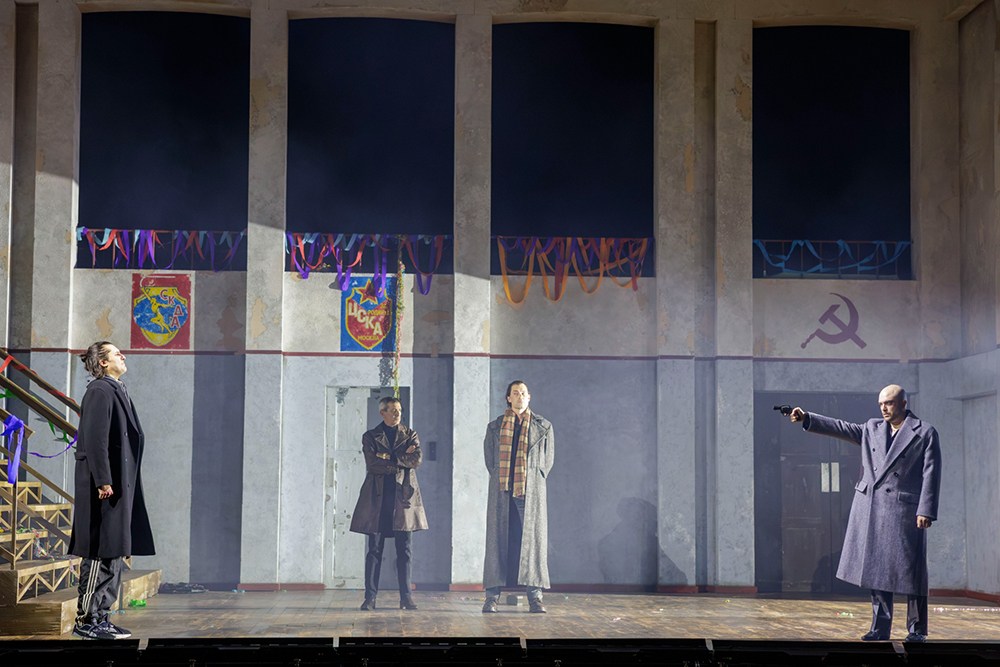
There was a fad a while back for photo books about Eastern bloc architecture. Derelict megastructures, brutalist monuments; you couldn’t move for them in the Barbican gift shop. Anyhow, Patrick Nolan and Leslie Travers – the director and designer respectively of Opera North’s new production of Eugene Onegin – were presumably big fans, because they’ve relocated the action to a provincial sports centre in the dying years of the USSR. It’s a fairly common gambit with Slavic operas. British opera companies are surely world leaders, by now, at rendering faded paintwork and water-stained concrete.
But why? It’s still Russia, of course, and presumably the idea is to make modern audiences feel closer to the action, though Tchaikovsky’s original Pushkin-era setting is surely far more comprehensible to Austen-loving British audiences than whatever was going on in Magnitogorsk circa 1983. Still, it does sort of work (we’ll come back to that ‘sort of’) and the visuals are very well-observed: grimy tea urns, faded propaganda posters and great chunks of collapsing ceiling.
Add period-appropriate costumes (by Elizabeth Gadsby) and the end result looks authentically repulsive, reaching a nadir in Act Two’s ball scene: a face-melting hellscape of 1980s leisurewear, pullulating with shoulder pads and shell suits. We must (and in fairness, we do) bring ourselves to love a Lensky (Caspar Singh) whose hairstyle is a nightmare fusion of man-bun and mullet. Meanwhile Tatyana (Verity Wingate), having delivered a Letter Scene of sweet, heart-rending awkwardness in Act One, is now forced into a blue lamé wrap dress and beige ankle boots. Hasn’t the poor girl suffered enough?
Anyway, try and make your peace with it because for the first two acts, at least, Nolan has thought it through. Mme Larina (Hannah Mason) is the commissar in charge of the crumbling venue, which explains the folk-dancing serfs, and Nolan almost makes the duel scene seem plausible as a sort of Russian roulette game watched by listless, fag-smoking seconds. With Act Three, though, we relocate to St Petersburg, and while Tchaikovsky switches up into full Imperial court mode, Nolan doesn’t budge. I thought that we might jump forward into post-communist luxury, but no; the hammer and sickle remain on the wall, despite Tatyana’s new aristocratic title and the presence of Prince Gremin (Joshua Bloom: a suave, oak-voiced silver fox).
It’s doubly odd, because the production has two intervals (and omits one of the Act Three dances outright), so there was presumably sufficient time for a set change. Possibly Opera North couldn’t afford one. To be clear, I enjoyed it a lot despite the anachronisms, the non-sequiturs and the fact that during extended solos, Nolan often forgets to direct at all, leaving his cast to pace about, hands flailing. With Tchaikovsky to do the heavy emotional lifting, we come to care very much about these badly dressed characters. Even Onegin (John Brancy) reveals a damaged humanity beneath Brancy’s tough-guy exterior and handsome singing. He’s a clenched, haunted figure, and Lensky actually thrashes him in their Act Two brawl (Singh is a big presence, for all the youthful tenderness of his voice).
Jingwen Cai, as Olga, is the pouting, sultry Little Miss Trouble to a T. And Wingate is a desperately vulnerable and complex Tatyana, pouring out her resolve as well as her shyness in phrases that initially seem to float, then cool and tighten as her face crumples in apprehension. Garry Walker conducts Tchaikovsky’s note-perfect score with generous, passionate sweeps of colour. He’s stepping down from Opera North in 2028, and he’ll be a tough act to follow.
The main work in English Touring Opera’s autumn season is Gluck’s Orpheus & Eurydice, directed by Jenny Ogilvie and conducted by Iwan Davies, with the tenor William Morgan giving a compelling performance in the huge role of Orpheus. For long stretches it’s effectively a one-man show and Morgan sings with eloquent directness in his portrayal of a man undone by loss. The setting is an instantly recognisable Purgatory – a sterile modern office, complete with water cooler – and the implication (which you can take or leave) is that after a disastrous workplace romance with Eurydice (a bright and forceful Galina Averina), his journey to Hades is the delusion of a jilted heart.
It’s stylish and surprisingly thought-provoking – implying, with reason, that Amor (Rosie Lomas, sounding icy and brilliant) might in fact be the opposite of benign. (Tchaikovsky’s Tatyana would agree.) Gluck is suddenly fashionable, inexplicably enough (Iphigénie en Tauride is on at ENO next month) and the composer Leo Grant has been brought in to rough-up the edges of his chaste, Hellenic classicism. It’s a legitimate strategy: Gluck, like Mozart, regularly wrote new material when his operas were revived, and ‘insertion arias’ by completely different composers were standard 18th-century practice. Grant’s eerie, electronically distorted interventions certainly felt destabilising. But I wish they’d let Gluck have the final word.



Comments