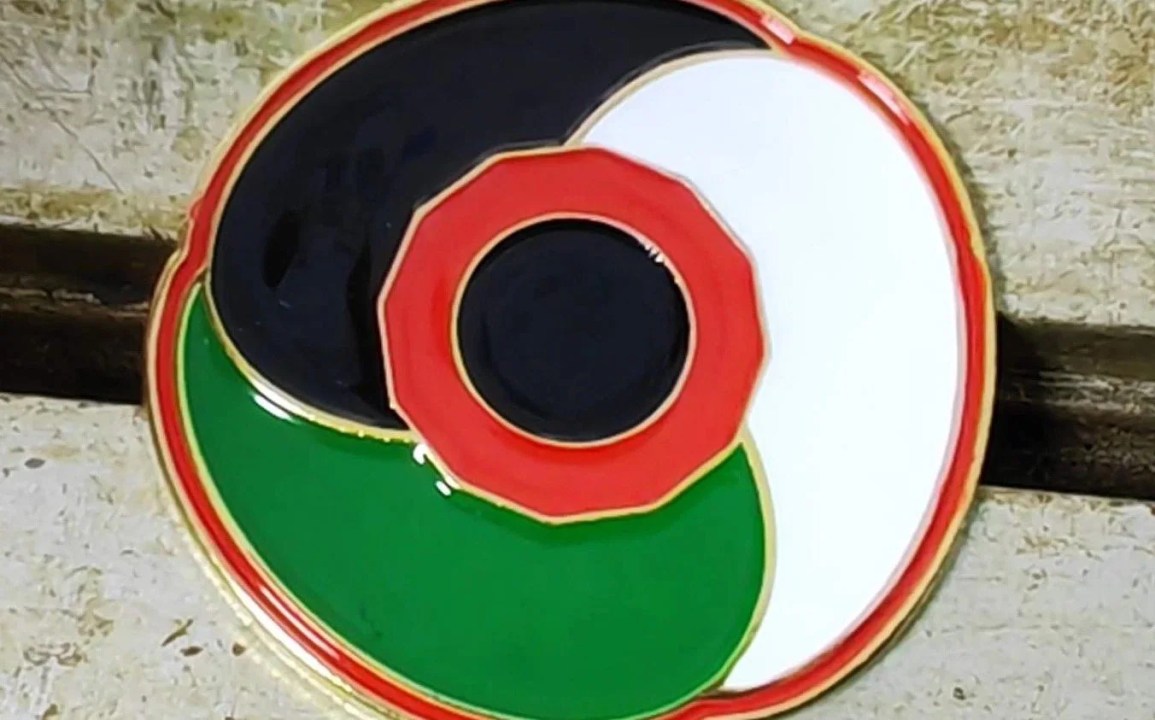
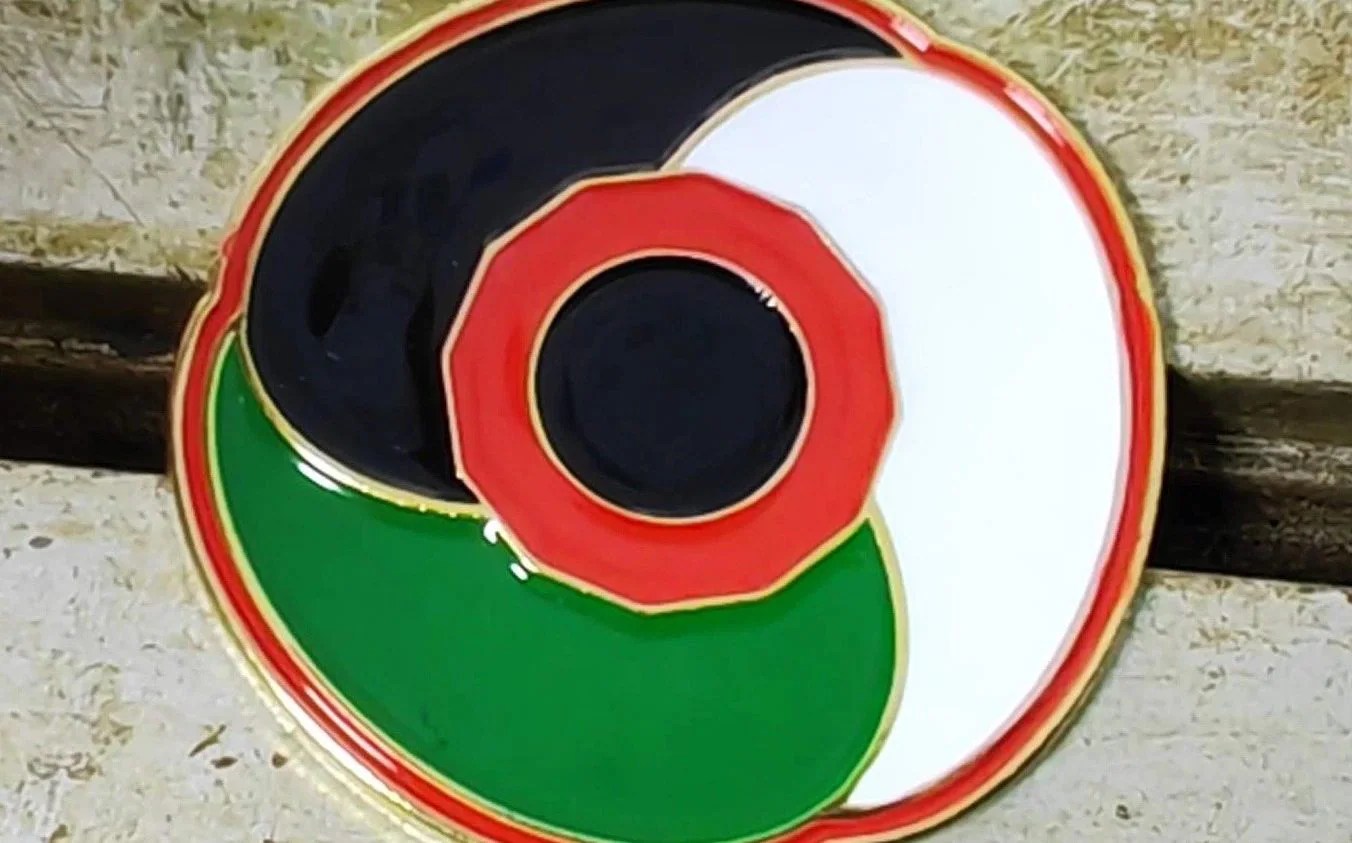
‘Israel has a history of appropriating Palestinian culture,’ says the website palestinepoppy.com. This is where you can purchase your Palestinian poppy badge for Remembrance Day. For only £1.78 a Palestine Peace enamel badge could have been yours via an eBay storefront that, as I write, is out of stock.
People should be as free to wear a Palestine poppy as a white one or a red one or no poppy at all. But we are also free to mock and condemn those who corrupt our traditions
Of that £1.78, an unspecified amount ‘covers cost of production’. An amount described only as ‘small’ goes to ‘charities working on the ground in Palestine, and organisations working to educate people about the region’s history and current situation, and bring about the end to the occupation and war crimes through legal routes.’
First among the beneficiaries proposed are the Friends of Al-Aqsa (FOA). An independent review commissioned by the Home Office found FOA to be an ‘anti-Israel campaign group’, part of a ‘Far Left and Islamist’ coalition. The review said that FOA’s founder, Ismail Patel, praised the killer of Eli Kay as a martyr. Fadi Abu Shkhaydam of Hamas had opened fire on passersby in Jerusalem – Kay, a tour guide, amongst them. ‘Hamas is no terrorist organisation,’ Patel had said in 2009. ‘We salute Hamas for standing up to Israel.’
Palestine Poppy says its bloom is the national flower of Palestine, but that’s the rather lovely purple Faqqua iris, named for a village near Jenin. Its history of the poppy as a symbol of remembrance is better. They mention the Canadian doctor John McCrae, and his poem In Flanders Fields, and how an international campaign led to the poppy acquiring the meaning it holds today. ‘I foresee the Palestine Poppy becoming an anti-apartheid symbol,’ the author of the website says, ‘similar to the raised fist.’
Cornflowers – bleuet de France – bloomed amongst the trenches, and meant much to the French. But they were less familiar to the British. Many Canadians, McCrae among them, thought of themselves then as men of Greater Britain. So did Sir William Osler, Regius Professor of Medicine at Oxford and McCrae’s old chief, with whom he stayed on leave in 1915. Osler died broken-hearted after his only son Revere was killed at Passchendaele.
Soldiers knew the poppy from the fields of home, and they knew it from poetry. Paul Fussell, in his wonderful Great War and Modern Memory, pointed out that half the poems in The Oxford Book of English Verse dwelt on flowers. Men of all ranks carried those poems with them – in their heads and in their knapsacks – and it was through the prism of what they knew from their countryside and their literature that they saw the horrors of the Great War.
Another tradition blended in. Homoerotic poetry and culture from before the War used the scarlet poppy as its own symbol, Bosie using it to personify the lips of forbidden love. Wilfred Owen’s poems never eroticise the slaughter, but they draw deeply on the wasted beauty of the bodies and futures of the young men who fell beside him. Housman’s Shropshire Lad was saturated with flowers and doomed young men: Owen took it to war with him in his head, Sassoon in his knapsack.
There’s something un-British about making a symbol part of a uniform, and expecting people to wear poppies the way American politicians do their Stars and Stripes lapel pins. But there’s something fine about the understated depth of feeling with which so many of us do wear them, each November, and how, at the eleventh hour of the eleventh day of the eleventh month, we fall silent.
Part of our tradition is that of free speech. People should be as free to wear a Palestine poppy as a white one or a red one or no poppy at all. But we are also free to mock and condemn those who corrupt our traditions. Symbols carry weight, which is why they are worth stealing.
The Palestine Poppy website takes the orthodox route of showing the poppy on a chest, not behind an ear. Their picture shows it being worn by a bearded gentleman in surgical scrubs. The Palestine Poppy is the creation of Abdul Qader Ismail. Noa Hoffman revealed him in these pages to be a man sympathetic to death by stoning, who has written that female genital mutilation ‘is allowed, and even desirable’ according to Islamic law. Ismail is an Oxford-trained paediatrician, an alumnus of Brasenose.
Cultural appropriation is often a mean-minded term for what is itself without meanness. But to accuse Israel of cultural appropriation and then to paint the Remembrance poppy in the colours of the Palestinian flag is killing something and wearing its skin. The Palestine poppy really is similar to the raised fist – it is polemic, when what a poppy should be is an evocation. I will wear my red poppy on the wards this November. I won’t be wearing what is political.
Poppies are poor as cut flowers; they don’t last long. Isaac Rosenberg, an East End private and the son of Jewish immigrants, was killed in action in 1918. Two years earlier he had written Break of Day in the Trenches. The poem introduces a rat whose ‘cosmopolitan sympathies’ bleakly amuse Rosenberg. He picks a poppy from the trench’s parapet, tucks it behind his ear, and considers the creature’s indifference to whether the trenches it crossed were German or British.
Poppies whose roots are in man’s veinsDrop, and are ever dropping;
But mine in my ear is safe-
Just a little white with the dust.





Comments