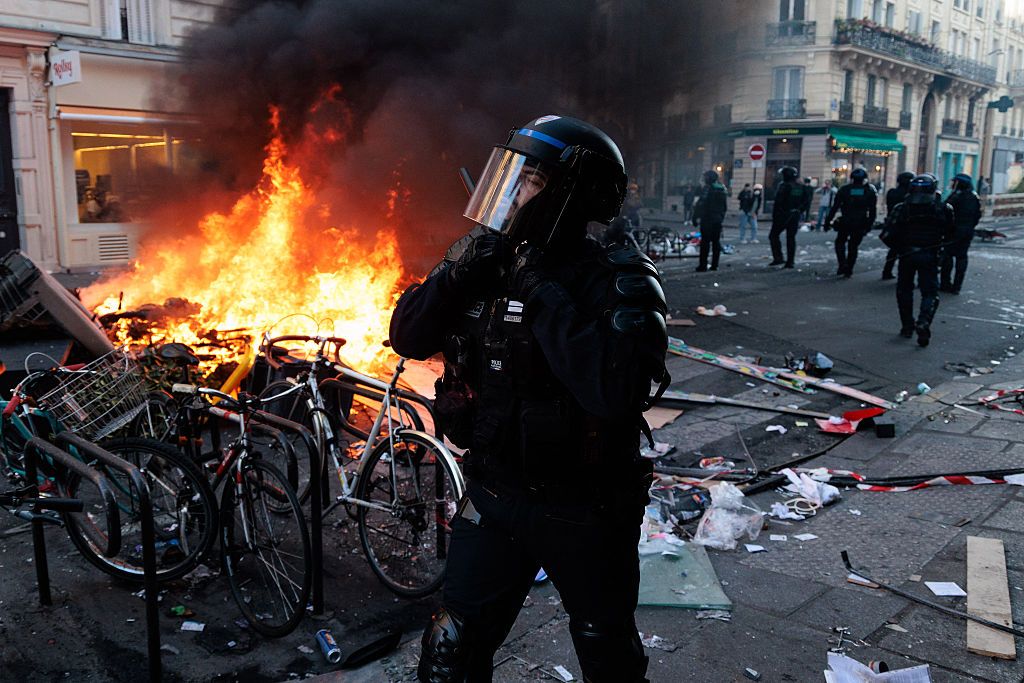
For a moment, the heart of Paris slipped beyond all state control. Standing on the Boulevard de Sebastopol – a tree-lined artery that runs through central Paris – gave one the impression, on Saturday, of being on a conveyor belt leading towards an industrial incinerator. Locals and voyeurs were all staring in the same direction, towards a mass of glowing red and black smoke 200 metres away. Here was a concentration of rioters, jeering and shouting. At times, the chant ‘aux armes’ (to arms) emerged from the crowd. Bangs of fireworks and the smell of combusting plastic lent the scene little that would distinguish it from a warzone.
A few police cars and six officers watched the approaching mass, too. Young men and women, they bore an air of resignation, leaning on their shields, some in armour, others not. ‘So, from here it’s only us who are left,’ I overheard one say.
The riot police looked as unprepared for the unrest as locals
Every 50 metres or so, a line of electric bicycles and other bits of available street material were stacked, blocking the road. Some were burnt, others burning, lithium batteries cracking and popping, with newly assembled piles waiting to be lit. Trashing the boulevard were far-left activists and, the majority, banlieuesards (kids from Paris’ poor, multicultural suburbs) motivated into aggression by opportunism and the simple mantra of ‘Acab’ – ‘all cops are bastards’. Together, they formed an organic but confused coalition of those trying to create a new society and others simply wishing destruction upon the immediate one.

A stone’s throw from where the police were standing, a masked, middle-class female student was helping two young men in tracksuits pile e-bikes onto the road. They were confronted by a distressed local woman. ‘What on earth are you doing, destroying Paris like this?’ She cried. ‘It’s the revolution, madam,’ the female student responded. ‘What revolution – what are you talking about?’
‘The revolution,’ she repeated, as if to say, ‘has nobody told you’. Young men, in black tracksuits, grinning with excitement, tried to calm the middle-aged bystander. ‘It’s fine,’ they were telling her, ‘Don’t worry about it.’ Most present at the riots were certainly not interested in fomenting revolution and had most probably never read a book, let alone Marx.
All along the boulevard, wild stampedes of excited youngsters, fleeing crackling fires or approaching police, sporadically rushed past, forcing bystanders against doorways or walls. The riots were spilling out from Place de la République, where they raged on until the following day.
Their scale was unbelievable. Street after street was trashed, filled with broken glass and groups of youths in black tracksuits. Looting was widespread, but it mostly targeted small businesses. Jewellers, watch repairers and corner shops lay in ruins. On a video widely circulated on social media, one male rioter of North African origin was showing off his new collection of handbags. ‘Excuse me sir, can you walk me through your outfit?’ the person behind the camera joked.
Near the Porte de Saint Martin, an arch celebrating Louis XIV’s victories in the Franche-Comté, I saw a phone repair shop in ruins. The owner and his family were inside, assessing the damage with tired, vulnerable stares. No police were present.
All day Saturday, in fact, it was difficult to even find police where the riots were focused, except at République or Les Halles. The first deputy mayor of Paris, Lamia El Aaraje, said on Sunday that the capital simply did not have enough police the day before to contain the riots. They were at capacity when the city’s forces succeeded in arresting a record 855 people, paltry against the real number of criminals.
In much of the centre, small groups of CRS, riot police, were seen huddled on street corners, advising passersby on directions – which way was safe, which wasn’t. Young men in their early 20s, they looked as unprepared for the unrest as locals. The CRS was concentrating its efforts at the nearby Place de la République, where far-left troublemakers, the ‘black blocs’, were battling it out alongside teenagers and activists.
Police there were subjected to mediaeval assaults of thrown cobblestones. In a video circulated online, a youth in a tracksuit danced in front of police with a strip of metal in his hand. He then launched it at them, injuring one officer who fell to the floor. ‘You killed him, wallahi! Wallahi! You killed him!’ His friend shrieked, in triumph.
Towards evening, the Arts et Metiers metro station smelt strongly of fumes. Outside, a road was blocked by another burning pile of e-bikes, the streets quieter than before but still in a state of anarchy, with small groups of masked youths left unchecked to rip out bins. Around a dozen young banlieuesards with large wooden batons ran past me, pursued minutes later by a lacklustre convoy of police cars with smashed-up windows. A nearby restaurant was still in service, its glowing lights working in tandem with street fires to illuminate the glass scattered across the road. A man draped in an Algerian flag cracked open the door. ‘Come join the revolution!’ he shouted at diners – middle-class locals who looked up silently from their tables.
Some have predicted that these riots could just be the beginning. They continued into Sunday, with far-left groups online calling for activists to ‘exhaust’ the police force. The prime minister Sébastien Lecornu demanded yesterday that local authorities put in place ‘localised’ curfews in some cities. These won’t deter the energised activists. ‘We almost had it,’ one young student protestor posted online. ‘We were within 400 metres of the Elysée palace…’
By nightfall on Saturday night, I was heading to the theatre, the Theatre de la Porte Saint-Martin, to see the Marriage of Figaro. Outside, crowds of youths roamed, sacking shops and smashing up cars. But the manager of the theatre was at the door, stoic as a captain of a sinking ship, welcoming frazzled elderly couples and young people who had braved the labyrinth of roadblocks and burning bins to see the performance. The play began late, theatregoers downing San Pellegrino at the bar to soothe their sore smoked-out throats.
Above the stage sits a fragment of the old curtain with the year 1781 in gold – the year Marie Antoinette commissioned the construction of the theatre. It has survived two revolutions, the Prussian siege of Paris, the commune and Nazi occupation. Outside, pops and bangs were heard, as well as sirens. ‘Thank you all for making it here tonight,’ the manager smiled, addressing the audience, ‘under such unusual conditions.’ We all applauded. The play was excellent.





Comments