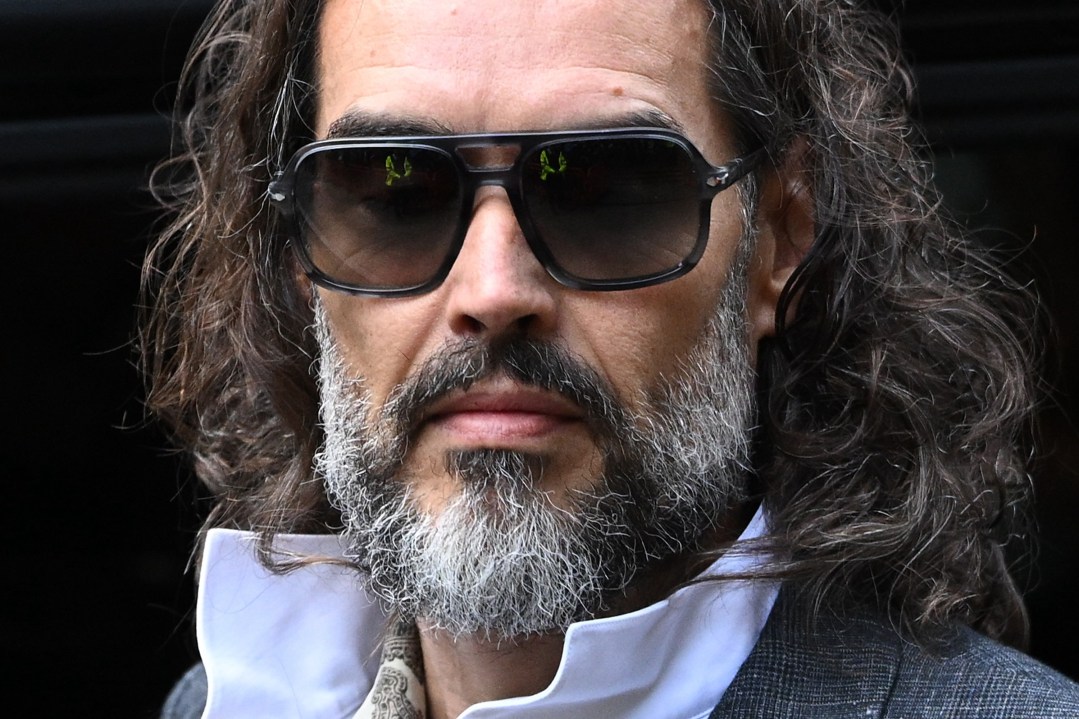
There was some dramatic testimony during the first week of Russell Brand’s trial and we didn’t need to miss a moment of the action because there are five – five – podcasts reporting daily from the courtroom. Brand faces three charges of rape, three of sexual assault and one of indecent assault, all of which he denies.

On the BBC’s Russell Brand on Trial, Anoushka Mutanda-Dougherty gives a breathless daily commentary on the trial, which is expected to last eight weeks. Minnie Stephenson lends an authoritative, let’s-get-down-to-business vibe to Channel 4’s Four The Record: Russell Brand on Trial. Sky News have their own Russell Brand On Trial series, which finds room for details such as the ‘basic’ coffee in the courtroom canteen.
The Trial: Russell Brand, from the Daily Mail, has a paid for omnibus edition on Saturdays called Brand Breakdown, which rounds up ‘highlights’ from its daily episodes. The presenters, Caroline Cheetham and Liz Hull, conjure an intimate atmosphere: like sitting with two seasoned court reporters in a bar. The most authoritative of the bunch is The Trial of Russell Brand from the Times, featuring Rosamund Urwin who headed the Sunday Times’ investigation into allegations against Brand.
Eight weeks. Five podcasts. One trial. But are daily dispatches from a sensitive court case really such a good idea? The format began in March 2020, with BBC Scotland’s The Alex Salmond Trial Podcast, which released daily reports throughout the 11-day court case. The genre really took off in 2022, when the Daily Mail launched The Trial podcast covering the case of Lucy Letby. It also released a series on the hearing of Constance Marten and Mark Gordon, who were jailed for 14 years for the death of their baby daughter.
There was a time when following a criminal trial meant buying a newspaper, turning to the court report and discovering what had happened the day before. If the case was sufficiently gripping, there might be a new story every day but if not, the case would disappear from the pages until things got interesting or relevant again. Imagine that: a news story being allowed to go quiet.
Today, we feel entitled to instant commentary on everything from elections to celebrity feuds. We want the latest update, the expert verdict, the reaction to the reaction. But a criminal trial is a rebuke to the modern attention economy, proceeding according to legal rules rather than the demands of an audience. Justice has its own timetable, and it is not obliged to respect our evening commute.
In other words, court cases can be boring. Days are often spent on details that don’t exactly scream podcast content: procedural wrangles, technical arguments and complex legal tug-of-wars. Some matters cannot even be discussed publicly if the jury has not heard them. The law, inconveniently for the content-hungry, does not always provide a satisfying narrative arc.
Justice has its own timetable, and it is not obliged to respect our evening commute
Competition can improve reporting but it can also open the door to sensationalism. The contempt rules in England and Wales place important limits on reporting that risks prejudicing active proceedings, but legality should be a minimum standard, not an ethical philosophy. A podcast can comply with the law and still encourage listeners to form premature conclusions, scrutinise every courtroom gesture or treat each witness’s appearance as another instalment in a celebrity saga.
So there seems a danger that, as five podcasts from the Brand trial compete for the daily attention and loyalty of listeners, the distinction between informing the public and cultivating an audience becomes harder to maintain. The trial becomes a story that must keep moving, even when the legal process has other ideas. And doesn’t all this seem another step closer to the unedifying, personality-driven and commercially packaged court coverage we see in the US? There, cameras are permitted in some trials, and high-profile cases attract relentless attention: live blogs, lawyers holding informal press conferences on the court steps, panel discussions in the evening. The courtroom becomes a stage, the lawyers its supporting cast, and the public an audience invited to pick a side.
There is a possible upside to the daily podcasts. They could become useful historical documents for future public scrutiny. Consider the case of Lucy Letby: as debate continues over whether her convictions are sound, anyone wishing to examine how the case was reported at the time could do worse than listen back to the daily dispatches, as long as they have hundreds of hours to spare. And who wouldn’t have been tempted by daily podcasts from Jeffrey Archer’s perjury case, the Jeremy Thorpe trial or the Birmingham pub bombings case?
There’s no escaping the vicarious thrill of watching a famous person’s fortunes unfold as their reputation is scrutinised and their liberty hangs in the balance. Whether or not the format is a good idea, I suspect that I’ll be tuning in again tomorrow.





Comments