
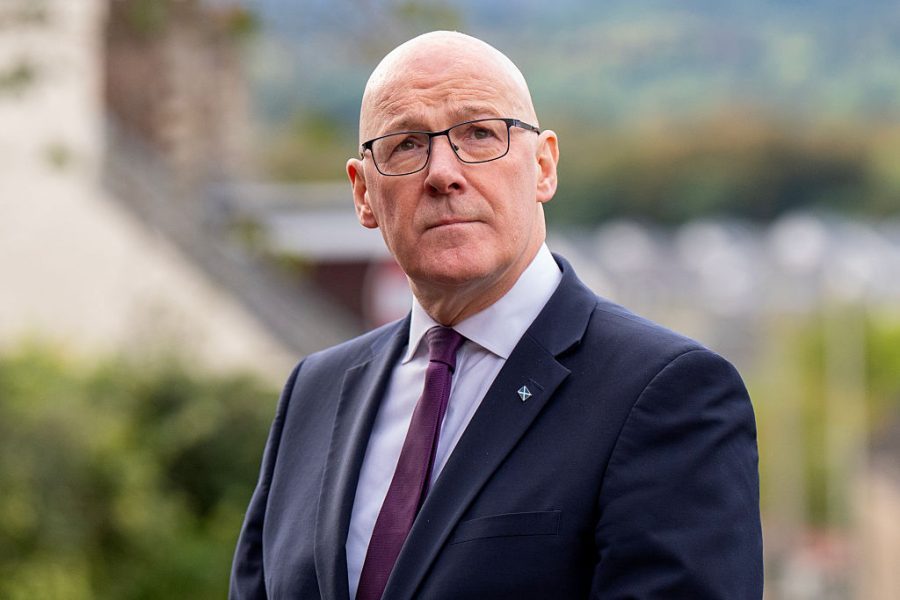
A few months ago, Colonel Alistair Scott Carns DSO, OBE, MC, RMR, MP was the talk of Westminster as a possible dark horse candidate for when, as seemed increasingly certain, Sir Keir Starmer was ejected from office. In June, the decorated Royal Marines reservist resigned as Minister for the Armed Forces on the same day that John Healey walked out as Defence Secretary. He did so in solidarity with Healey’s judgement that the Defence Investment Plan was underfunded and made service military personnel unsafe.
Perhaps it was the fact that he resigned towards the end of the day when Healey had taken the plunge in the morning, or maybe it was simply a reflection of his inexperience, having only been an MP for two years. In any event, having decided not to contest the leadership and seeing Andy Burnham ascend to the premiership unopposed, Carns was left on the backbenches when the new prime minister appointed his government, while John Healey became Chancellor of the Exchequer.
These are choices, and they have to be honestly made
Carns is clearly ambitious. Only 46, he forfeited a certain promotion to brigadier to stand for parliament. Now one of around 300 Labour backbench MPs, he must make noise to remind the party leadership that he is still there and still up in the hunt.
This week, Carns came out swinging with his sights set on the Scottish National party (SNP) and on defence, an area which has often been one of the SNP’s weaker suits. He lambasted the Nationalists for not setting out how an independent Scotland would organise its defence forces. He regards this as a dereliction of duty and pulled no punches in his riposte:

Seeing Scotland divided from the United Kingdom is in the main interest of Russia and Iran. So the SNP, by not engaging constructively and strategically in defence is a gift to Russia, and it’s the most amateur politics I’ve ever seen in my life.
The SNP has struggled to articulate a vision of an independent Scotland’s military capabilities and role. It is opposed to nuclear weapons, in favour of unilateral disarmament and its current policy is to negotiate the ‘speediest safe withdrawal’ of the Royal Navy’s submarine fleet from HM Naval Base Clyde. Until 2012, it was also against membership of Nato but would now seek to be part of the alliance after independence.
Imagining a defence force for a country of 5.5 million people is very different from looking at discrete elements of the armed forces of a state a dozen times that size. But a separatist party cannot simply ignore the hard questions and hope for the best. In the run-up to the independence referendum in 2014, the House of Commons Scottish Affairs Committee, of which I was then the clerk, examined possible scenarios for a separate Scotland in a variety of policy areas.
Four of the committee’s reports looked at defence: removing the Trident nuclear deterrent (October 2012); the future of Scottish shipyards (January 2013); jobs in the Scottish defence industry (March 2013); and the shape of a Scottish Defence Force (November 2013). There were many serious questions left unanswered and a distinct sense of a conspiracy of optimism.
For example, the withdrawal of the Vanguard-class submarines carrying the Trident nuclear deterrent from HMNB Clyde is currently impossible. Faslane was chosen very carefully as the site for the base because of a number of factors, many of them physical; the need for deep water channels for the boats to navigate safely and without being visible, and a sufficiently secure and distanced location for handling the nuclear warheads. There are very few other feasible sites anywhere in the UK, and anywhere that could be used would take years to construct and prepare.
Carns pointed out that any unreasonable demands to vacate HMNB Clyde would mean an independent Scotland would find it difficult to be accepted into Nato:
Our nuclear deterrent is the only nuclear deterrent capability that is allocated to Nato. Not many people know that. You cannot say we want to be a member of Nato, but we don’t want a nuclear capability in Scotland – these two things are incompatible.
Declaring Scotland a nuclear-free zone might also create obstacles for the alliance’s Dual Capable Aircraft, ‘central to Nato’s nuclear deterrence posture’, which are equipped to deliver tactical nuclear weapons. If Scotland did want to apply for membership, these issues would be important. Often, however, words like ‘demand’ and ‘insist’ dominate the language of the SNP when its spokesmen talk about a future independent state.
If someone has a principled belief in an independent Scotland, they will – must – accept that some aspects of financial, socio-economic, political and industrial life are very likely to get worse, at least initially. When Ireland became a dominion in 1922, it was reliant on a small, agricultural economy with no contribution from the rest of the UK. That is not a decisive argument against independence.
But those who want to extract Scotland from the Union have a duty to the electorate to be much clearer about their plans and how much it would cost. A Scottish Defence Force would not be a scaled-down version of the British armed forces but an altogether smaller and less ambitious entity: no heavy armour, no fast jets, no large warships, more limited reconnaissance and surveillance, little to no expeditionary capability. It might well, like Ireland, be heavily reliant on the remaining UK for air defence.
These are choices, and they have to be honestly made. It may be, though, that a recent Labour minister is not best placed to lecture on facing up to uncomfortable truths when it comes to the defence of the realm.





Comments