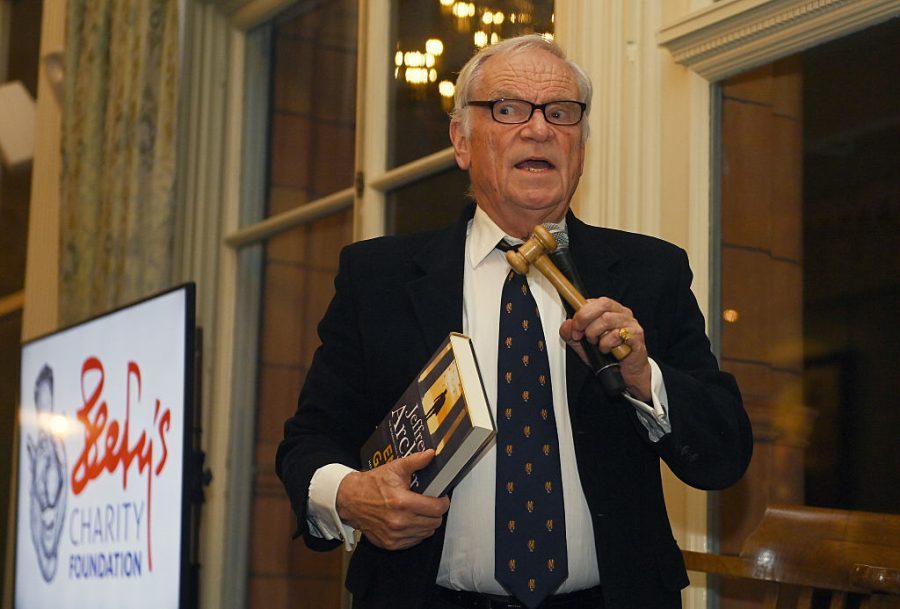
Had I not been the Director General of Prisons when Jeffrey Archer served his four-year sentence for perjury, I think I might still have found some of the sentimentality over his recent death hard to take. But my experience of personally ensuring his celebrity status did not disadvantage him in custody, and then having to deal with his appalling behaviour, his exploitation of prisoners and staff, and his constant manipulation of the media means that I must offer a different view.
Prior to his imprisonment, Archer’s general view of those who go to prison was not sympathetic. Famously, he had the 1993 Tory conference baying their support when, in introducing Michael Howard’s ‘prison works’ speech, he demanded that the then home secretary ‘stand and deliver’. Prisons were to be more austere, leisure activities were to be curbed and home leave restricted. Of course, Archer’s view changed immediately when he experienced his first taste of incarceration.
Archer was not the first, or last, affluent and influential person to find themselves incarcerated. Often, the experience of such individuals throws an honest and constructive light on the undoubted misery of imprisonment. Jonathan Aitken, for example, used his experience positively and, upon release, used it to help the Conservative party develop a more thoughtful penal policy. And, briefly, he became a prison chaplain.
Archer was very different and, from the day he arrived in Belmarsh to begin his four-year sentence, he seemed never to be out of the press. For my part, I insisted we treat Archer as any other white-collar, non-violent inmate. I supported gubernatorial decisions that he be sent to an open prison and then that he be allowed to work daily at Lincoln Theatre Royal and to have occasional days of freedom to spend with his family. Most other individuals would have grasped those opportunities rather than exploit them, which Archer did constantly, celebrating, for example, his attendance at a garden party hosted by ex-cabinet colleague Gillian Shepherd. David Blunkett, then the home secretary wrote to me in exasperated but entirely understandable terms to say:
I am sick and tired of reading Jeffrey Archer stories about his cushy conditions, the freedom he has been given, the opportunity to do whatever he likes, and the snook that he is cocking at all of us.
That made two of us.

Eventually, in a way which exposed his dishonesty, his ruthlessness and his contempt for those he considered beneath him, Archer organised a lunch at a restaurant in Lincoln to which he persuaded a senior prison officer – against all the rules – to attend. In his diaries, ludicrously and deceitfully, Archer insisted the purpose of the lunch was to discuss the drug culture in prisons. When a Sun photographer mysteriously appeared to capture the impropriety of such a scene, Archer knew that it would fuel interest in the first volume of his prison diaries which were to be published a few days later. He may have been a liar, but he was not a fool, and he will have known that the prison officer would pay for the lapse with his job. And he did, being forced to resign days later.
Subsequently, I received an indignant letter from a publican whose pub was near to North Sea Camp Prison, where Archer was held, pleading with me to persuade him to pay for the room he occasionally used on his return from day release and where – it was alleged – he met certain young women. By that time, I’d already moved Archer back to a fully secure prison.
He may have been charming – indeed, one can see from the interview with The Spectator released last week that Archer – temporarily at least – charmed him. Certainly, there was no challenge to the colourful claim (amongst others) that when summoned personally by the then cabinet secretary to advise on the divorce of Charles and Diana, Archer drove up and parked outside No. 10. This was in 1996, seven years after the Downing Street gates were erected, and 23 years after vehicular access was permanently prohibited.
Archer’s prison diaries, while occasionally accurately capturing the reality and pain of imprisonment, were let down by similar untruths. Very early in his published account, and reflecting a new liberalism not identifiable from his party conference rant, he talked melodramatically of a fellow Belmarsh prisoner, a 17-year-old, imprisoned for shoplifting: ‘This is Great Britain, not Turkey, not Nigeria, not Kosovo, but Britain.’ Except that there weren’t any 17-year-olds in Belmarsh and very, very few young people were ever sent to prison simply for shoplifting in 2001.
His lurid description of the hell that was Belmarsh was contradicted by other prisoners, including the affluent property developer and entrepreneur Nicholas Hoogstraten, incarcerated at the same time. Hoogstraten wrote:
Nothing much of what Archer has to say is true. There is nothing wrong with the food. The officers and staff are 95 per cent decent people trying to do a difficult job…
Archer wrote as if the discomfort of life inside a busy London prison was there simply to inconvenience him. At one point he compared the prison showers unfavourably with ‘the shower at my apartment on London’s Embankment’. As I told the Independent at the time:
All the world seemed to be interested in the self-centred writings of one prisoner who, relative amongst the population, had very few problems, no dependency, and who will go out and lead a contented and affluent life.
As Archer did, unlike the hapless and decent – if naïve – prison officer whose career and life he shredded for a manufactured expose in the Sun.






Comments