Nowadays, no one takes much interest in the Stirling Prize. But there was a time when the award, the winner of which will be announced this week, was front page news.
That time was October 2004. One Saturday evening, at eight o’ clock on the 16th day of the month, Channel 4 went live to Old Billingsgate in the City of London for the announcement of Britain’s best new building. The favourite was Norman Foster’s curvaceous skyscraper at 30 St Mary Axe, already known to everyone as the Gherkin. The competition included Daniel Libeskind’s angular Imperial War Museum North, Peter Cook’s eccentric Kunsthaus Graz and Ian Ritchie’s elegant Spire of Dublin. Some 1.2 million viewers tuned in to watch. Bookmakers were taking bets. A few years earlier, presenter Waldemar Januszczak had even gone into Downing Street to ask Tony Blair, then the Prime Minister, which of the six on the shortlist he thought should win. Architecture had its equivalent of the Booker and the Turner rolled into one, and moreover a rare night when the public took an interest in buildings.
The Stirling has not simply become boring; British architecture has become more cautious
I know because I was there. I worked at the Royal Institute of British Architects between 2003 and 2005, during what now looks like the high-water mark of its principal prize, and spent a lot of that period trying to persuade newspapers that it mattered. With the Gherkin this was not too difficult: the front page in question was that of the Observer the morning after 30 St Mary Axe won. Thirty years on, with the next Stirling to be announced on 15 October, that seems incredible: not simply that a new office building might command such attention, but that the identity of its architect and the question of whether it represented the best of contemporary Britain could be treated as mainstream news.
Initially, the Stirling had luck on its side. Founded in 1996 as the successor to the RIBA’s Building of the Year award, it arrived just as Britain entered an extraordinary period of self-confidence.
“Cool Britannia” and Geri’s dress and Oasis and all that. Lottery money, cultural regeneration and an expanding economy were producing incredible museums, galleries, bridges, schools and civic buildings. The early winners read like a greatest-hits album: Future Systems’ Lord’s Media Centre, Will Alsop’s Peckham Library, Wilkinson Eyre’s Magna and Gateshead Millennium Bridge, Herzog & de Meuron’s Laban, the Gherkin, the Scottish Parliament and Richard Rogers’s Barajas airport terminal. Architecture started to seem cool too.
And the architects were characters. “Starchitects” such as Foster, Rogers, Zaha Hadid and Will Alsop were famous enough to be caricatured, admired and loathed in equal measure. So the Stirling, named after James Stirling rather than the currency, had personalities and water-cooler arguments. Was the Fabergé-like Gherkin a masterpiece or a mere bauble celebrating the City’s resurgent wealth? Was the £414-million Scottish Parliament a triumph of design or an obscenely expensive fiasco? The Stirling did not have to manufacture drama – it merely had to package it for TV.
Then, slowly, the air went out of it. The public still takes an interest in buildings – look at the popularity of Grand Designs – but mention the Stirling these days and you’ll get a blank look.
The financial crash of 2008 did not kill ambitious architecture, but it killed the mood. The great wave of millennium and Lottery-funded projects had passed. By 2010, leading architects were already predicting that cuts would bring an end to what had come to look like a golden age. The profession increasingly turned, for good reasons, towards housing, sustainability, retrofit, reuse and social value. These can produce good architecture, but they do not necessarily produce a building that can be understood in a three-second television shot.
The television audience disappeared too. Channel 4 stopped carrying the ceremony after 2009; the BBC picked it up through The Culture Show, but by 2011 its audience was reportedly around 280,000. This year’s 30th-anniversary ceremony will return to Old Billingsgate, but the RIBA now advertises it principally as a gala evening, with individual tickets ranging from £50 to £495 and tables costing £4,050. The prize that once held millions of eyeballs increasingly talks just to the people in the same room.
Not all of this is the RIBA’s fault. Architecture itself has retreated from British cultural life. Television prefers property porn and the age of the “starchitect” has gone. Yet architecture is simultaneously omnipresent and strangely invisible. We fight about housing targets, the blight of tower blocks, developing the green belt, planning, beauty, density, Nimbys and the like every day, yet architects themselves have almost vanished from the national conversation.
The Stirling has also developed a taste problem. The buildings are very often good, but often very dull. Again and again the shortlist has favoured the conscientious and defensible over the thrilling, strange or provocative. To be fair, critics have complained about this for years. In 2009, the Independent declared that the prize had “lost its potency”. Rowan Moore of the Observer later argued that it had a habit of choosing “everyone’s second favourite”. It sometimes feels as though the first criterion is that nobody on the jury should feel too embarrassed about voting for the winner. It’s all about the safe choice.
The Stirling has also developed a taste problem. The buildings are very often good, but often very dull
Ian Ritchie, later also a judge in 2006, recalls: “Stirling judges were, as I experienced when chairing [the award committee] placed under some pressure to pick the ‘starchitect’ rather than the architecture…but the so-called top prizes are impossible to fairly determine [anyway]: are you promoting the next generation or honouring a loveable geriatric? The judging is a well-intentioned charade.”
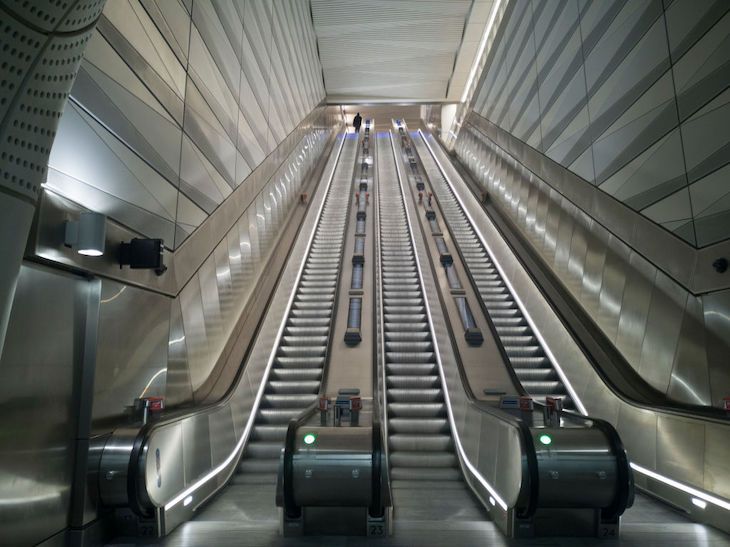
Yet the recent roll-call is honourable, if unexciting: Grafton’s Kingston University Town House, Niall McLaughlin’s Magdalene College library, Mæ’s John Morden Centre, the Elizabeth Line, although that’s mostly engineering, and, last year, Witherford Watson Mann’s Appleby Blue Almshouse. These are accomplished buildings (and a railway network). But ask a reasonably cultured person to name the last winner or two and you may wait a while.
This year illustrates the problem. The six finalists include a house in Epping Forest, a revived 1970s theatre in Hertfordshire, a housing development in south-east London, two Cambridge college projects and Renzo Piano’s Paddington Square, which also required the destruction of a beautiful 111-year-old Royal Mail sorting office in a conservation area. They may all be excellent. But even the Guardian’s assessment of the shortlist noted how Piano’s glass cube stood far apart from a field otherwise dominated by restrained brick buildings. The prevailing language is care, context, repair, public value and burnished environmental credentials. All admirable qualities. None is likely to start a row in a pub.
That tells us something else. The Stirling has not simply become boring; British architecture has become more cautious. Buildings are harder to procure, money is tighter, planning is more tortuous, sustainability is a non-negotiable and flamboyance can take a hike. The prize can only choose from the buildings that are commissioned. If Britain no longer builds exuberant public monuments, the RIBA cannot conjure them into existence. As a result, Ritchie concludes: “The Stirling has been in a coma for quite a few years…it is well past its sell-by date.”
Should the Stirling be quietly put out of its misery? I think that would be a mistake. Thirty years makes it an extraordinary, if eccentric, history of Britain’s changing priorities. But the prize needs to decide whether it exists merely to confer professional esteem – as do so many other prizes nowadays – or to tell the public why architecture matters.
If it wants the latter, it needs to become less polite. Publish the disagreements inside the jury. Give the public a meaningful vote. Ask not only whether a building is green and accessible, but whether it changes the way we think about architecture. Risk choosing something that half of everyone hates.
The Stirling briefly became important because, for one night, architecture became part of our shared culture: debatable, glamorous, ridiculous, consequential and even fun. It cannot recreate the media world of 2004 and physical front pages have largely disappeared. But it could recover its underlying confidence.
Otherwise the 30th anniversary will pass much as the recent ones have: excellent architects congratulating excellent architects on excellent buildings, while almost nobody notices at all.
Jonathan Morrison is the author of How to Build a Space Station





Comments