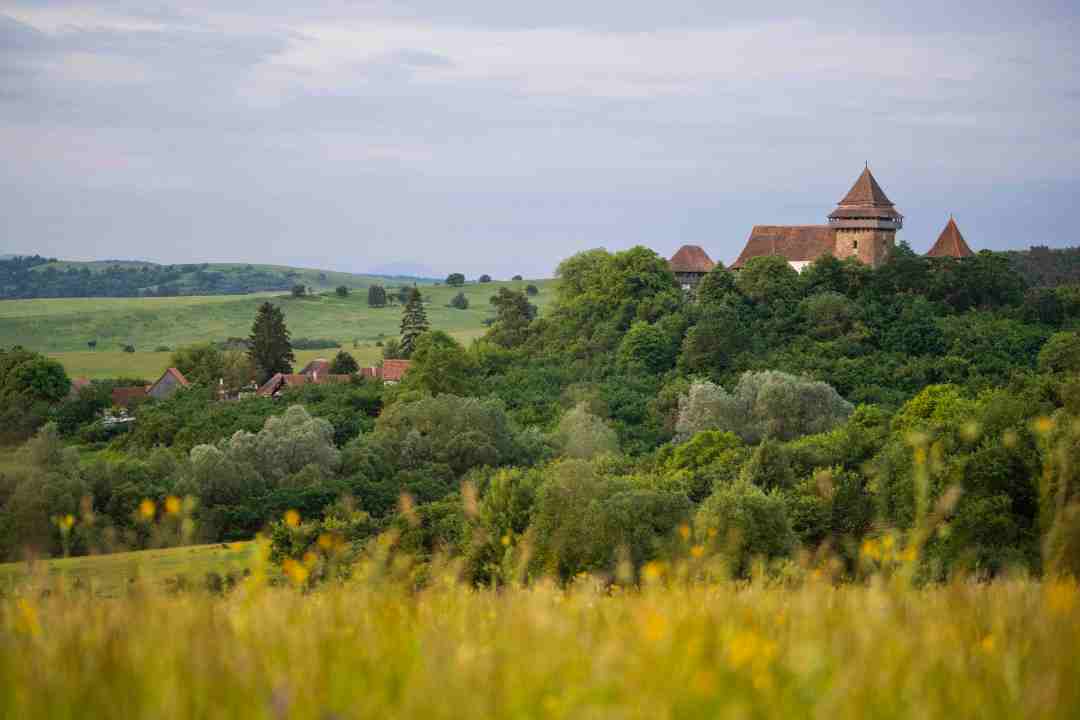
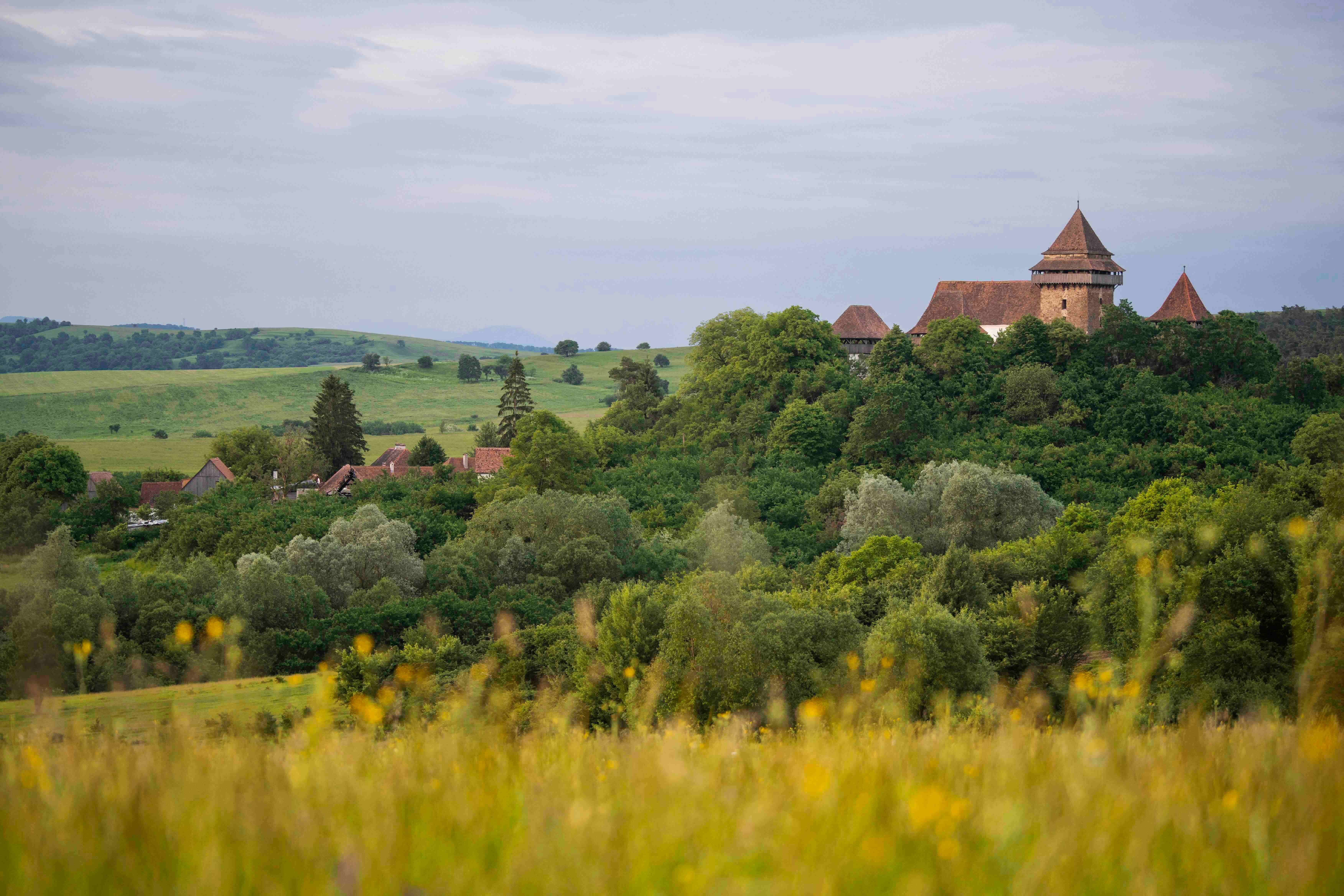
The listing had not mentioned what turned out to be the unique attribute of our holiday digs. ‘This cosy, charming two room apartment is located in a house right in the middle of Viscri,’ it simply stated. This was factually correct: it was cosy and charming, if in an extremely rustic, antique style. And it is in the middle of Viscri, the historic Transylvanian village which has developed an international profile since King Charles bought a property there in 2006. But what the Airbnb page had neglected to highlight was that we were actually staying right next door to the King – which seemed a curious detail to omit.
We only discovered this on the morning of our second day as we enjoyed the sun on deck chairs on our little lawn and noticed that in the adjacent, larger garden, there appeared to be groups of sightseers taking photographs. Some years ago, as a news editor on The Sun, I had accompanied a story about the introduction of holiday lettings on an estate owned by the then Prince of Wales with the headline ‘HeirBnB’ – and now this old gag came to mind to describe the status of our £66.50- a-night room.
Charles does have a family connection with the place: his third cousin, twice removed, Princess Marie, was the last Queen of Romania. But his interest seems to be more social and historical than familial, sparked by reading Patrick Leigh Fermor’s accounts of journeying by foot around what was formerly the outer reaches of the Austro-Hungarian empire in the 1930s, and, more recently, William Blacker’s evocative post-communism account, Along The Enchanted Way.
Our host, as the rentals website calls them, was a Romanian national but ethnically German, descended from the Saxon people who had built Viscri, and the many other fortified villages like it across Transylvania, in medieval times. They were invited to settle here because their belligerent culture meant they were seen as a human bastion against the various hordes from the East who enjoyed sweeping across Europe every few decades to conquer and pillage.
Every house built in Viscri was attached to its neighbour and semi-fortified – with thick walls either side of a robust wooden gate behind which both inhabitants and livestock could be locked up safely out of reach of any passing pugnacious Tartars. Viscri’s church, which dates from the mid-12th century, doubles as a castle too. The occupants farmed small holdings using non-industrial working practices. They still build haystacks manually around a vertical pole, for instance. And perhaps as a result the Transylvanian countryside seems more verdant than anywhere I have ever been before – and I’ve spent a great deal of time in Wales.
Ceausescu hated this enduring peasant culture, seeing it as backward, and would happily have bulldozed all the ancient villages and replaced them with brutalist concrete flats – but before he could get round to this, there was a collapsing-Iron-Curtain uprising and he was executed by firing squad on Christmas Day,1989. After centuries in Romania, most of the Saxons were then lured back to reuniting Germany by the promise of what must then have seemed astronomical wages and cheap Western goods. Their abandoned homes were then variously taken over by gypsies, native Romanians, lifestyle influencers and British heads of state.
Charles’s house is, as you would expect, the grandest in town
In these more peaceful times, the houses are painted pretty pastel colours. They have swallows and swifts nesting in the eaves, while there are storks’ nests on the tops of the telegraph poles that punctuate the village’s main drag. Cows and horses are more prevalent than cars on the high street. Charles’s house is, as you would expect, the grandest in town even if it is still extremely modest compared to Sandringham or Balmoral. I was most smitten with the smart geometric layout of his vegetable garden, a little note of Chelsea amid the traditional Romanian rusticity. The King reputedly stays there for a week or so annually but when he’s not in residence it is run as a boutique museum where the small tour extends to being shown his bed, a roughly-hewn wooden affair.
I can only hope the King’s mattress is more comfortable than the one we were sleeping on, which felt, at least to my feverish mind, unable to sleep at 4am, as though it was stuffed with the scrunched-up, worn-out smocks of the generations of agrarian peasants who had lived and farmed here before the advent of Airbnb. This is definitely not a five-star hotel. It is authentically uncomfortable.
I have been rather taken with Charles since he finally got the big job four years ago. He has put a lot of effort into his Kingship, possibly at the expense of his own fragile health, pulled off some potentially tricky stuff, like a Trump visit, and provided a brilliantly phrased response to the grotesque Earl Spencer book. Seeing Charles’ genuine attachment to this quite special place only further endeared him to me. You couldn’t imagine his younger brother Andrew showing an interest in and commitment to preserving the unbroken agrarian peasant tradition in eastern Europe, for example – and look how he turned out.
Aside from an absence of marketing talent, and that bumpy mattress, our host was as charming as her apartment and its village. She even allowed us to use the kitchens of the then-unlet bigger flat next door to cook in. I attempted my own version of the cabbage, white beans, potato and smoked pork stews I had eaten in various Romanian restaurants – there are several good ones in Viscri – only to discover that there was no salt.
I did consider popping next door but I knew the owner wasn’t in. He was doing investitures at Buckingham Palace. I tried the people on the other side instead.



Comments