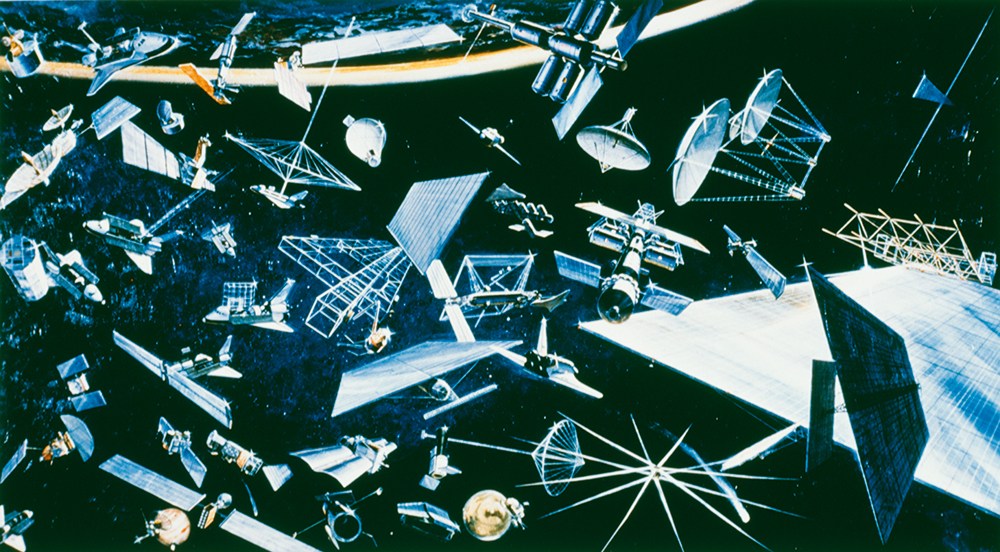

On September 14, the United States announced it had deployed a space weapon to Earth’s orbit. US Secretary of the Air Force Troy Meink declared it a response to “evolving threats.” But what is a space weapon, and what are these threats?
The truth is we still don’t really know. The weapons are classified and we earthlings are in the dark. Cutting-edge military space tech ranges from maneuverable space-craft capable of tracking and shooting down enemy satellites to communication jammers that clock or swamp the enemy’s data links.
But if the weapons are mysterious, the need for them is very real.
In 2019, the US created an entirely new branch of the military – the US Space Force – as a response to the growing risk of hostile activity aimed at its satellites and communication systems. On January 27 of last year, President Donald Trump signed an executive order for the creation of the Golden Dome, a sophisticated new multilayer missile defense system for the United States. At a cost of more than $1 trillion, this advanced military upgrade aims to detect and destroy ballistic, hypersonic and cruise missiles, which are an increasingly perilous threat. Space-based capabilities, such as the detection, guidance, targeting and command of missiles through satellites, are crucial to the Golden Dome’s success.
Most of the junk comes from dead satellites and bits of old Soviet rockets
This isn’t just a grandiose Trump vanity project. America is vulnerable to attack in a way it has never been before. For centuries it has felt itself comfortably protected by two enormous oceans. But with the development of advances in missile technology and the exponential growth of China as a military power and peer competitor, this comfort has grown cold.
America must protect itself, and moreover it must protect the global economy too. Only about 31 operational satellites support most of the world’s GPS and timing services, the infrastructure crucial for the world’s financial system. Much of the global economy relies on satellite-based timing, including global financial markets, telecommunications and even power grids. Unsynchronized clocks caused by damaged satellites could cause a catastrophic shutdown of the global payment system – and this could bring down the global banking system with it. It’s gone largely unnoticed that when Israel attacked Iran it also very deliberately and systematically destroyed Iran’s main space research center and the many laboratories used for developing military satellites for intelligence-gathering in the two recent escalations.

Physically blowing them up with missiles would carry a host of other problems which would affect all major countries, not just the antagonists in any potential conflict.
We’ve grown used to the idea of a nuclear arms race, and with Iran, the need for constant vigilance and consistent attempts to thwart its progress toward nuclear weapons. Now, though, with the rise of space weapons, there’s another arms race well under way and our very vulnerable and interconnected global systems are under threat. And – terrifyingly – even if the satellites our lives depend on are not deliberately targeted, the growing chaos and antagonism in space still poses an existential threat.
Exploded satellites create a lot of junk – “space debris” as it is increasingly known – and this, it turns out, is fast becoming one of the most difficult and intractable problems for the future of economic growth. Most people are aware that the modern world is full of trash – we dump it in the ocean, in landfills, or often just ship it to the cash-strapped coastlines of the developing world. Few know the orbit of our planet today is also utterly, and perhaps irredeemably, full of trash. If I were to propel you up into the closest area of outer space, low Earth orbit, you would find a staggering 130 million pieces of debris zooming around.
This debris is shattered into an unmanageable number of small fragments, many of them around the size of a coin or a Kinder Egg. The combined weight of all this junk is around 13,000 metric tons – more than the weight of the Eiffel Tower. And the vast majority of it comes from dead satellites and bits of old Soviet rockets, doomed to spin pointlessly around the Earth for hundreds if not thousands of years. These are, effectively, missiles: at an average speed of eight kilometers per second, a piece of speeding space junk the size of a matchbox could tear an enormous hole in any one of the roughly 10,000 working satellites circling the Earth’s atmosphere right now.
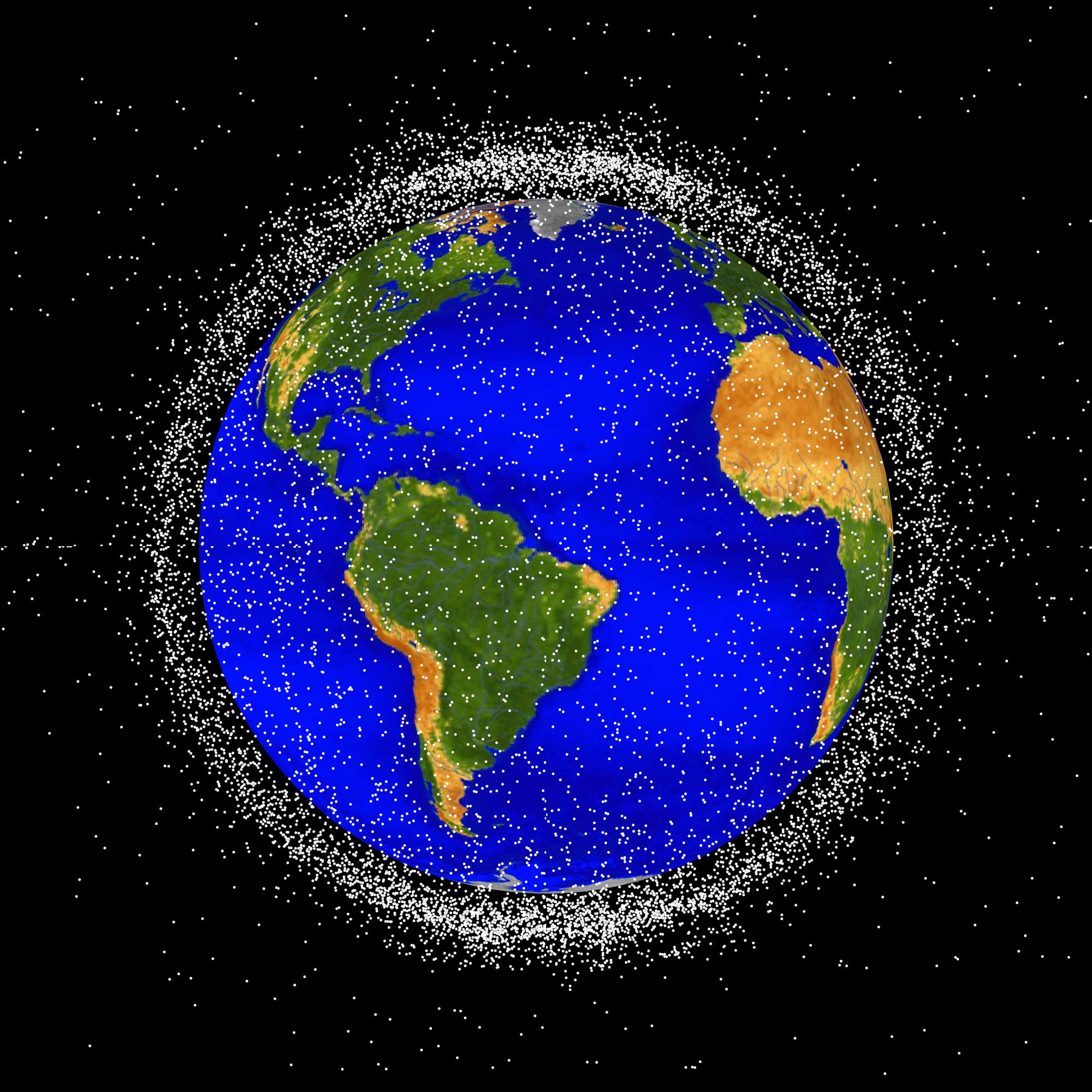
All countries have a vested interest in reducing the space trash before it poses a serious threat to humanity and yet they’re also trapped in the escalating logic of the space-weapons race, which sends ever more tech into space – more satellites and more potential for metal parts scattered into this lethal, spinning orbit.
Our global civilization’s nightmare situation occurs where there is so much debris that the risk of a catastrophic cascade of collisions wipes out the basic functionality of the orbital environment itself. This scenario, known as “Kessler syndrome,” was coined after NASA scientist Donald J. Kessler wrote an influential paper in 1978. He believed that the sheer scale of debris might one day create such an apocalyptic future that low Earth orbit might become uninhabitable for satellites, which would destabilize every part of 21st-century life.
Some think it might almost be too late. Space insurance companies are already anxious about the increasing costs of insuring rockets and satellites. They, too, are worried that the collision risks posed by all this junk make it financially impossible to justify any insurance economy in outer space at all.
Scientists have proposed a form of active debris removal (ADR) as a technological fix to this problem, and innovators have come up with solutions that range from enormous space harpoons and robotic arms to cosmic fishing nets. But capability is just one barrier. The chief difficulty is around responsibility, liability and ownership of the junk itself. The state which owned the original satellite technically still owns its debris – even if it survives only as thousands of grape-sized fragments. No international body has the legal right to clean up our orbital environment, and no individual country may infringe on other nations’ satellite fragments.
Given the abject dysfunction of almost all global institutions today, it is perhaps no surprise to learn that dealing with space debris on a diplomatic level has been borderline impossible. Most of the regulatory structure for Earth’s orbit is governed under a handful of UN agreements, most notably the 1967 Outer Space Treaty.
Dealing with space debris on a diplomatic level has so far been borderline impossible
Despite the enormous transformations in the space industry – the Golden Dome, the growing debris, the escalating threat of satellite wars, for example – this agreement still determines almost all of the legal maneuverings in the upper levels of the atmosphere. A lack of multilateral cooperation means little advancement has been made on the legal front ever since.
One of the main reasons why progress on such a vital issue has stalled for decades is that the issues of space weapons and space debris are so closely intertwined. Any operation to track, identify, remove or salvage space debris by one country is viewed by others as potentially having a dual-use military purpose. Russia is, unsurprisingly, responsible for by far the most space debris, but Vladimir Putin was unlikely to shoulder responsibility or join any international ADR effort even before the war in Ukraine.
There’s an escalating risk of space debris from China, but how would we know that a Chinese clean-up operation in space wasn’t cover for an escalation of the satellite wars? As the problem grows, so the political paranoia around space grows with it. And if the major powers can’t cooperate on ADR, how can we expect a sensible policy around the use of space weapons?
Smaller initiatives fare no better than the grand attempts. All modern nations are organized by a profit-motivated private sector and a public sector with limited mechanisms of accountability. Although some innovative debris companies seem to be emerging, it can cost tens of millions of dollars to dislodge a single piece of space trash from orbit. More importantly, there is almost no profit to be extracted from doing so, meaning no instrument is in place to develop a marketplace for debris remediation. Public initiatives, which are largely cash-strapped, aren’t much help either – even though a state-led artificial market could get things moving, at least in theory. What’s left is a tragedy of the space commons, where national self-interest supersedes the collective benefits of sharing communal resources.
The evolution of modern warfare means that outer space is fast becoming the most important domain for competition between nations, but space weapons mean “space debris” and the potential for apocalyptic disruption of the global economy. It’s a truly civilizational risk wrapped around all the anxieties, paranoia, rivalry and hostility of countries engaged in a number of proxy wars with each other already. Can humanity rise to the challenge of outer space cooperation? It is one of the defining tests of our century.
Given the myriad failures of multilateral diplomacy until now, I reserve the right to be pessimistic.






Comments