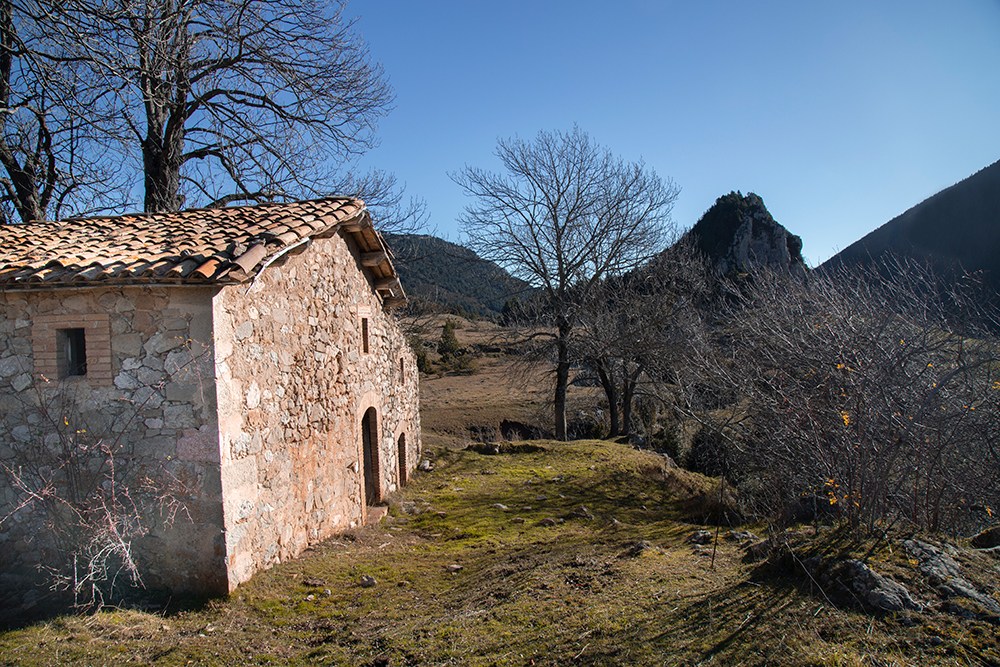
A small, beautiful book about betrayal, the cost of isolation and the persistence of human decency, Colm Tóibín’s The Bridge is set in the 1950s, in a remote Catalan village high in the Pyrenees, among people cut off from the modern world. Cut off for now. A bridge across the river threatens to speed the advent of paved roads, telephones and electricity.
Miquel and his father live in an old stone dwelling on a hardscrabble farm, attended by an orphaned houseboy, Manolo, and haunted by the reverberating absence of Miquel’s mother, who was caught in a sudden snowstorm and died. Her corpse, buried under ice, lay undiscovered until a spring thaw. Since her death, Miquel and his father have taken to smuggling goods out of nearby Andorra. The latest cargo consists of items emblematic of creeping modernity: styluses for record-players and a load of condoms, ‘enough for an army for a year’.
Consider the condom. It facilitates contact of a certain kind and also acts as a barrier – an equivocal function perfectly suited to a novel where the unequivocal is exceedingly rare, where silence is both blessing and curse, where ice both kills and preserves and where a stranger is both threat and promise.
Tóibín’s 12th novel is a sequel to A Long Winter, a novella he tacked on to a collection of stories called Mothers and Sons (2006). He has said that when planning the novella, he aimed for a style that would be ‘slow, immersive, third-person intimate’. That’s exactly what we get in The Bridge, which would be a bleak book if it weren’t for the loving – I want to say exciting – attention to detail, and the sombre gorgeousness of the prose.
It’s not a happy story. Miquel’s father sees the newly constructed bridge as an opportunity for more convenient, modernised smuggling (‘smuggling was, for many, a game, like hunting’), and rushes to take advantage, trading Miquel’s beloved donkey, along with his own, for a jeep. The Pyrenees is not a part of the world suited to haste. Halfway through the book, on the bridge itself, the police stop father and son; their contraband is hidden under a pile of stones in the back of the new jeep. They have been betrayed – by the father’s foolishness, and by a supposed friend’s perfidy, with dire consequences. Miquel, who is passive to a fault, accepts his fate with an animal-like (donkey-like) placidity.
Gay in a world where the very idea is an abomination, Miquel is doubly cut off. Lying awake at night, he comes to believe that his ‘isolation was nothing new, that he had always been far away even from those to whom he had been closest’. His next thought is sadder still: ‘He was closer to his mother in the months… when he was searching for her body than he had been when she was alive.’ Furtive embraces with Manolo dilute his essential loneliness, as does an erotic encounter in the town where the bridge has been built – a meeting explicitly detailed yet somehow prudishly veiled by Miquel’s innate reticence.
The beauty of the novel lies not in the dramatic mountainous landscape or even in the slow, immersive style, but rather in the person of Miquel, whose gentle, uncomplaining, totally unselfconscious goodness is a kind of miracle – the triumph of virtue over fear and want and malicious manipulation. He knows better than to reveal himself – ‘the rule was you kept your thoughts to yourself’ – or to expect a happy ending. Indeed, his situation is never promising. Yet he will endure, sustained by ‘memories and imaginings’ and something else – not hope but ‘a kind of brightness’.






Comments